The Best Accounting Services for Startups, by Stage

Quick Answer:
Pre-seed startups usually need a bookkeeper or a low-cost bookkeeping tool. Seed companies add accrual books, a monthly close and tax support. By Series A, investors expect a controller-led close and a monthly board report. Series B companies prepare for audits and formal revenue policies, and often bring in senior finance help through a fractional CFO, a finance operations partner, or both. As startups grow, their accounting needs extend beyond keeping books clean. Accounti helps growing companies coordinate accountants, tax specialists and auditors, standardize financial reporting and prepare for investor scrutiny, without needing to hire a full-time CFO too early.
The right accounting services for startups change as the company raises money. A pre-seed team needs clean books at a low monthly cost. A Series B company needs a fast monthly close, written accounting policies and records that can pass an audit. Choosing a provider for the stage you are in, while planning for the next one, saves you from switching providers in the middle of a fundraise.
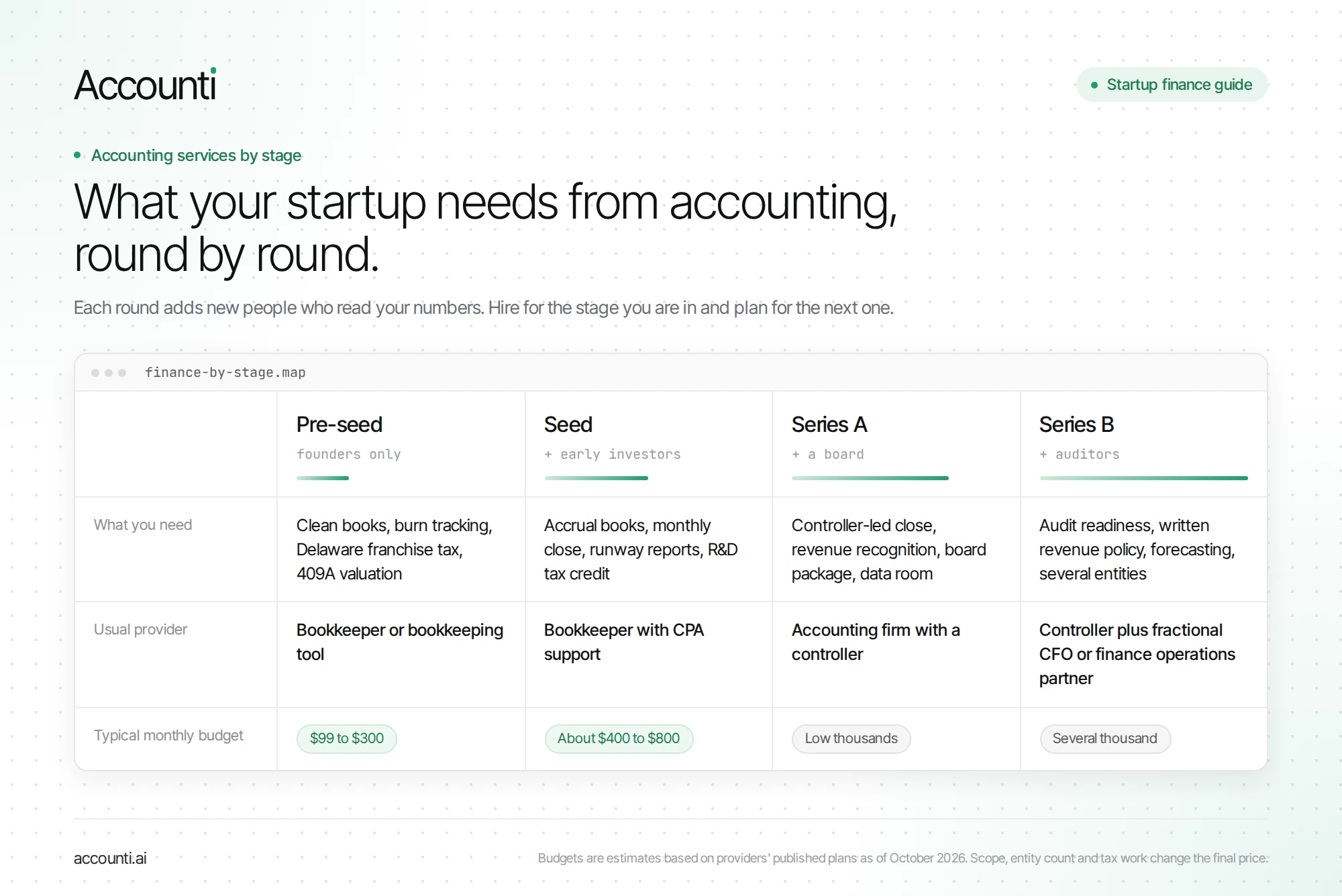
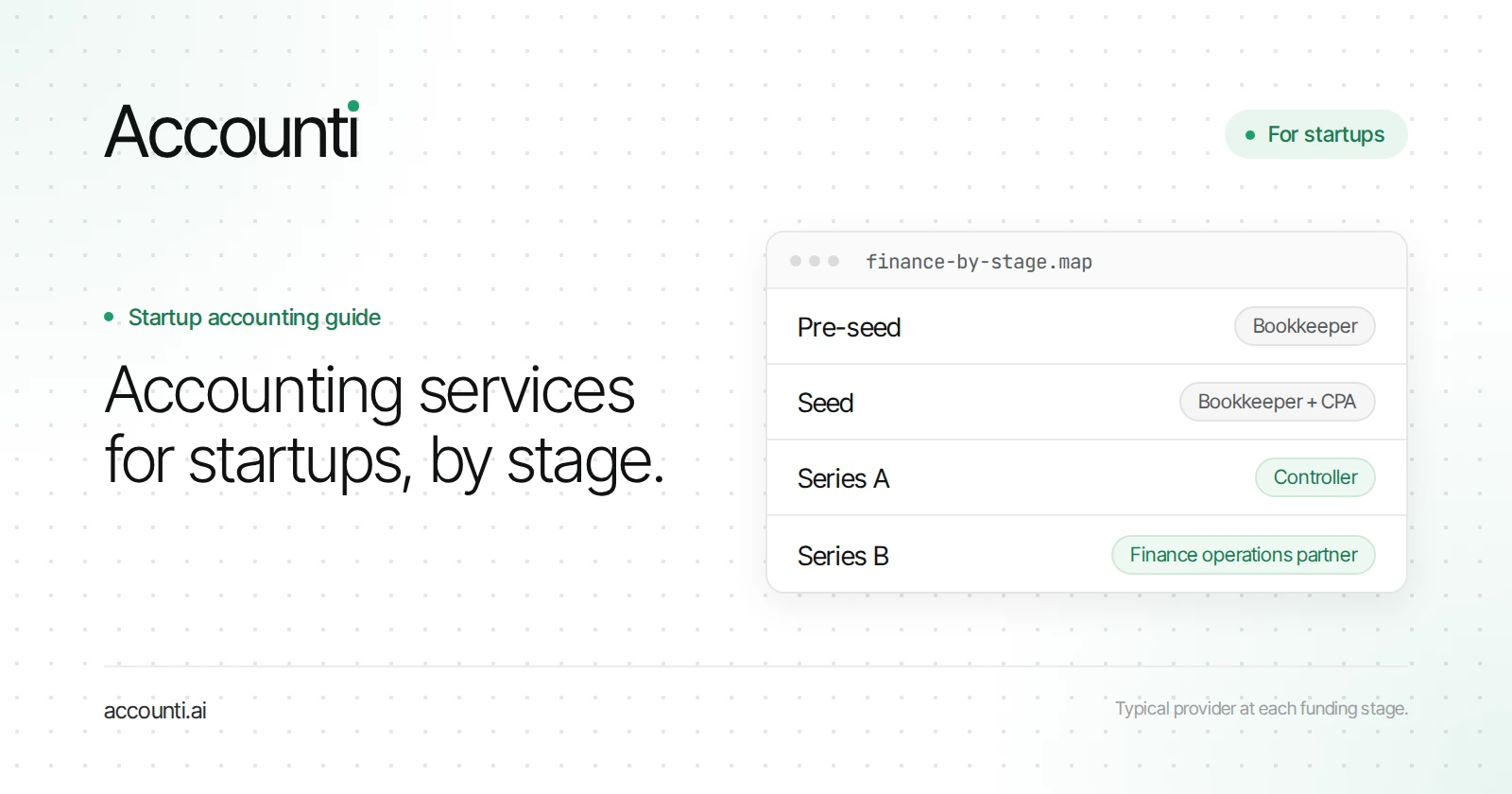
Alt text: Accounting services for startups by stage, showing what pre-seed, seed, Series A and Series B companies need, the usual provider and typical monthly budget
Finance terms founders hear first
These terms come up in almost every conversation with an accounting provider.
| Term | What it means |
|---|---|
| Cash basis | Records money when it actually moves in or out of the bank |
| Accrual basis | Records revenue when you earn it and expenses when you incur them, which is the view investors expect |
| Monthly close | Finalizing a month's books so the numbers stop changing and can be reported |
| Controller | A senior accountant who owns the close, accounting policies and internal checks |
| Fractional CFO | A part-time senior finance leader who handles forecasting, planning and fundraising support |
| Data room | A shared folder of financial and legal documents that investors review during due diligence |
Which accounting services suit pre-seed, seed, Series A and Series B companies?
Each funding stage adds new people who read your numbers, from the founders alone at pre-seed to a board, investors and auditors by Series B.
| Stage | What you need | Usual provider | Typical monthly budget |
|---|---|---|---|
| Pre-seed | Clean books, burn tracking, Delaware franchise tax, 409A valuation | Bookkeeper or bookkeeping tool | $99 to $300 |
| Seed | Accrual books, monthly close, runway reports, R&D tax credit | Bookkeeper with CPA support | About $400 to $800 |
| Series A | Controller-led close, revenue recognition, board package, data room | Accounting firm with a controller | Low thousands |
| Series B | Audit readiness, written revenue policy, forecasting, several entities | Controller plus fractional CFO or finance operations partner | Several thousand |
(These budgets are estimates based on the published plans cited in this guide, so confirm them with each provider.)
Pre-seed
At pre-seed you have a small team, a bank account and a cap table, and the record of who owns which shares. The job is to record every transaction correctly and know your monthly burn, with the amount of cash the company spends each month.
So, for example; Delaware corporations owe an annual franchise tax and report by March 1, and any company granting stock options needs a 409A valuation, and an independent price for its common stock that protects employees from tax penalties on their options. Indinero's startup offering places teams of 1 to 10 people with under roughly $3M in annual recurring revenue (ARR) in this group.
Budget usually decides the choice. Pilot lists its Essentials plan for companies spending up to $100,000 a month, with software sorting transactions and books kept on a cash basis. Ask any provider to set up a chart of accounts, the list of categories your books use, in a format investors recognize, because rebuilding it later costs far more.
Seed
Seed companies hire their first employees, run payroll in more than one state and start sending investors regular updates. This is the point to move to accrual books, because investors compare revenue and costs by the month they belong to.
You also need a monthly close and a runway report, which shows how many months of cash you have left at the current burn. Many seed companies claim the federal R&D tax credit for the first time, and qualifying startups can apply it against their payroll taxes.
Offset Partners describes its Clean Books tier as the starting point for pre-seed and seed companies. Its next tier, the Controller Layer, adds a structured close and subscription metrics such as deferred revenue, which is cash collected for service you have not delivered yet.
Series A
By Series A you have a board, and the board expects a monthly package. It typically includes a profit and loss statement, balance sheet, cash flow statement, key metrics, and budget versus actual spending by department. Subscription businesses also face revenue recognition questions. A customer who pays $120,000 upfront for a one-year contract, for example, is recorded as $10,000 of revenue in each month of that year. The data room should be ready before the next round begins.
Indinero describes this as the stage where a controller-led close with reviewed financials replaces basic bookkeeping. A bookkeeper alone starts to fall short here, because someone has to decide how each type of transaction should be treated and write that policy down.
Series B
Series B companies often run several legal entities and an enterprise resource planning (ERP) system such as NetSuite. Audit readiness becomes a requirement, meaning your records can pass an independent audit without a scramble. Auditors will also test your revenue policy against ASC 606, the US accounting standard for recognizing revenue from customer contracts. Forecasting, scenario planning and fundraising support turn into regular work, which is usually where a fractional CFO comes in.
Growth at this stage often leaves several capable people touching finance, such as an in-house hire, an outsourced accountant, a tax firm and an auditor, with nobody responsible for making their work fit together.
What startup accounting costs by stage
Accounting services for startups typically cost $99 to $500 a month for bookkeeping, $650 to $1,500 a month for a full-service accounting firm, and $1,750 a month or more for fractional CFO support. Scope drives the price more than headcount does. The starting prices below were checked on October 22, 2026, so verify each one on the provider's site before you decide.
| Provider | Type | Starting price | Best stage |
|---|---|---|---|
| Pilot Essentials | Software-led bookkeeping, cash basis | $99 a month | Pre-seed |
| Bench | Bookkeeping, tax extra | From $199 a month | Pre-seed |
| Fondo | Bookkeeping and tax | From $399 a month | Pre-seed to seed |
| Kruze Consulting | CPA firm with accrual bookkeeping | $650 to $850 a month | Seed to Series A |
| Graphite Financial | Accounting and finance | From $1,500 a month | Series A and later |
| Pilot CFO | Fractional CFO | $1,750 to $3,150 a month | Series A and later |
| Accounti | Finance operations partner | Custom engagement | Seed to Series B |
Sources: Pilot's pricing page, Median's 2026 cost breakdown for Bench, Truewind's 2026 comparison for Fondo, Kruze's pricing page and StartupCFO's comparison for Graphite. Kruze works only with funded Delaware C-corps that have raised at least $500,000. Keep in mind that these plans cover different amounts of work, since Pilot's $99 plan has no dedicated bookkeeper and Kruze's includes an accounting manager.
Watch for costs outside the monthly fee. Cleanup of messy past months, cash-to-accrual conversion, new state tax registrations and R&D credit studies are often billed separately, so a low headline price can cost more over a year than a bundled plan.
What does each type of provider cover?
Startup accounting firms fall into three broad types. Each is built around a different core job, and knowing that job tells you which one to hire first.
| Provider type | Core job | Usually includes | Usually leaves out |
|---|---|---|---|
| Bookkeeper or CPA firm | Record transactions and file taxes | Categorizing, reconciling, monthly close, tax returns | Forecasts, approval workflows, data room preparation |
| Bookkeeping software with review | Keep simple books current at low cost | Automatic categorizing and matching, basic reports | Judgment on complex revenue, written policies |
| Finance operations partner | Own how the finance function runs and the standard it meets | Close calendar, reporting standard, board pack, revenue policy, audit preparation | Officer-level strategy and fundraising decisions |
Bookkeepers and CPA firms
A bookkeeper categorizes transactions, reconciles accounts by matching your books against bank and card statements, and closes the month. A CPA firm adds tax filing and advice on how the company is structured. This model works well when transactions are simple and someone on the team reads the reports. The limit is scope, because a traditional bookkeeper rarely builds your forecast or prepares a data room.
AI accounting tools
These providers use software to sort and match transactions automatically, and some plans add a person who reviews the result. Pilot's Essentials plan is the clearest example at $99 a month. StartupCFO says it bundles bookkeeping and tax from around $199 a month and CFO support from around $349 a month, with no hourly billing.
Price and speed are the appeal. Software does not understand your business model, though, so ask who signs off on each month's close and whether the plan can switch to accrual books when you raise.
Finance operations partners
A finance operations partner takes ownership of how your finance function runs, beyond recording transactions. Accounti works this way through two services for companies, which many clients use together.
Finance Orchestration is for founders who have several people touching finance and no one making sure the work fits together. Accounti becomes the senior owner of that work. It sets a close calendar, agrees one standard for reporting revenue and core numbers, and keeps the accountant, tax firm and auditor on one schedule, so the board pack arrives on a fixed date and matches the books.
Finance Operations works inside the accounting itself. It covers day-to-day processing, a shorter monthly close, written policies with revenue recognition first, and audit support. The service is modular, so you start with whatever is most broken and add more as needed.
One US B2B software company moving from seed to Series A used Accounti to cut monthly reporting time from more than 15 hours to 8. Accounti also supports companies operating across countries, including a client that became audit-ready in both India and Dubai.
Neither service replaces a fractional CFO. Strategy and capital decisions stay with the founders and the board. Accounti is also a poor fit for very early companies with one clean set of books, or for teams that already have a senior finance leader in the seat. Pricing is set per engagement.
How do you choose between a bookkeeper, an AI tool and a finance operations partner?
Start with the finance question you cannot answer today. The gap it reveals points to the type of help you need.
| The question you can't answer | What it signals | Who to hire |
|---|---|---|
| Where did the money go last month? | Records are incomplete | Bookkeeper or bookkeeping tool |
| How long does our cash last under three hiring plans? | No forward planning | Fractional CFO |
| Why doesn't the board pack match the books? | No one owns the finance function as a whole | Finance operations partner |
| Will our numbers hold up in diligence? | The accounting standard is too loose | Finance operations partner, with a controller |
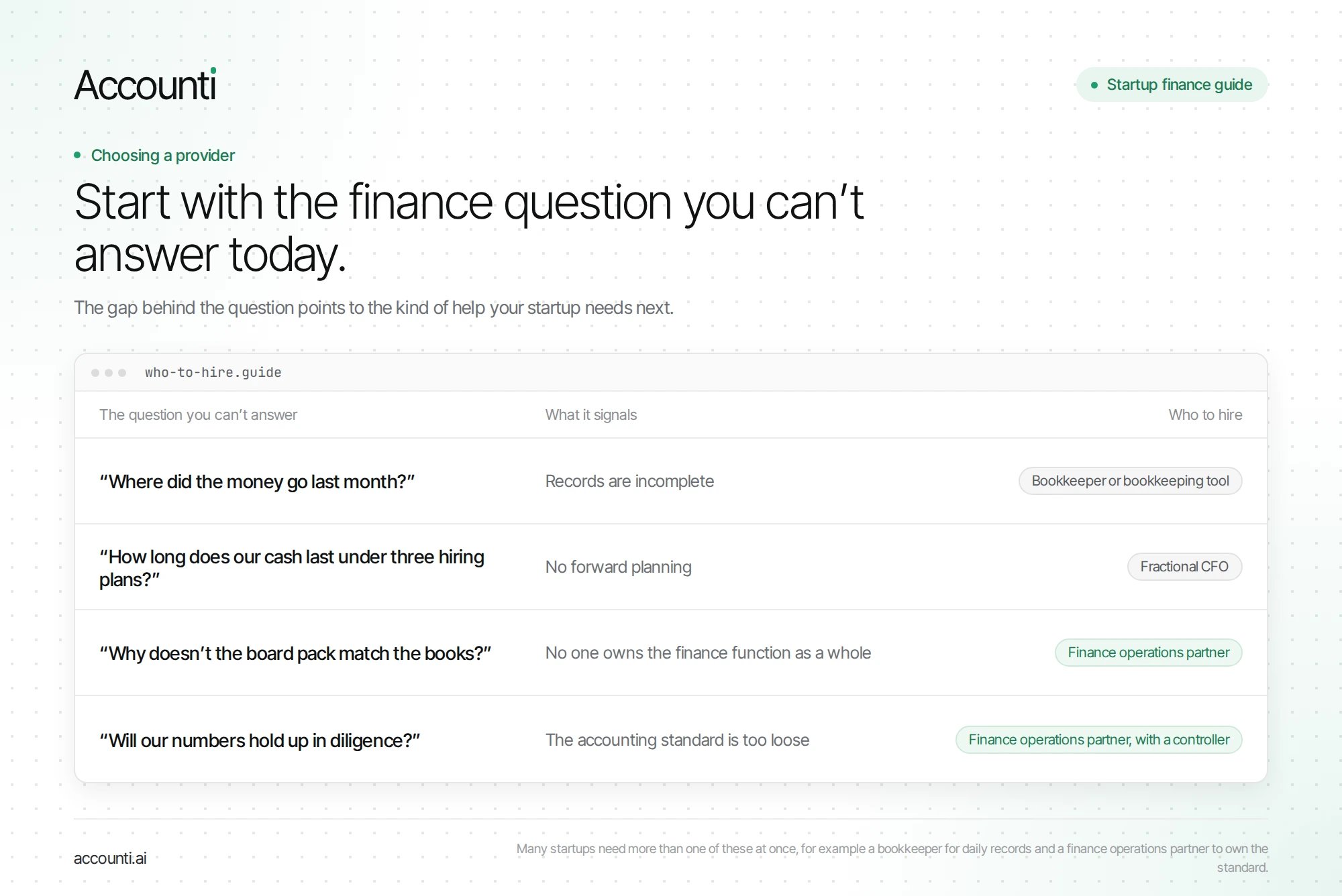
Alt text: Decision guide for choosing between a bookkeeper, a bookkeeping tool, a fractional CFO and a finance operations partner based on the finance question a startup cannot answer
Four factors usually settle the decision:
- Transaction complexity. Several entities, currencies or revenue models push you away from software and toward people with accounting judgment.
- Who reads the reports. A founder checking a dashboard needs less than a board or lead investor reviewing a monthly package.
- Geography. US-only startups have many providers to choose from. Cross-border structures narrow the field quickly.
- In-house capacity. A finance lead on staff can direct a lighter provider. Without one, the provider has to carry more of the judgment.
Signs it is time to switch
Switching is worth the effort when the close keeps slipping past the middle of the following month, or when investors ask for reports your provider cannot produce. A fundraise within a quarter on cash-basis books is another signal, as is a new entity or a first hire outside the US.
Common hiring mistakes
The most expensive mistake is hiring for this month instead of the next fundraise. A company six months from a seed round that stays on cash-basis books will pay for a rushed accrual conversion just as investors begin their review.
Another mistake is never speaking to your provider. Monthly review calls are where a misclassified contractor or an unpaid invoice gets caught before an investor sees it. Hiring a full-service firm too early also wastes money, since a pre-seed company with ten transactions a week only needs reliable books.
Questions to ask before you sign
- Who reviews each month's close, and what are their credentials?
- How do you handle the switch from cash to accrual books, and what does it cost?
- Can I export all my data if we part ways, and what does offboarding look like?
- Can you share a reference from a company at our stage?
Choosing for the stage you are in
Accounting services for startups work best when they grow with the company. Start light, move to accrual books before your first priced round, and add controller and CFO support as your board and investors ask for more. When finance has outgrown a single owner but a full-time CFO is still too early, Accounti can take ownership of the standard your numbers are held to. Book a call before your next raise or board review, so your finance is ready before anyone starts asking questions.
Frequently asked questions
How much do accounting services for startups cost?
Bookkeeping usually runs from about $99 to $500 a month. A full-service accounting firm with a dedicated manager costs roughly $650 to $1,500 a month, and fractional CFO support starts around $1,750 a month. Scope, the number of entities and tax work drive the final price.
When should a startup hire a CPA?
Bring in a CPA when you need tax returns filed, an R&D tax credit claimed, registrations in several states or reviewed financial statements, which usually happens around seed. Before that, a bookkeeper or a bookkeeping tool with a CPA add-on is often enough.
Is an AI accounting tool enough for a startup?
For simple, US-only books at pre-seed, often yes, as long as a person reviews each month's close. Once you have several entities, complex revenue or investor reporting, you need someone who decides how transactions are recorded and writes those policies down.
When does a startup need a fractional CFO?
Usually when you are preparing for a Series A or need runway scenarios, board packages and fundraising models. A bookkeeper records what already happened, while a fractional CFO plans the next 12 to 24 months.
What is the difference between a fractional CFO and a finance operations partner?
A fractional CFO is a part-time finance leader who handles strategy, forecasting and fundraising. A finance operations partner owns how the finance function runs day to day, including the close calendar, reporting standard, accounting policies and audit preparation, while strategic decisions stay with the founders and the board.
Written by
Co-founder and COO
Harsha Baisya is a finance professional with over seven years of experience across startups and established organizations. Her expertise spans financial management, business finance, financial analysis, and building effective finance processes that support business growth. As Co-Founder and COO of Accounti, Harsha brings a practical understanding of the financial and operational challenges businesses face as they scale. Her experience includes working with finance teams to improve financial visibility, streamline processes, manage costs, and strengthen financial reporting. She focuses on helping businesses build reliable financial systems that support informed decision-making, operational efficiency, and sustainable growth.