How to Open a Demat Account in India as a Foreign Investor

Quick Look:
A foreign investor opens a demat account in India with a depository participant (DP), and the steps depend on the investment route. Investors in Indian private companies use the foreign direct investment (FDI) route, which needs no registration with the Securities and Exchange Board of India (SEBI). They need a PAN (Form 96 for foreign entities, Form 95 for individuals), notarized and apostilled corporate documents, and KYC with the DP. Funds buying listed securities register as Foreign Portfolio Investors through a designated depository participant and a custodian, using the Common Application Form.
A foreign fund or angel investor buying shares in an Indian private company usually invests under the foreign direct investment (FDI) route. This route does not require registration with the Securities and Exchange Board of India (SEBI), the country's markets regulator. The investor still needs an Indian Permanent Account Number (PAN), which is India's tax identification number, and a demat account with a depository participant (DP). Its corporate documents also have to be notarized and apostilled before Indian intermediaries will accept them.
A demat (dematerialized) account holds shares in electronic form, much like a brokerage account, and the DP is the bank or broker that opens and services it. Indian law now requires many private companies to issue shares only in demat form, so the account has to be open before the company can allot shares to you or record a transfer in your name.
Funds that buy listed Indian securities follow a separate process. They register with SEBI as Foreign Portfolio Investors (FPIs) through a Designated Depository Participant (DDP), a SEBI-approved intermediary that processes the registration on SEBI's behalf, and appoint a custodian to hold their securities. This guide covers that route in a later section.
This guide is for CFOs and finance heads at foreign funds who need a clear picture of the India process before a round closes. Because each step depends on the one before it, a small gap early on tends to show up later, when a deal is already underway. The guide is based on how Accounti's India Demat Pro team handles this work, having opened and managed more than 200 demat accounts for investors across 11-plus countries.
Do foreign investors need a demat account to hold shares in an Indian private company?
In most cases, yes. India has two depositories that hold shares electronically, National Securities Depository Limited (NSDL) and Central Depository Services (India) Limited (CDSL). Investors access them through a demat account opened with a DP.
What Rule 9B requires
Rule 9B of the Companies (Prospectus and Allotment of Securities) Rules, 2014 requires every private company, other than a small company or a government company, to issue securities only in demat form. The Ministry of Corporate Affairs (MCA), which administers company law in India, extended the compliance deadline to June 30, 2025 (JSA). Shareholders of a covered company can now transfer their shares only in demat form. They can also subscribe to more shares in that company only after their existing holding has been converted.
What this means for you: a foreign investor in a covered company cannot receive new shares, sell shares or join a follow-on round without a working demat account.
Which companies are exempt
Small companies are exempt from Rule 9B. From December 1, 2025, the MCA defines a small company as one with paid-up capital of up to ₹10 crore and turnover of up to ₹100 crore (Fox Mandal). Holding companies and subsidiaries can never qualify as small companies, however low their capital or turnover.
What this means for you: many venture-backed startups are covered even when they look small on paper. Ask the investee company to confirm in writing whether Rule 9B applies before you send funds.

Choose the right investor route
The route you invest under decides which regulator reviews your application, which forms you file and what your demat account can hold. Confirm it before you approach any provider.
| Route | Typical investor | Main regulator | Demat account use |
|---|---|---|---|
| FDI | Funds, angels and strategic investors in Indian private companies | Reserve Bank of India (RBI), under the Foreign Exchange Management Act (FEMA) | Holds shares allotted or transferred in demat form, now mandatory for most private companies |
| FPI | Funds and institutions buying listed securities | SEBI | Holds listed equity and debt |
| Foreign Venture Capital Investor (FVCI) | Foreign venture capital funds registered with SEBI | SEBI and RBI | Holds securities acquired under the FVCI registration |
| Non-resident Indian (NRI) or Overseas Citizen of India (OCI) | Individuals of Indian origin | RBI and SEBI | Personal demat linked to an NRE or NRO bank account |
Funds investing in Indian startups usually do so under FDI, so this guide covers that route in the most detail, followed by the FPI and individual routes.
Venture funds can also register as FVCIs, although this is optional. Since SEBI's September 2024 amendment, FVCI applications go to a DDP, which grants registration on SEBI's behalf for a fee of USD 2,500 (Nishith Desai Associates).
What does the process involve, from PAN and KYC to an operational account?
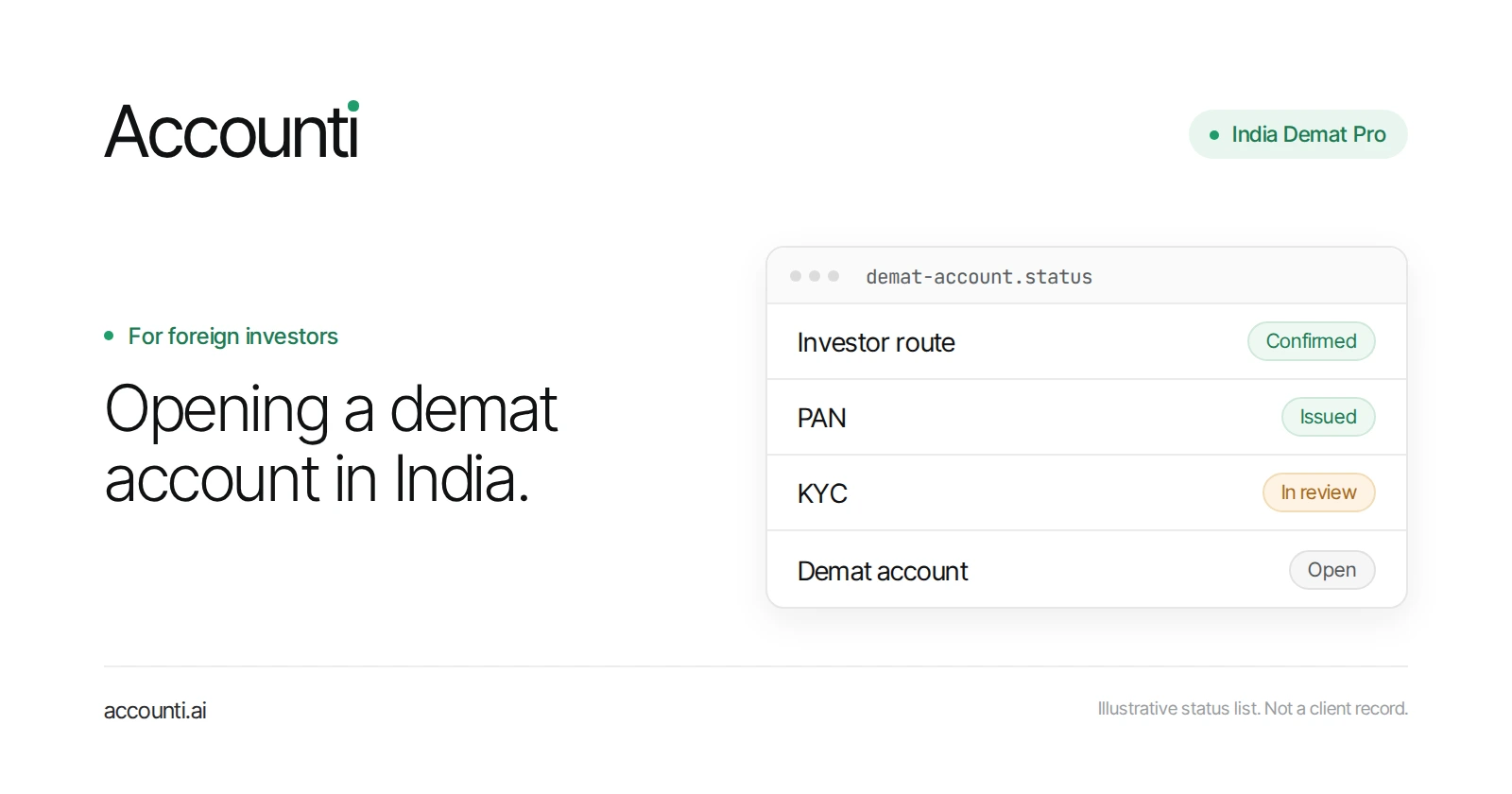
Under the FDI route, you authenticate your documents, get a PAN, complete KYC with a DP and then receive your shares in a non-FPI demat account. Each step relies on the one before it, so the work has to happen in this order.
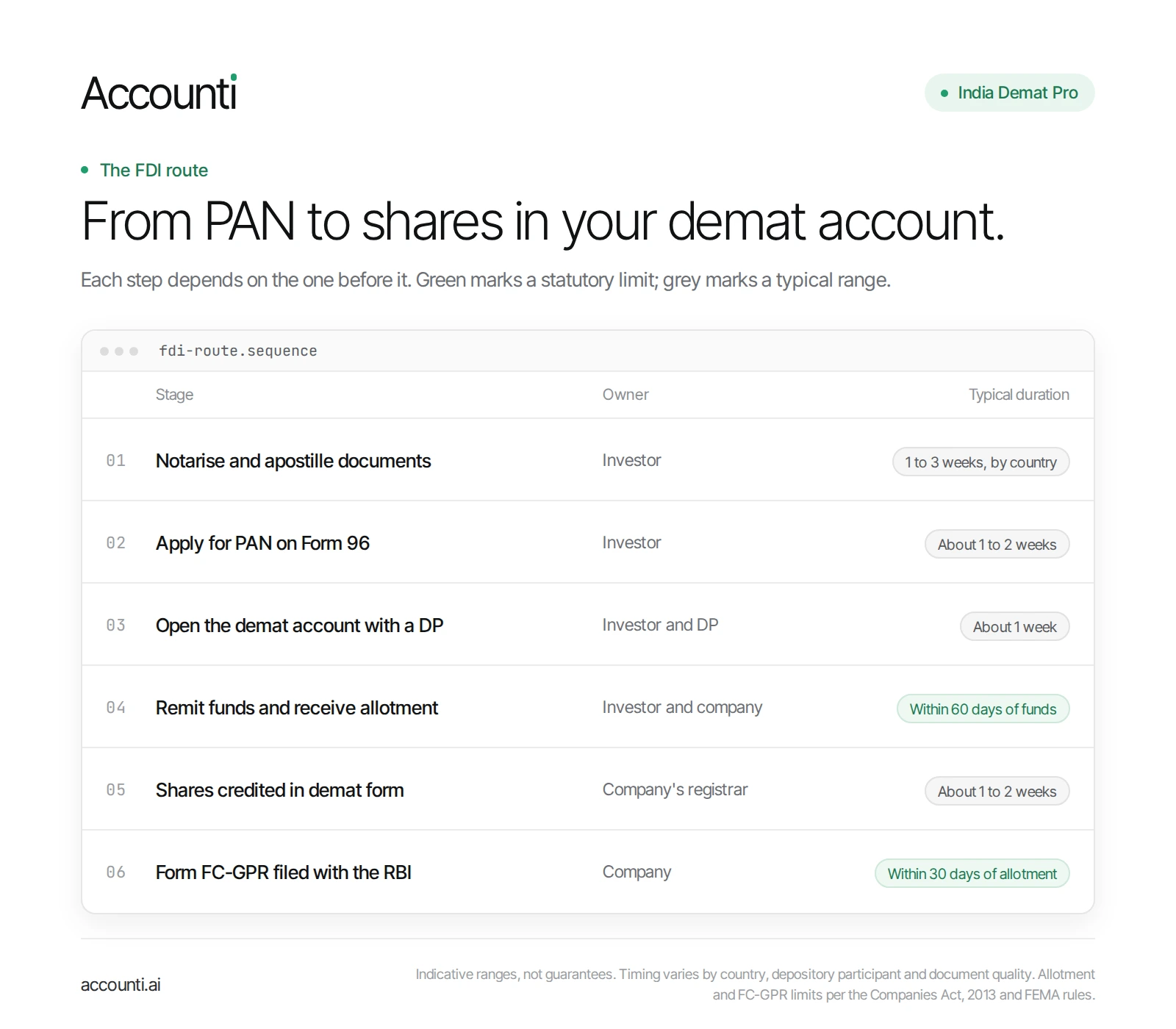
- Prepare and authenticate documents. A notary first certifies your corporate documents. They are then apostilled, which means an authority in the issuing country certifies them for use abroad, if that country is part of the Hague Apostille Convention, as the US is. Documents from other countries are attested by an Indian embassy or consulate instead, a process called consularization. Timing depends on the country.
- Get a PAN. Foreign entities apply on Form 96 and foreign individuals on Form 95. These forms replaced Form 49AA from April 1, 2026, under the Income-tax Rules, 2026 (TaxGuru). A PAN issued earlier on Form 49AA stays valid, so investors who already hold one do not need to reapply.
- Complete KYC and open the account. KYC (know your customer) is the identity and ownership check every DP must run. The DP reviews your documents and opens the account once it receives the originals. One broker says it opens accounts for foreign companies within four working days of receiving documents (Zerodha), so courier time to India often decides the real schedule.
- Send funds and receive the allotment. Share your DP ID and client ID, the two numbers that identify your demat account, with the company before it allots shares. The company then allots shares within the deadline in the table below.
- Receive the shares. The company's registrar and transfer agent (RTA), which maintains its shareholder records, credits the shares to your demat account. They then appear on your DP statement.
- Company reports the investment. The company reports the investment to the RBI on Form FC-GPR.
Deadlines after you send funds
| Event | Deadline | Responsible party |
|---|---|---|
| Allot shares | Within 60 days of receiving the funds (Treelife) | Investee company |
| Refund funds if shares are not allotted | Within 15 days after the 60-day period ends (Treelife) | Investee company |
| Report a fresh allotment on Form FC-GPR | Within 30 days of allotment (Global Law Experts) | Investee company |
| Report a transfer between a resident and a non-resident on Form FC-TRS | Within 60 days of the transfer or receipt of payment, whichever is earlier (Global Law Experts) | Resident party to the transfer |
What this means for you: these deadlines bind the company, but a missed filing can hold up your own transfer or exit later. Ask for the FC-GPR acknowledgment once it is filed, since a buyer's due diligence team will usually ask to see it.
Send the funds from the investor's own bank account through regular banking channels. The company's bank issues a Foreign Inward Remittance Certificate (FIRC), which confirms the money came from abroad, along with a KYC report on the investor. The company attaches both to its FC-GPR filing (Global Law Experts). A payment from a related entity or a third party will not match these records, and the bank is likely to query it.
Delays usually happen between steps, for example when the company is ready to allot shares but does not have the investor's client ID yet. India Demat Pro runs the full sequence as one project with one team responsible for it, so each hand-off is tracked.
What documents does a foreign company need to open a demat account in India?
There is no single official checklist for foreign companies opening a demat account in India. Each DP sets its own list, and law firms have pointed out the need for a standard one (Cyril Amarchand Mangaldas). In practice, DPs ask for a broadly similar set of documents, based on published checklists such as those from Purva Sharegistry and Arihant Capital.
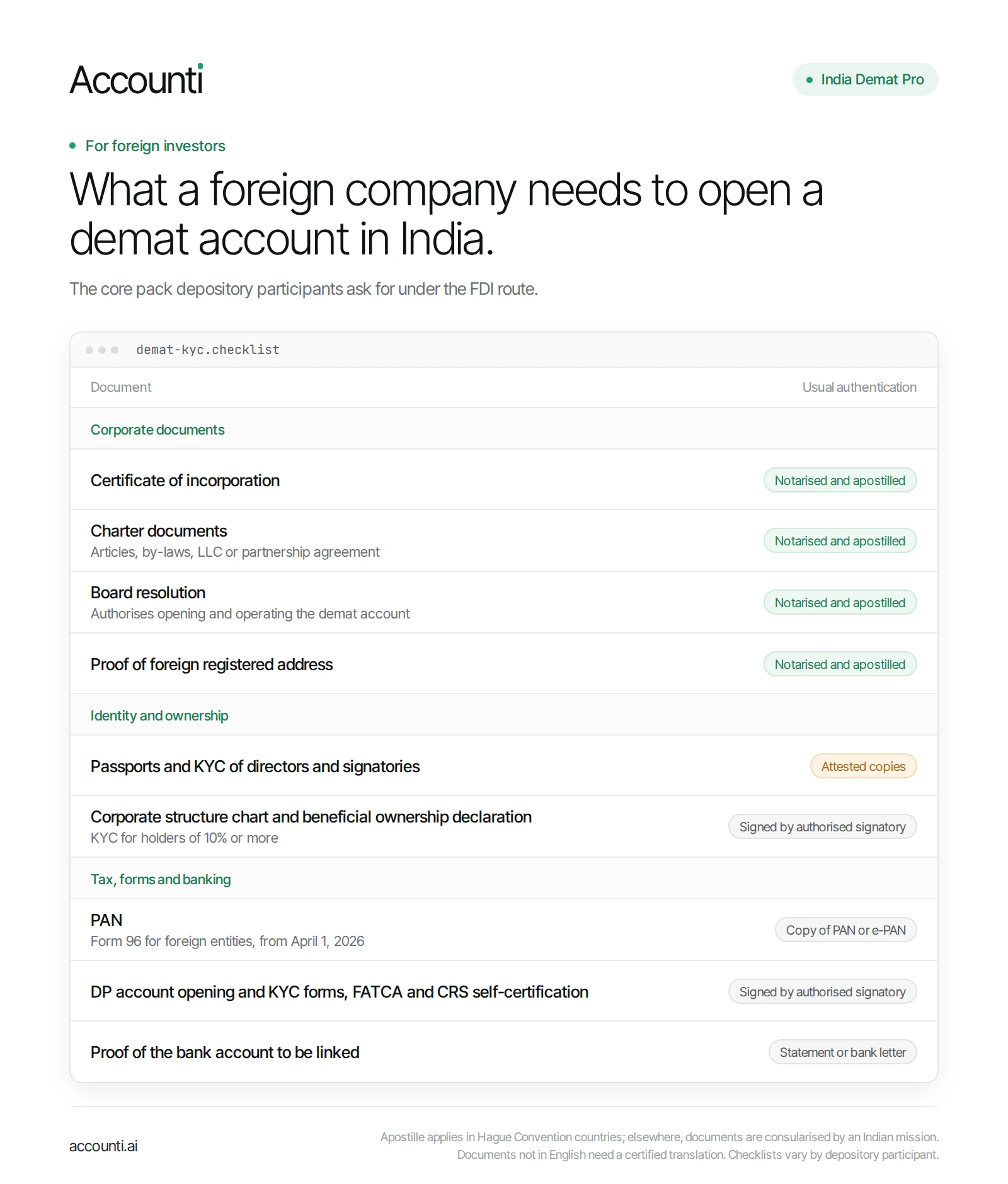
| Document | Why the DP asks for it | Usual authentication |
|---|---|---|
| DP account opening and KYC forms | Record the account holder's details | Signed by the authorized signatory |
| Certificate of incorporation | Proves the entity legally exists | Notarized, then apostilled or consularized |
| Charter documents (articles, by-laws, or an LLC or partnership agreement) | Show how the entity is governed and who can act for it | Notarized, then apostilled or consularized |
| Board resolution | Approves opening and operating the demat account and names the signatories | Notarized, then apostilled or consularized |
| Proof of registered address abroad | Confirms the entity's address | Notarized, then apostilled or consularized |
| Passports and KYC forms of directors and authorized signatories | Identify the people acting for the entity | Attested copies |
| Corporate structure chart and beneficial ownership declaration | Identify every ultimate beneficial owner | Signed by the authorized signatory |
| PAN | Links the account to the investor's Indian tax ID | Copy of the PAN or e-PAN |
| FATCA and CRS self-certification | Records the entity's tax residency for international reporting | Signed by the authorized signatory |
| Proof of the bank account to be linked | Confirms where funds come from and go to | Bank statement or bank letter |
FATCA is the US Foreign Account Tax Compliance Act, and CRS is the Common Reporting Standard used by most other countries. Both require financial institutions to collect tax residency details from account holders.
For any shareholder holding 10% or more, the DP usually asks for further KYC or shareholding documents. It keeps going up the ownership chain until it identifies every ultimate beneficial owner (UBO), the individual who ultimately owns or controls the entity (Arihant Capital). Any document that is not in English needs a certified translation, which is notarized and apostilled along with the original.
The exact requirements also depend on where the investor is based. A US limited partnership, for example, may need a different set of documents from an entity in the Cayman Islands or Singapore. This is why Accounti reviews each investor's structure before preparing the document package, instead of working from a generic checklist.
Investment funds need extra care here. DPs often return applications where names or dates differ between the fund's constitutional documents, its general partner's authority and the investment manager's signatory list. Prepare the ownership chart first and check it against these documents.
Dematerializing shares you already hold
Investors from earlier funding rounds may still hold paper share certificates. If the company is covered by Rule 9B, these have to be converted to demat form, a process called dematerialization, before the investor can transfer them or subscribe to more shares. The process usually runs in four steps:
- The investor submits a dematerialization request to its DP along with the original share certificates.
- The DP forwards the request to the company's RTA.
- The company and its RTA check the certificates against the register of members and confirm the request.
- The shares are credited to the investor's demat account.
What this means for you: shares still on paper cannot be sold or added to, so start well before a planned exit or follow-on round. Buyers and lead investors will not close a deal against paper certificates.
Common reasons for delay include lost certificates, names that do not match between the register of members and the KYC documents, and unsigned transfer deeds from earlier share sales. Under India Demat Pro, Accounti handles all communication with the company and its RTA until the conversion is confirmed, so the investor does not have to follow up with anyone.
NRI and foreign individual options
Individual investors have a simpler process. An NRI or a person of Indian origin (PIO) who wants to buy listed Indian shares on a repatriable basis, meaning the money can later be sent back abroad, uses the RBI's Portfolio Investment Scheme (PIS). The investment runs through a designated branch of an authorized dealer bank, using a Non-Resident External (NRE) or Non-Resident Ordinary (NRO) account at that branch (NSE). The NRE account supports repatriable investment and the NRO account supports non-repatriable investment.
Check whether a provider accepts clients from your country. SBI and its broking arm, for instance, say they do not solicit NRIs living in the US, UK, Canada or Japan (SBI), so US-based investors should confirm a provider's onboarding policy before applying. A foreign individual who is not of Indian origin cannot use the NRI route. These investors hold private company shares under FDI and apply for a PAN on Form 95.
The FPI route for listed securities
Funds that want to buy listed Indian securities register as FPIs. According to NSE, an FPI needs to appoint the following providers (NSE):
| Provider | Role |
|---|---|
| Designated Depository Participant (DDP) | Processes the FPI registration on SEBI's behalf |
| SEBI-registered custodian | Holds the securities and settles trades |
| Designated bank | Operates the FPI's bank accounts in India |
| Legal representative | Handles regulatory filings in India |
| Tax advisor | Handles Indian tax compliance |
| Trading and clearing members | Execute and settle trades on the exchange |
| Compliance officer | Owns ongoing regulatory compliance |
Registration starts with the Common Application Form (CAF), a single filing that covers FPI registration, PAN allocation and KYC for the bank and demat accounts (Citi custody CAF). The form is filled in online, then printed and sent to the DDP with original signatures, Annexure B, supporting documents and the fees (NSDL).
Funds with investors of Indian origin also need to watch contribution limits. A single NRI, OCI or resident Indian must hold less than 25% of the fund, and all of them together must hold less than 50% (SEBI master circular). Since June 2024, FPIs based in an International Financial Services Centre (IFSC) in India, such as GIFT City, and regulated by the International Financial Services Centres Authority (IFSCA) can accept up to 100% from these investors, subject to conditions (Business Standard).
What this means for you: a fund with a large share of Indian-origin investors should check these limits before applying, since a breach can stop the registration at the DDP stage.
Timelines and common delays
No regulator sets a fixed timeline for opening a demat account, so treat any timeline a provider gives you as an estimate and leave some buffer in your closing plan.
These are the usual causes of delay:
- Apostilled documents that are not in the format the DP needs
- Signatures that do not match the list of authorized signatories or the board resolution
- Ownership charts that do not match the fund documents
- Time taken to courier original documents from the US
- Paper share certificates from an earlier round that were never converted
- A change in directors or signatories after the board resolution was passed
Checking your documents against the DP's checklist before you submit them usually saves more time than fixing problems afterwards.
Costs and tax at entry and exit
The main costs are PAN and document authentication fees, DP account charges and any RTA fees. These vary by provider, so ask each one for a written fee schedule before you begin.
Capital gains rates, withholding tax and treaty benefits depend on your investor category and home country, and can change with each annual Finance Act, India's yearly budget law. Check the current position with an Indian tax advisor before you sign.
The Section 281 certificate at exit
Buyers often ask the seller for a Section 281 certificate (section 499 of the Income-tax Act, 2025) before a share transfer. Under this provision, a transfer made while tax proceedings are pending against the seller can be treated as void against the tax department's claims. The transfer stays valid in either of these cases (Income Tax Department):
- It was made for adequate consideration and without notice of the pending proceedings.
- It was made with the prior permission of the Assessing Officer, the tax official responsible for the seller's case.
What this means for you: the buyer wants assurance that the tax department cannot later challenge the transfer, so plan for the certificate well before closing.
After the sale, the investor also has to file an income tax return in India for the capital gains. Accounti obtains the Section 281 certificate as part of the transaction, so it is ready when the buyer asks for it, and files the capital gains return after the sale so the exit is fully closed.
Finance controls after account opening
Once the account is open, a few tasks need to happen regularly, and each one should have a clear owner.
| Task | Why it matters |
|---|---|
| Reconcile DP statements against your own books on a fixed schedule | Catches differences early |
| Keep tax and FEMA records in a form your Indian advisors can use directly | Speeds up filings, audits and exits |
| Track changes to signatories, directors and beneficial owners | Each change means updating the KYC held by the DP |
For many funds, putting the India records in order is the first step toward managing the finances of the wider portfolio as one operation, which is what Accounti's Global Portfolio Operations service does.
Who can handle the complete process?
Each party involved handles only part of the process.
| Party | What it handles |
|---|---|
| DP | Opens and maintains the demat account |
| Investee company and its RTA | Allot and credit the shares, and report the investment to the RBI |
| Notary and apostille authority | Authenticate documents in the investor's country |
| Tax advisor | Handles the PAN, capital gains and tax filings |
What is usually missing is someone who manages the whole sequence, follows up on each step and catches mismatches before the documents reach the DP.
India Demat Pro from Accounti fills that gap. It is a fully managed service that covers a foreign investor's stake in an Indian private company from account setup to exit. The Accounti team reviews the investor's structure, prepares the full document package and works with its banking and depository partners until the account is active. It also handles dematerialization, share transfers, the Section 281 certificate and the capital gains filing at exit. The investor gathers its documents and signs where needed, and Accounti takes care of the rest. Accounti's India Demat Pro clients include VersionOne, FJ Labs, AngelList and Gaingels.
Whoever handles the process, the first steps for a private company investment are the same. Confirm whether the company is covered by Rule 9B, start getting your documents apostilled and apply for a PAN on Form 96. Book a call with Accounti before your next funding round or share transfer, so your India paperwork is ready well before anyone asks for it.
Frequently asked questions
Does a foreign investor in an Indian private company need a demat account?
In most cases, yes. Rule 9B requires private companies other than small and government companies to issue securities only in demat form, and holders must dematerialize existing shares before transferring them or subscribing to more.
Does an FDI investor need to register with SEBI?
No. FDI into private companies is governed by the Reserve Bank of India (RBI) under the Foreign Exchange Management Act (FEMA). The investor needs a PAN, completed KYC and a demat account with a depository participant. Registration with the Securities and Exchange Board of India (SEBI) applies to Foreign Portfolio Investors (FPIs) and Foreign Venture Capital Investors (FVCIs).
Which form does a foreign company use to apply for a PAN?
Form 96. From April 1, 2026, the Income-tax Rules, 2026 replaced Form 49AA with Form 95 for foreign individuals and Form 96 for foreign entities. A PAN issued earlier under Form 49AA remains valid. FPIs obtain PAN through the Common Application Form.
How long does it take to open a demat account as a foreign company?
No regulator sets a fixed turnaround. Document authentication and PAN usually take the longest, and some depository participants open the account within a few working days of receiving the originals. Once funds arrive, the investee has 60 days to allot shares and 30 days after allotment to report the investment to the RBI on Form FC-GPR.
Can a foreign individual open a demat account in India?
Yes. Non-resident Indians (NRIs), persons of Indian origin (PIOs) and Overseas Citizens of India (OCIs) can open one linked to an NRE or NRO account, using the Portfolio Investment Scheme for repatriable exchange purchases. A foreign individual without Indian origin holds private company shares under the FDI route, with a PAN on Form 95.
How does a foreign investor sell shares in an Indian private company?
The shares must first be in demat form. Paper certificates are dematerialised before the sale. The seller then gives its depository participant a Delivery Instruction Slip to move the shares to the buyer’s demat account. When the buyer is an Indian resident, the sale price must follow FEMA pricing rules, and the resident party reports the transfer to the RBI on Form FC-TRS within 60 days. Buyers often ask for a Section 281 certificate (section 499 of the Income-tax Act, 2025) before closing, and the seller files an Indian income tax return on the capital gain after the sale.
Can a foreign angel investor open a demat account in India?
Yes. A foreign individual investing in an Indian private company does so under the FDI route, applies for a PAN on Form 95 and opens a demat account with a depository participant. No SEBI registration is needed.
Written by
Co-founder and CEO
Rohit Kapoor is a senior finance professional with over 20 years of experience across financial planning, management reporting, financial controlling, cost management, and finance transformation. He brings extensive experience in working with global business teams and cross-functional stakeholders to strengthen financial processes, improve operational efficiency, and establish scalable finance frameworks. Rohit’s expertise lies in simplifying complex processes, building sustainable finance operations, and developing high-performing teams. Combining strategic leadership with a hands-on approach, he focuses on aligning finance functions with business objectives and enabling better decision-making through robust financial controls, effective reporting, and process improvement.