How to Accurately Calculate Burn Rate and Extend Your Startup’s Cash Runway
Quick Answer:
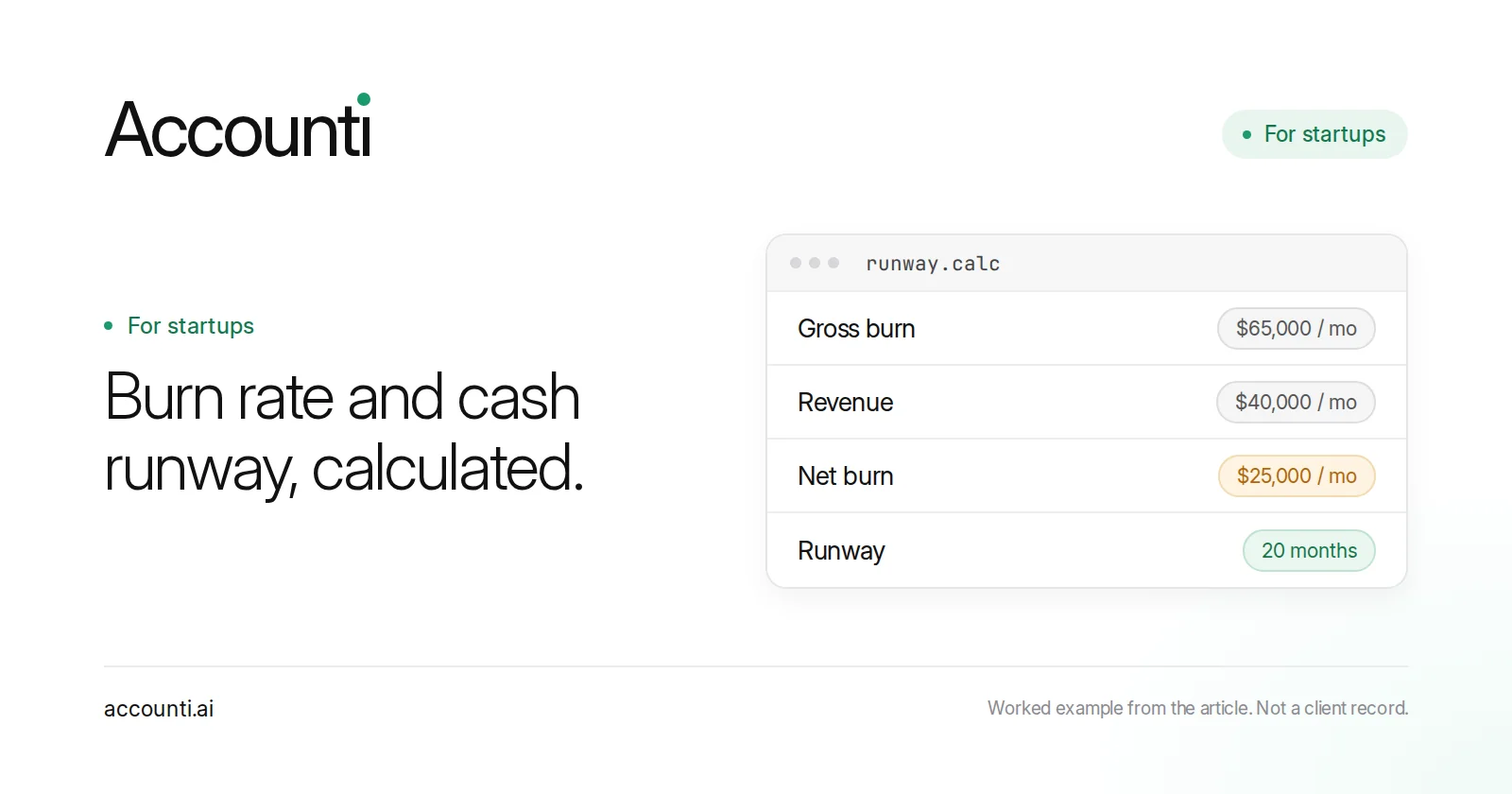
Burn rate is how fast a company spends its cash. Gross burn is total monthly operating spend, and net burn is that spend minus monthly revenue. Runway is cash in the bank divided by net burn. A startup spending $65,000 a month with $40,000 of revenue has a net burn of $25,000, so $500,000 in the bank gives it 20 months of runway.
Burn rate is a crucial financial metric that measures how quickly a company is spending its cash reserves over a specific period, typically monthly.
It's the rate at which a company is losing money, particularly when the company's expenses exceed its revenues.
Importance of Understanding Burn Rate for Businesses
Understanding burn rate is vital for businesses, especially startups, for several reasons:
- It helps predict how long a company can operate before running out of cash
- It informs financial planning and budgeting decisions
- It's a key indicator of a company's financial health and sustainability
- It influences investor interest and funding decisions
Why Burn Rate is a Key Financial Metric
Burn rate serves as a critical financial metric because it:
- Provides insight into a company's cash management
- Helps in forecasting future funding needs
- Indicates the company's runway (how long it can operate before needing additional funding)
- Reflects the company's operational efficiency
Reasons Startups Monitor Burn Rate
Startups closely monitor their burn rate for the following reasons:
- To ensure they have enough cash to reach important milestones
- To make informed decisions about cost-cutting or revenue-generating initiatives
- To determine when to start fundraising efforts
- To demonstrate financial responsibility to investors
- To compare their financial performance against industry benchmarks
Types of Burn Rate
There are two primary types of burn rate: Gross Burn Rate and Net Burn Rate.
Gross Burn Rate
Gross burn rate represents the total amount of cash a company spends each month on operating expenses.
Formula: Gross Burn Rate = Total Monthly Expenses
For example, if a startup spends $50,000 on salaries, $10,000 on rent, and $5,000 on other expenses in a month, its gross burn rate would be:
$50,000 + $10,000 + $5,000 = $65,000 per month
Here's a chart showing how gross burn rate might fluctuate based on different expenses:
Net Burn Rate
Net burn rate is the rate at which a company is losing money. It takes into account both expenses and revenue.
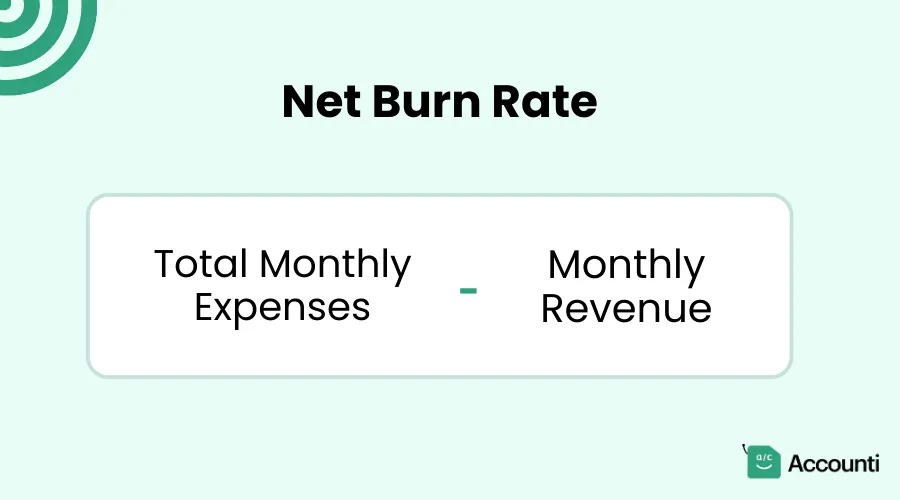
Formula: Net Burn Rate = Total Monthly Expenses - Monthly Revenue
For instance, if the same startup from our previous example has a monthly revenue of $40,000, its net burn rate would be:
$65,000 - $40,000 = $25,000 per month
Comparison: Gross Burn Rate vs. Net Burn Rate
Here's a table highlighting the key differences between gross and net burn rates:
| Aspect | Gross Burn Rate | Net Burn Rate |
|---|---|---|
| Definition | Total monthly expenses | Monthly expenses minus revenue |
| Formula | Total Monthly Expenses | Total Monthly Expenses - Monthly Revenue |
| What it shows | Total cash outflow | Actual cash loss |
| Considers revenue | No | Yes |
| Use case | Understanding total operational costs | Determining actual financial sustainability |
How to Calculate Burn Rate
Step-by-Step Guide
To calculate burn rate accurately, follow these steps:
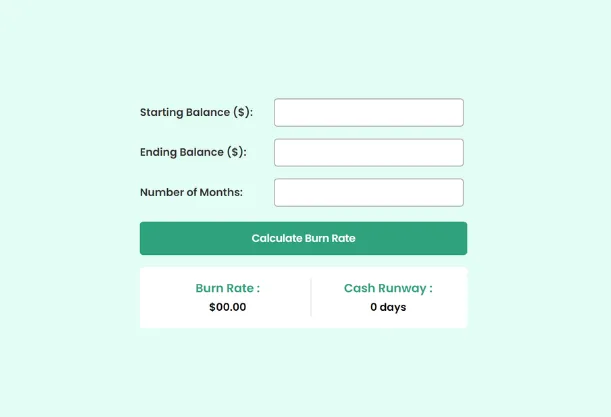
- Gather financial data
- Identify total monthly expenses
- Determine monthly revenue (for net burn rate)
- Apply the formula (for both gross and net burn rate)
Here's an example walkthrough with numbers:
| Step | Action | Gross Burn Rate | Net Burn Rate |
|---|---|---|---|
| 1 | Gather financial data | ✓ | ✓ |
| 2 | Identify monthly expenses | $65,000 | $65,000 |
| 3 | Determine monthly revenue | N/A | $40,000 |
| 4 | Apply formula | $65,000 | $65,000 - $40,000 = $25,000 |
Why Burn Rate is Critical for Startups
Cash Runway and Burn Rate
Cash runway is the amount of time a company can continue operating before it runs out of money, assuming the current burn rate remains constant.
Formula: Cash Runway = Cash Available / Net Burn Rate
For example, if a startup has $500,000 in the bank and a net burn rate of $25,000 per month, its cash runway would be:
$500,000 / $25,000 = 20 months
Monitoring and Reducing Burn Rate
To manage burn rate effectively, consider these tips:
- Cut unnecessary costs
- Improve operational efficiency
- Automate processes
- Renegotiate contracts
- Focus on revenue-generating activities
Here's a comparison of high vs. low burn rate startups and their potential outcomes:
| Aspect | High Burn Rate Startup | Low Burn Rate Startup |
|---|---|---|
| Cash runway | Shorter | Longer |
| Funding pressure | Higher | Lower |
| Growth potential | Potentially faster | Potentially slower |
| Risk level | Higher | Lower |
| Investor appeal | Mixed (depends on growth) | Generally positive |
| Flexibility | Lower | Higher |
Tools for Tracking and Calculating Burn Rate
Manual Calculations vs. Financial Software
Pros and cons of manual vs. software-based burn rate calculations:
Manual Calculations:
- Full control over the process
- No additional costs
- Time-consuming
- Prone to human error
Financial Software:
- Automated calculations
- Real-time updates
- Potential costs
- Learning curve
Popular tools for tracking burn rate include QuickBooks, Xero, and custom spreadsheets. Here's a comparison of manual tracking vs. software tools:
| Feature | Manual Tracking | Software Tools |
|---|---|---|
| Accuracy | Moderate (human error risk) | High (automated calculations) |
| Time investment | High | Low |
| Cost | Low | Varies (free to premium) |
| Customization | High | Moderate to High |
| Real-time updates | No | Yes |
| Integration with other financial data | Limited | Extensive |
Burn Rate and Investor Interest
Why Investors Care About Burn Rate
Investors assess company health using burn rate in the following ways:
- Evaluating financial efficiency
- Estimating future funding needs
- Assessing management's ability to control costs
- Comparing performance against industry benchmarks
Burn rate benchmarks that investors look for can vary by industry and stage of the company. Here's a general comparison of healthy vs. unhealthy burn rate ranges:
| Startup Stage | Healthy Burn Rate | Unhealthy Burn Rate |
|---|---|---|
| Seed | $10K - $50K/month | >$100K/month |
| Series A | $100K - $200K/month | >$300K/month |
| Series B | $200K - $400K/month | >$600K/month |
Note: These figures are generalizations and can vary significantly based on industry, location, and specific company circumstances.
Common Mistakes to Avoid When Calculating Burn Rate
Overlooking Variable Expenses
Be sure to include these commonly overlooked variable expenses:
- Utilities
- Travel and entertainment
- Seasonal marketing costs
- One-time purchases or fees
- Contractor or freelancer payments
Ignoring Revenue Fluctuations
Revenue fluctuations can significantly impact net burn rate. Here's a comparison of consistent vs. fluctuating revenue and its impact on burn rate:
As you can see, fluctuating revenue can lead to unpredictable net burn rates, making financial planning more challenging.
Conclusion
Understanding and managing burn rate is crucial for startups and growing businesses. Here are the key takeaways:
- Burn rate measures the rate at which a company spends its cash reserves
- There are two types: gross burn rate and net burn rate
- Calculating burn rate helps determine cash runway and financial health
- Investors use burn rate as a key metric for assessing startups
- Regularly monitoring and managing burn rate is essential for long-term success
- Avoid common mistakes like overlooking variable expenses and ignoring revenue fluctuations
By maintaining a sustainable burn rate, startups can extend their runway, improve their chances of success, and attract potential investors. Remember, the goal is not always to have the lowest possible burn rate, but to find the right balance between growth and financial sustainability.
Frequently asked questions
What is the difference between gross burn and net burn?
Gross burn is total monthly cash spending. Net burn subtracts monthly cash revenue, so it shows how much cash the company actually loses each month.
How do you calculate cash runway?
Divide current cash by monthly net burn. $500,000 of cash with a $25,000 net burn gives 20 months.
How much runway should a startup have?
Many investors expect 18 to 24 months after a round, which leaves time to reach milestones before raising again.
How can a startup reduce its burn rate?
Cut spending that doesn't drive growth, renegotiate contracts, delay non-essential hires and collect from customers faster.