Key Considerations for Foreign Funds Setting Up Demat Accounts in India
Quick Answer:
Before opening an Indian demat account, a foreign fund has to settle its investment route, its depository participant and its documents. A fund buying shares in Indian private companies uses the FDI route, which needs a PAN and KYC but no SEBI registration. Investing in listed shares requires registration as a Foreign Portfolio Investor. Funds should also plan for capital gains tax on exit, treaty claims and repatriating proceeds through an authorised dealer bank.
India's financial market has become a beacon for foreign investors, offering a blend of robust growth potential and economic stability. As the world's fastest-growing major economy, India presents a compelling case for foreign funds looking to diversify their portfolios and tap into emerging market opportunities.
At the heart of this investment ecosystem lies the Demat account - a crucial tool for trading and investment in Indian securities. For foreign funds eyeing the Indian market, setting up a Demat account is not just a procedural step, but a gateway to seamless investment operations in the country.
This article delves into the key considerations foreign funds must keep in mind when establishing Demat accounts in India, ensuring compliance, efficiency, and optimal returns on their investments.
What is a Demat Account?
A Demat account, short for a Dematerialized account, is an electronic repository that holds an investor's securities in digital form. It eliminates the need for physical share certificates, reducing risks associated with theft, forgery, and damage while streamlining the trading process.
In the Indian stock market, Demat accounts play a pivotal role by:
- Facilitating instant transfer of securities
- Reducing paperwork and administrative burden
- Enabling quick settlement of trades
- Providing a consolidated view of all investments
Why Foreign Funds Need Demat Accounts
For foreign funds, Demat accounts are not just a convenience but a necessity. Here's why:
For a more detailed, step-by-step guide on setting up a Demat account in India, foreign investors can refer to the India Demat Account Setup. This resource provides insights into the procedural requirements, necessary documentation, and regulatory compliance that foreign funds need to navigate when entering the Indian market. Following these guidelines ensures a smooth investment process and compliance with Indian financial regulations.
- Legal Requirement: Listed securities are held in demat form, and Rule 9B requires private companies other than small companies to issue and transfer shares only in demat form.
- Efficient Portfolio Management: Demat accounts allow for easy tracking and management of diverse investments in the Indian market.
- Seamless Trading: They enable quick execution of trades, which is crucial in volatile market conditions.
- Regulatory Compliance: Demat accounts help in maintaining transparency and adherence to Indian market regulations.
For more information read this detailed article: Why Foreign Investors Need Demat Account (India)
Key Considerations Before Setting Up a Demat Account
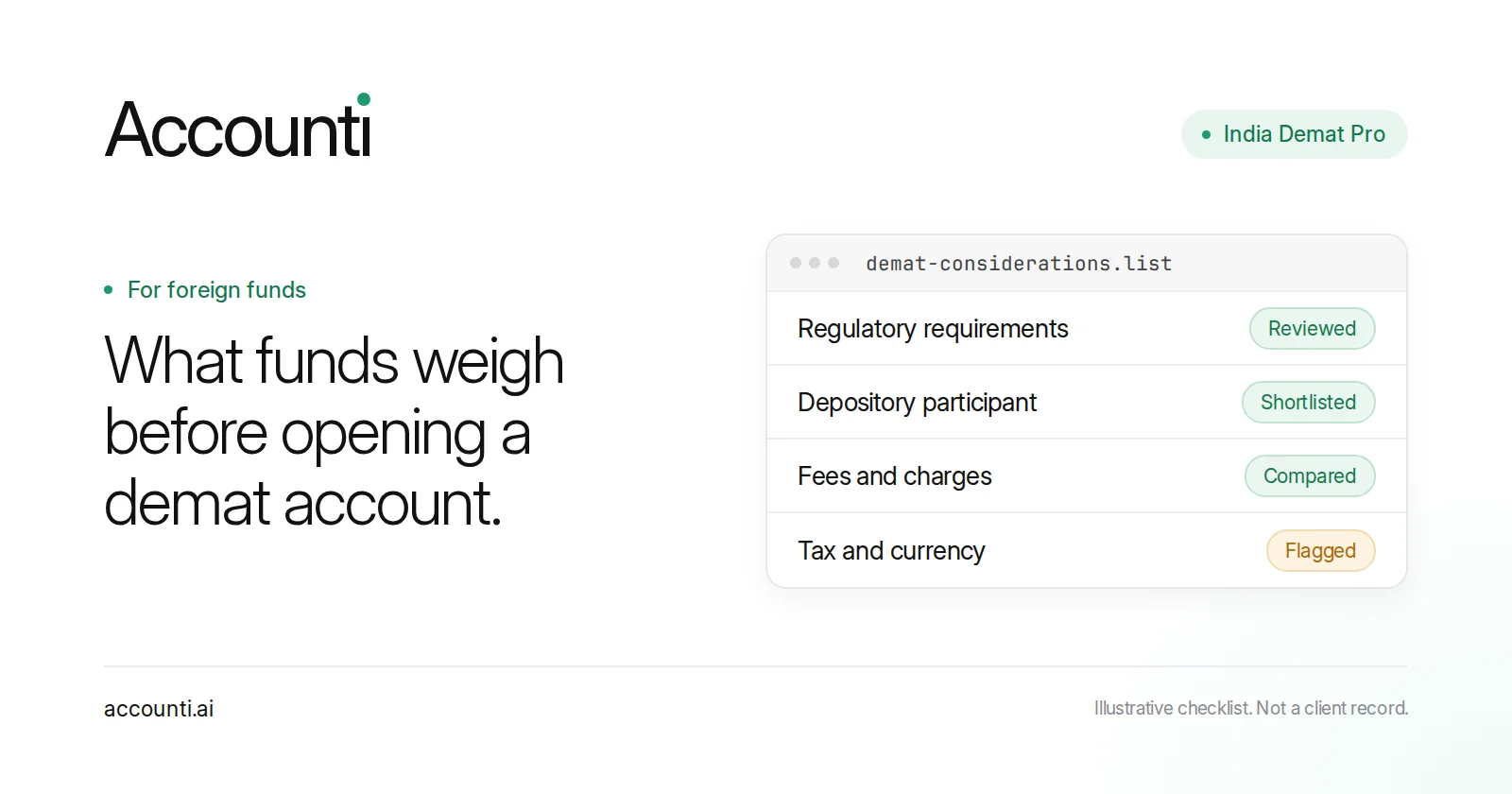
Regulatory Requirements
Navigating the regulatory landscape is crucial for foreign funds. Key points to consider include:
- Investment route: Funds investing in Indian private companies use the FDI route under RBI and FEMA rules, with no SEBI registration. Funds buying listed securities must register with SEBI as Foreign Portfolio Investors.
- Documentation: Foreign entities need to provide extensive documentation, including:
- Proof of identity and address
- Tax residency certificate
- Board resolution for opening the account
Choosing a Depository Participant (DP)
Selecting the right Depository Participant is critical. Factors to consider include:
- Reputation and reliability
- Technology infrastructure
- Service quality and customer support
- Fee structure
- Additional services offered (e.g., research, advisory)
NSDL vs. CDSL
| Feature | National Securities Depository Limited (NSDL) | Central Depository Services Limited (CDSL) |
|---|---|---|
| Establishment | 1996 | 1999 |
| Market Share | Larger | Smaller but growing |
| Technology | Advanced | User-friendly |
| Geographical Presence | Wider | Expanding |
| Cost Structure | Generally higher | Often more competitive |
Transaction Costs and Fees
Understanding the fee structure is crucial for managing investment costs. Common fees include:
- Account opening charges
- Annual maintenance fees
- Transaction fees
- Dematerialization charges
Here's a comparative table of fee structures (note: these are indicative and may vary):
| Fee Type | NSDL | CDSL |
|---|---|---|
| Account Opening | ₹500 - ₹1000 | ₹450 - ₹750 |
| Annual Maintenance | ₹300 - ₹500 | ₹250 - ₹450 |
| Transaction (Buy) | 0.03% - 0.05% | 0.02% - 0.04% |
| Transaction (Sell) | 0.03% - 0.05% | 0.02% - 0.04% |
Tax Implications
Tax on Gains from Indian Investments
Foreign funds must be aware of the tax implications on their investments:
- Short-term Capital Gains: For equity held less than one year, taxed at 20%
- Long-term Capital Gains: For equity held more than one year, taxed at 12.5% (on gains over ₹1.25 lakh)
- Dividend Tax: Taxed in the hands of the recipient at applicable rates
Double Taxation Avoidance Agreements (DTAA)
DTAAs can significantly benefit foreign funds by preventing double taxation. Key points:
- India has DTAA with over 80 countries
- Benefits include reduced withholding tax rates and tax credits
- Notable DTAA partners: USA, UK, Singapore, Mauritius, Netherlands
Currency and Exchange Rate Risks
Managing Currency Risks
Foreign funds face inherent currency risks when investing in India:
Impact: Currency fluctuations can erode returns even if underlying investments perform well
Hedging Tools:
- Forward contracts
- Currency futures
- Options contracts
Repatriation of Funds
Understanding repatriation rules is crucial:
- Current Account Transactions: Generally allowed without restrictions
- Capital Account Transactions: Subject to FEMA regulations
- Process: Involves submitting necessary documents to the authorized dealer bank
- Limitations: Certain sectors may have restrictions on the percentage of repatriation
Conclusion
Setting up a Demat account in India is a critical step for foreign funds looking to tap into the country's vibrant financial markets. By carefully considering regulatory requirements, choosing the right depository participant, understanding fee structures, and being aware of tax implications and currency risks, foreign funds can position themselves for success in the Indian market.
The process may seem complex, but with proper planning and expert guidance, it can be navigated successfully. As India continues to reform its financial sector and attract global investment, foreign funds that are well-prepared and informed stand to benefit significantly from the opportunities that lie ahead.
FAQs
Can I open a Demat account from abroad?
Yes, non-resident Indians (NRIs) and foreign investors can open a Demat account from abroad. The process typically requires submitting specific documents, including a valid passport, visa, and proof of overseas address. The account can be opened with an authorized Depository Participant (DP) in India. Some banks and financial institutions also provide the option to complete the application online.
How to open a Demat account for a foreign company?
A foreign company investing in an Indian private company uses the FDI route and does not need SEBI registration. It needs a PAN, apostilled corporate documents such as the Certificate of Incorporation and a board resolution, and KYC for its authorised signatories, and then opens a demat account with a depository participant. Registration as a Foreign Portfolio Investor (FPI) with SEBI is needed only to trade listed Indian securities.
Can I open an Indian Demat account from the UK?
Yes, you can open a Demat account in India from the UK. The process is similar to that for other foreign investors and NRIs, involving the submission of a PAN card, passport, overseas address proof, and other necessary documents to an authorized Depository Participant. Some Indian banks and financial institutions allow the process to be completed online.
Can I invest in Indian mutual funds from the UK?
Yes, NRIs and foreign investors from the UK can invest in Indian mutual funds. You need to have an NRE or NRO account and a Demat account. Investments are subject to the rules of the Foreign Exchange Management Act (FEMA). Mutual funds offer both repatriation and non-repatriation options, and many fund houses allow online investments directly through their websites or through intermediaries.
Frequently asked questions
Does a foreign fund need to register as an FPI to invest in an Indian startup?
No. Equity in an unlisted Indian company counts as FDI, so FPI registration is not required. FPI registration covers listed securities.
What is the difference between NSDL and CDSL?
They are India's two depositories. Both hold securities electronically, and an investor can hold shares with either one through a depository participant.
Can a foreign fund repatriate sale proceeds from India?
Generally yes, for investments made under FDI rules, once tax is paid and the transfer is reported. The money moves through an authorised dealer bank.
Do tax treaties reduce a foreign fund's Indian capital gains tax?
Sometimes. A tax residency certificate lets a fund claim treaty benefits, but many of India's treaties now give India the right to tax gains on shares.