Single Trigger vs. Double Trigger Acceleration: What You Need to Know

Quick answer
Single-trigger acceleration vests some or all of an employee's unvested equity as soon as the company is acquired. Double-trigger acceleration needs two events: the acquisition, and the employee's termination without cause or resignation for good reason, usually within 12 months of the deal. Acquirers generally prefer double trigger because it gives key people a reason to stay after closing.
Ever wondered what happens to your stock options when your company gets acquired? That's where single trigger and double trigger acceleration come into play - and trust me, understanding these concepts could be the difference between walking away with valuable equity or empty-handed.
Let me break it down for you. Think of trigger accelerations like insurance policies for your equity. They protect your ownership stake when big changes happen at your company, like mergers or acquisitions. But here's the thing: not all trigger accelerations work the same way. Just as you wouldn't want a one-size-fits-all insurance policy, the type of trigger acceleration that's best for you depends on your specific situation.
Whether you're a founder figuring out how to structure equity packages, an employee trying to negotiate better terms for your stock options, or an investor looking to protect your interests, you'll want to understand exactly how single and double trigger acceleration work. I've helped countless professionals navigate these waters, and I can tell you - the details matter more than you might think.
What is Single Trigger Acceleration?
Single trigger acceleration is like having an automatic switch that activates your equity vesting immediately upon one specific event. Typically, this event is a change in control of the company, such as an acquisition or merger.
How Single Trigger Acceleration Works
Let's say you have stock options that vest over four years, and your company includes a single trigger acceleration clause. If your company gets acquired after you've been there for just one year, all your remaining unvested shares would immediately vest upon the acquisition - no additional conditions required.
Pros of Single Trigger Acceleration:
- Immediate financial benefit for option holders
- Clear-cut activation requirements
- Strong protection for employees during acquisitions
- Simpler to understand and implement
Cons of Single Trigger Acceleration:
- Can make companies less attractive to potential acquirers
- May reduce employee retention post-acquisition
- Could lead to significant immediate costs for acquiring companies
- Potential tax implications for accelerated vesting
What is Double Trigger Acceleration?
Double trigger acceleration is more like a two-factor authentication system for your equity. It requires two separate events to occur before acceleration kicks in.
How Double Trigger Acceleration Works
The first trigger is typically a change in control (like an acquisition), while the second trigger is usually an involuntary termination or significant reduction in responsibilities within a specified period after the first trigger (often 12-18 months).
Common Second Trigger Events:
- Termination without cause
- Constructive termination
- Significant reduction in responsibilities
- Forced relocation
- Material reduction in compensation
Pros of Double Trigger Acceleration:
- Balanced protection for both employees and company
- More attractive to potential acquirers
- Encourages post-acquisition retention
- Better aligned with market standards
Cons of Double Trigger Acceleration:
- More complex to negotiate and implement
- May create uncertainty for employees
- Requires careful definition of qualifying events
- Can lead to disputes over what constitutes a second trigger
Key Differences Between Single and Double Trigger Acceleration
Comparison Table
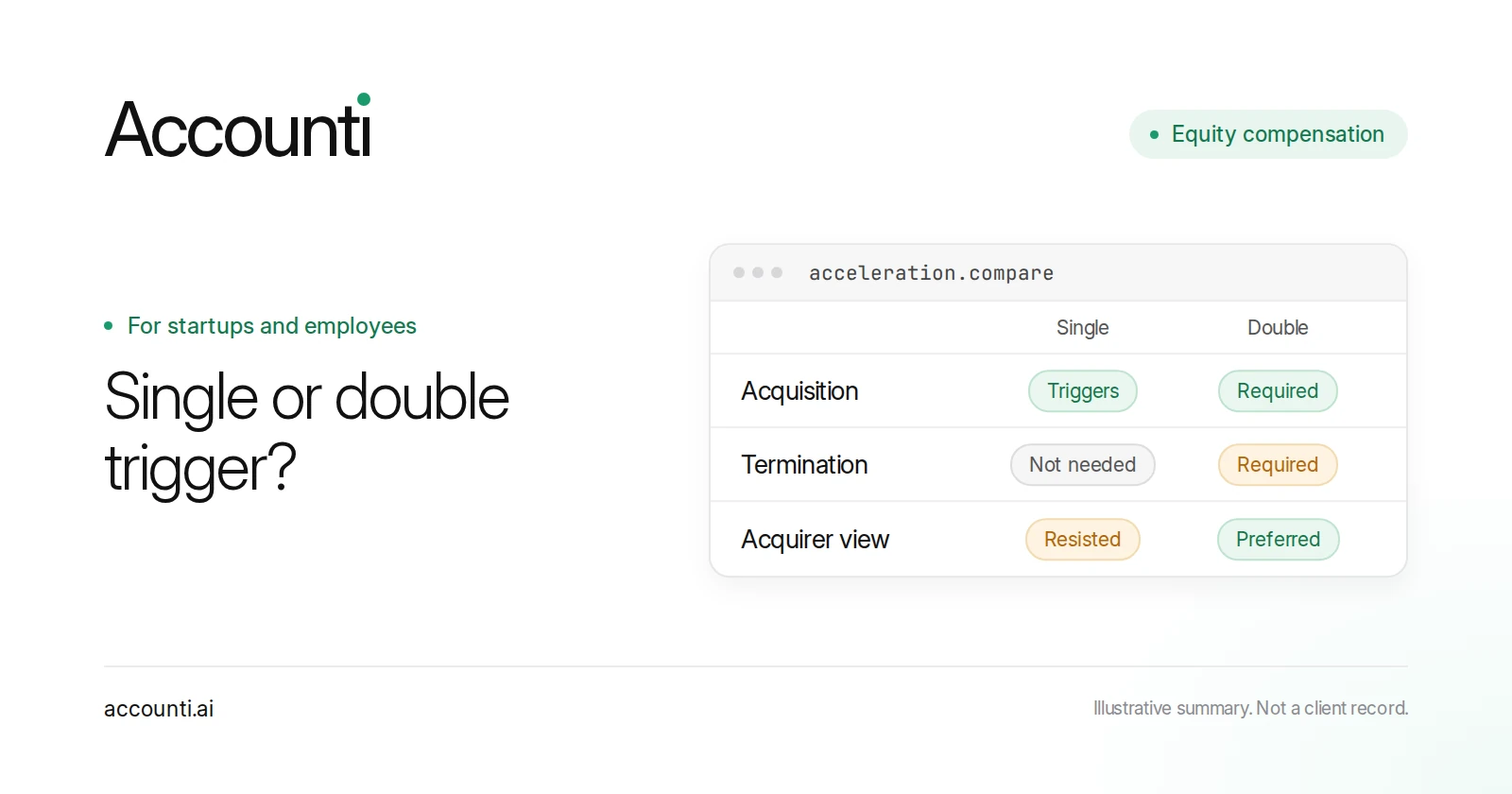
| Feature | Single Trigger | Double Trigger |
|---|---|---|
| Activation Requirements | One event (typically change in control) | Two events (change in control + termination) |
| Timing of Acceleration | Immediate upon trigger event | Delayed until second trigger occurs |
| Employee Retention Impact | Lower retention potential | Higher retention potential |
| Acquirer Preference | Less preferred | More preferred |
| Implementation Complexity | Simpler | More complex |
| Market Standard | Less common | More common |
| Cost to Acquirer | Higher immediate cost | More distributed cost |
| Employee Protection Level | Stronger immediate protection | Balanced protection |

When Should a Company Use Single Trigger vs. Double Trigger Acceleration?
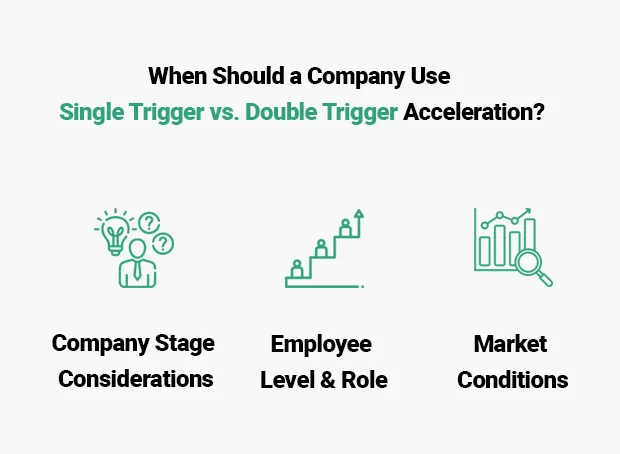
Choosing between single and double trigger acceleration depends on various factors that companies need to carefully consider:
Company Stage Considerations
Early-stage startups might lean toward single trigger acceleration to attract key talent, while more mature companies often prefer double trigger arrangements to balance employee protection with company interests.
Employee Level and Role
- C-Suite Executives: Often negotiate for single trigger or modified double trigger
- Key Technical Talent: May warrant single trigger protection
- General Employees: Typically receive standard double trigger provisions
Market Conditions
In competitive hiring markets, companies might need to offer more favorable acceleration terms to attract top talent. However, this should be balanced against future M&A considerations.
Implications for Employees and Founders
Impact on Employee Equity
Understanding trigger acceleration clauses is crucial for evaluating equity compensation packages. Employees should consider:
- Vesting schedule alignment with acceleration terms
- Definition of qualifying events
- Protection period after an acquisition
- Documentation requirements for claiming acceleration
Founder Considerations
Founders face unique challenges when structuring acceleration provisions:
- Balancing attractiveness to employees with company interests
- Considering impact on future funding rounds
- Planning for potential exit scenarios
- Maintaining consistency across equity agreements
Legal and Tax Considerations
Tax Implications
Trigger accelerations can have significant tax consequences:
- Immediate vesting may create immediate tax obligations
- Alternative minimum tax considerations
- Impact on company's tax deductions
- State-specific tax implications
Legal Framework
Proper legal documentation is crucial for both types of acceleration:
- Clear definitions of triggering events
- Specific timelines for claiming acceleration
- Dispute resolution procedures
- Compliance with securities laws
Best Practices for Implementation
To ensure smooth execution of acceleration provisions:
- Maintain detailed documentation
- Establish clear communication protocols
- Create standard operating procedures
- Regular review and updates of policies
Conclusion
The choice between single and double trigger acceleration is not one-size-fits-all. Companies must carefully weigh their specific circumstances, market conditions, and long-term objectives when structuring these provisions. While double trigger acceleration has become the market standard due to its balanced approach, there are still valid scenarios where single trigger acceleration might be appropriate.
Remember that these provisions are negotiable and should be tailored to meet both company and employee needs. The key is to structure them in a way that provides meaningful protection while aligning with business objectives and market practices.

Frequently Asked Questions
Is single trigger or double trigger acceleration better?
The choice between single-trigger and double-trigger acceleration depends on the specific goals and circumstances of a company and its employees. Single-trigger acceleration provides immediate vesting upon a single event, such as a company's acquisition, offering immediate benefits to employees. However, it may deter potential acquirers concerned about immediate equity payouts. Double-trigger acceleration requires two events, typically an acquisition followed by an employee's involuntary termination, balancing employee protection with acquirer interests by ensuring key personnel remain post-acquisition. This balance often makes double-trigger acceleration the preferred choice in startup equity arrangements.
What is the difference between single trigger and double trigger RSU?
Single-trigger RSUs vest upon the occurrence of a single event, commonly a time-based milestone, allowing employees to receive shares without an exit event. In contrast, double-trigger RSUs require two conditions for vesting: a time-based schedule and a liquidity event, such as an IPO or acquisition. This structure ensures that employees gain full ownership only when the company undergoes a significant financial event, aligning employee rewards with company performance.
What are the benefits of double trigger?
Double-trigger acceleration offers several advantages:
- Employee Protection: Ensures employees receive their equity if terminated without cause after a change in control, providing job security during transitions.
- Retention Incentive: Encourages employees to remain with the company post-acquisition, as their equity vests only upon meeting both conditions.
- Appealing to Acquirers: Reduces immediate financial obligations for acquirers, as not all equity vests upon acquisition, making the company more attractive for purchase.
This structure aligns the interests of employees and acquirers, facilitating smoother transitions during ownership changes.
How long is the typical protection period for double trigger acceleration?
The protection period for double-trigger acceleration usually ranges from 9 to 18 months following a change in control. This timeframe allows employees to secure their positions and equity rights during the transitional phase after an acquisition.
Can a company have both single and double trigger acceleration provisions?
Yes, a company can incorporate both single and double-trigger acceleration provisions in its equity agreements. This hybrid approach allows for flexibility in addressing various scenarios, such as immediate vesting upon certain events (single-trigger) and conditional vesting requiring multiple events (double-trigger). Implementing both provisions can be tailored to meet the specific needs and goals of the company and its employees.
Frequently asked questions
Which is more common, single or double trigger?
Double trigger, especially for employees. Acquirers often resist single trigger because it removes the reason to stay.
What counts as good reason under double-trigger acceleration?
Usually a material pay cut, a significant reduction in role or a forced relocation, as defined in the equity agreement.
Does acceleration apply to all unvested shares?
Not always. An agreement may accelerate all unvested equity or only part of it, such as 25% or 50%.
Can acceleration terms affect the sale of a company?
Yes. Broad single-trigger terms can lower what an acquirer will pay, because it has to fund new retention packages.
Written by
Co-founder and CEO
Rohit Kapoor is a senior finance professional with over 20 years of experience across financial planning, management reporting, financial controlling, cost management, and finance transformation. He brings extensive experience in working with global business teams and cross-functional stakeholders to strengthen financial processes, improve operational efficiency, and establish scalable finance frameworks. Rohit’s expertise lies in simplifying complex processes, building sustainable finance operations, and developing high-performing teams. Combining strategic leadership with a hands-on approach, he focuses on aligning finance functions with business objectives and enabling better decision-making through robust financial controls, effective reporting, and process improvement.