AI Bookkeeping Tools vs a Finance Operations Partner: What to Choose for Early-Stage Startups

Quick Answer:
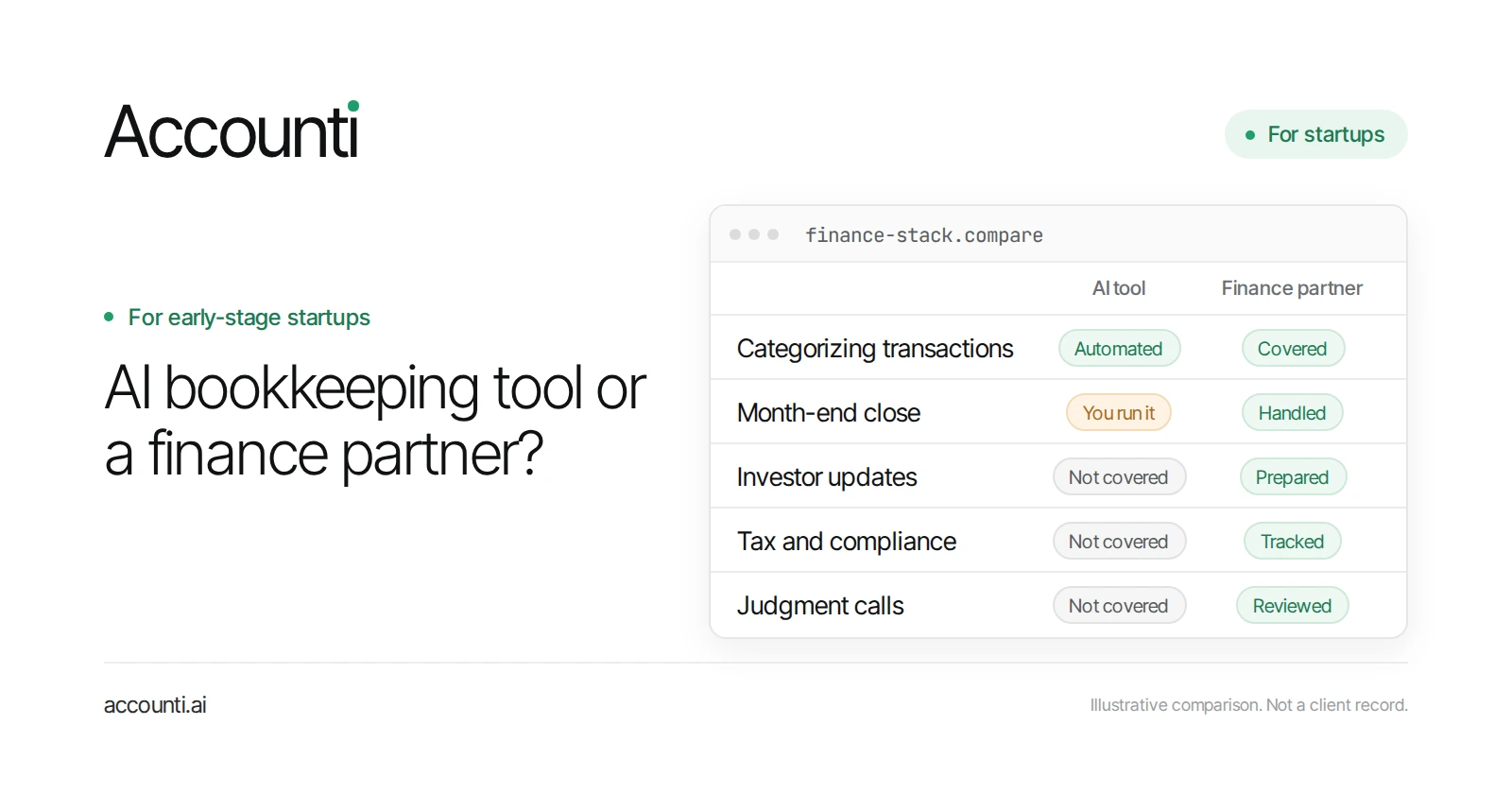
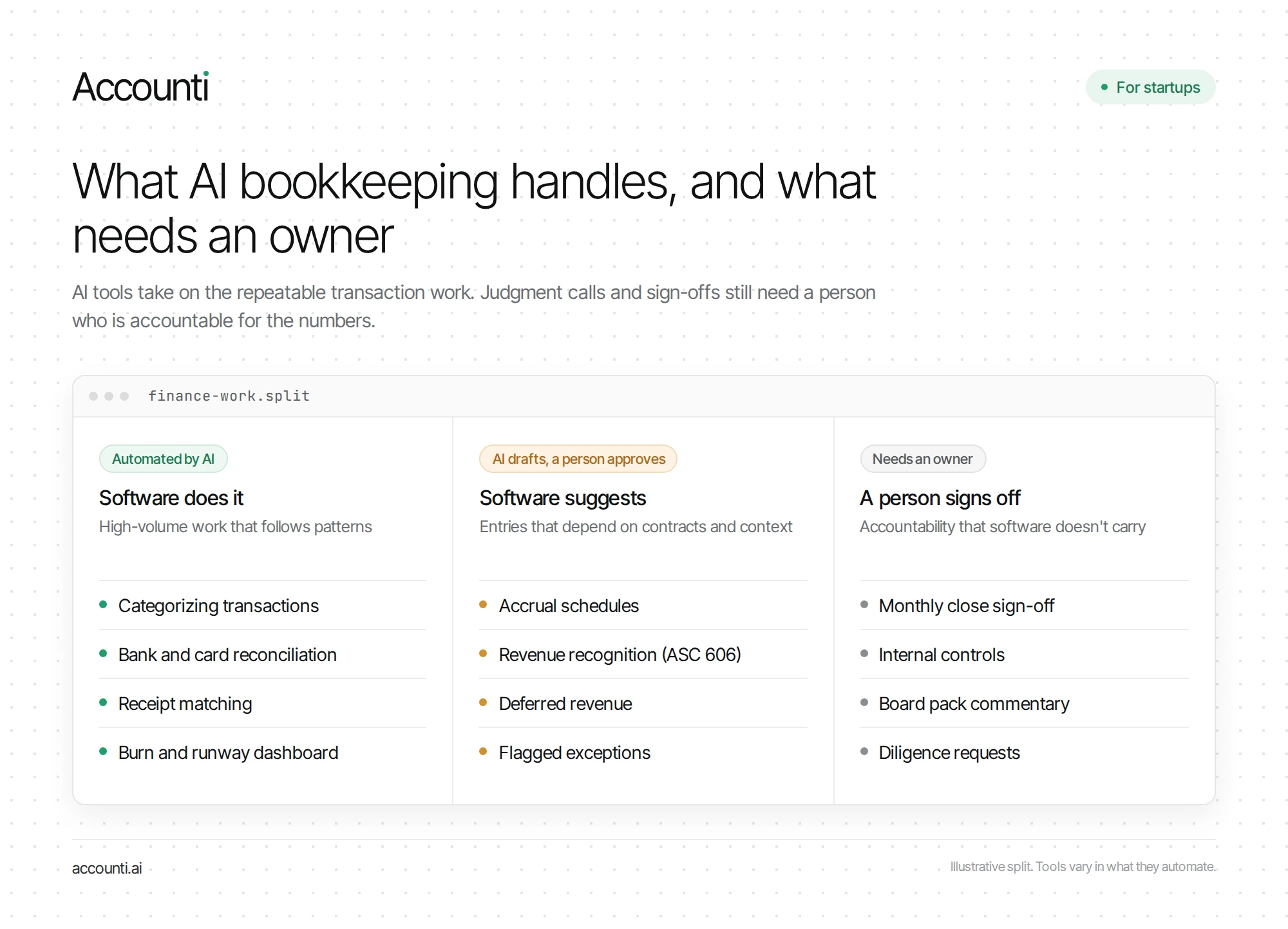
AI bookkeeping tools are good at transaction work, such as sorting expenses into categories, matching bank and card feeds, and keeping burn and runway current. A finance operations partner owns the work software can't sign off on: the monthly close, revenue rules, controls and the reporting investors check. Simple books at the seed stage can run on AI with a monthly human review. Annual contracts, a fundraise within the next year or a second entity usually mean your finances need an owner.
Somewhere between $1M in revenue and a Series A conversation, the books stop being a back-office chore and start being a document investors read closely. That is usually when founders ask whether AI bookkeeping for startups is enough, or whether they need a team that runs finance operations for them.
Finance terms used in this guide
| Term | What it means |
|---|---|
| Close | The monthly process of checking, adjusting and locking the books so the numbers stop changing |
| Reconciliation | Matching your ledger to bank, card and payment processor statements |
| Accrual | Recording revenue or expenses when they are earned or incurred, not when cash moves |
| Deferred revenue | Cash a customer paid upfront for service you haven't delivered yet |
| ASC 606 | The US accounting standard that sets when and how a company records revenue from customer contracts |
| Data room | The folder of financials and documents investors review during due diligence |
What do AI bookkeeping tools do well?
AI bookkeeping tools are strongest at high-volume, repeatable work. They categorize transactions, reconcile bank and card feeds, and keep a live dashboard of burn (how much cash you spend each month) and runway (how many months that cash will last). For a startup with a handful of revenue streams and few exceptions, that covers most of the monthly bookkeeping workload. Finvisor's comparison describes AI bookkeeping as effective for simple, repeatable transactions where the goal is keeping books current.
How Digits and Zeni approach it
Digits accounting is built around an AI-native general ledger, the core record of every transaction a company makes. When it launched, the company said its system auto-books over 93% of inbound transactions to a business-specific chart of accounts. Its 2026 announcements put that figure at 95% or more. Both numbers come from Digits itself, so read them as the best case for clean, simple books rather than a promise for yours.
Zeni accounting takes a different route by pairing AI with people. Its plans include a dedicated finance team, with Starter from $549 a month and Growth from $799 a month on monthly billing, and lower rates on annual plans. Tax filings and payroll support are priced as add-ons. Zeni also syncs with QuickBooks Online Plus and will move your data there if you use something else.
The two vendors are at different points on the spectrum between software and service. Digits is a ledger your team or your accountant runs. Zeni bundles the software with people who do the bookkeeping for you.
What this means for founders: When your transactions are mostly card spend, SaaS subscriptions and a single payment processor, either option can keep the books clean at a modest cost. AI-only is a reasonable choice at this stage, as long as someone reviews the output each month.
Where do they stop?
AI bookkeeping tools stop where the answer depends on context rather than pattern. Software can see that a charge looks like last month's charge. It has no way to know that your new annual contract changes how revenue should be recorded, or that a founder paid for a laptop personally and it belongs on the balance sheet.
Judgment and exceptions
Pattern-matching errors tend to repeat. MATAX describes a case where a $400 monthly subscription was misclassified for a full year because nothing in the workflow prompted a correction. The same source points to startups near $1M in revenue with annual contracts, usage-based pricing, multiple currencies or international payroll as the point where AI alone starts to struggle.
Revenue recognition under ASC 606 is the clearest example. Say a customer pays $24,000 upfront for a 12-month contract. The cash arrives in January, but only $2,000 counts as revenue each month, and the rest is held on the balance sheet as deferred revenue. Tools are getting better at this, and Digits now drafts accrual schedules for an accountant to approve. Even then, a person still has to decide the treatment and confirm it, and a dashboard built on rules nobody checked can look confident while being wrong.
Close discipline and review
A tool can post entries every day. It cannot own a close calendar, chase a missing invoice from your ops lead, or confirm that the month is final. Finative argues that automation errors build up quietly and surface during audits or diligence, which is the most expensive time to find them. Month-end review, internal controls and accrual entries are where a qualified person adds accountability that software doesn't carry.
Investor and diligence scrutiny
Investors ask where a number came from. A gross margin figure that can't be traced back through the ledger to invoices and receipts loses credibility fast. MATAX makes the same point: investors expect a clear path from each reported number to its source. Board decks also need commentary, such as why burn rose in a given month or how a pricing change will affect next quarter. That explanation comes from someone who understands both the numbers and the business.
What this means for founders: AI keeps your books up to date, but up-to-date numbers can still be wrong. Revenue treatment, the close and investor questions all need someone who is accountable for the answer.
When does a startup need a finance operations partner?
A startup needs a finance operations partner when the cost of a wrong or late number is higher than the cost of having someone responsible for it. In practice, that moment usually arrives with a fundraise, a diligence request, a second entity or a board that expects reporting on a fixed schedule.
Signals worth acting on
A few patterns show up again and again before founders make the switch:
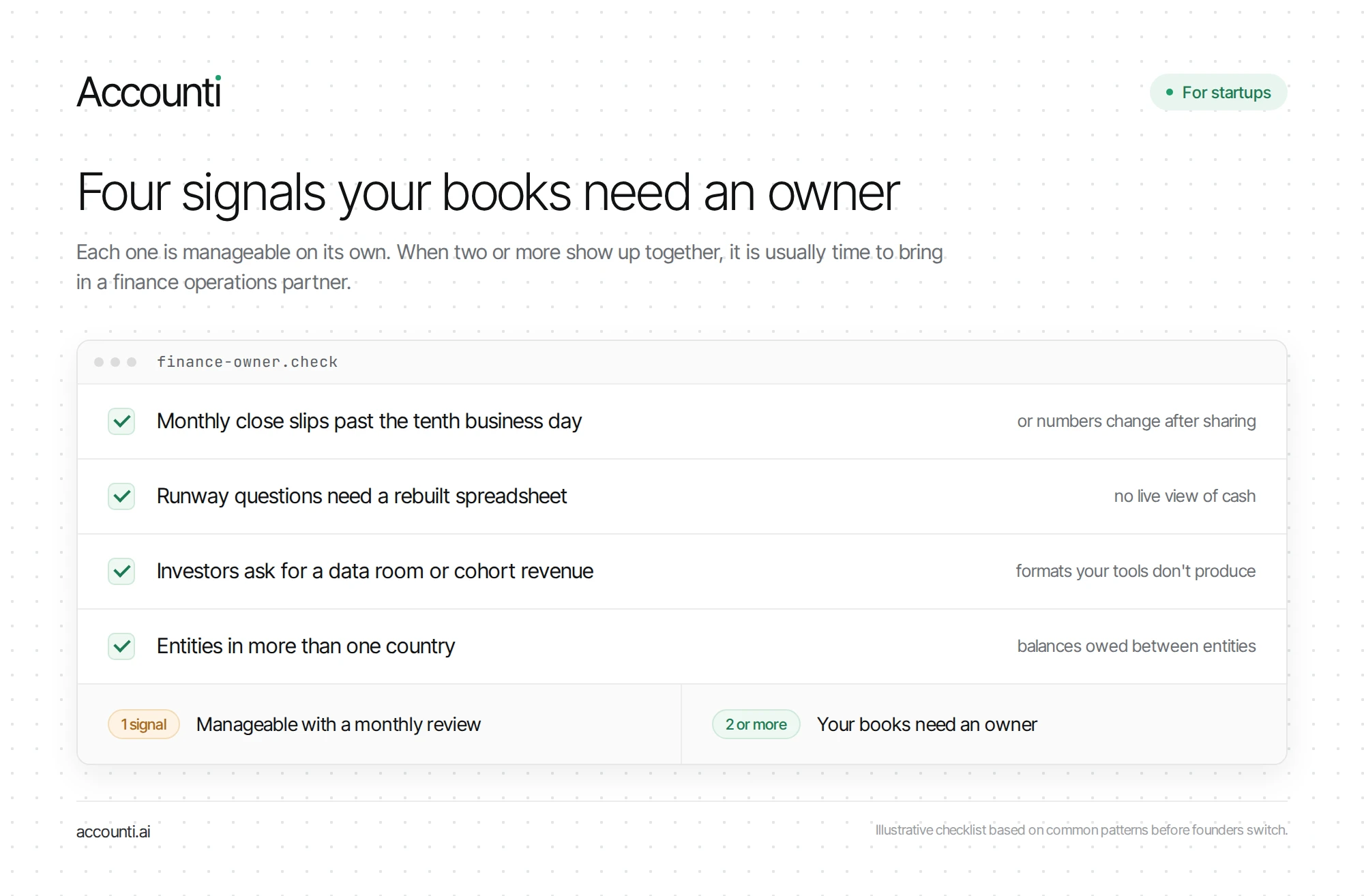
- Monthly closes slip past the tenth business day, or a number changes after you've shared it.
- Answering a runway or cash flow question means asking someone to rebuild a spreadsheet.
- Investors ask for a data room, revenue by customer cohort, or monthly financials in a format your tools don't produce.
- You operate entities in more than one country, with balances owed between them and different filing calendars.
Any one of these can be managed on its own. Two or more at the same time usually mean the books need an owner.
What a finance operations partner adds
A finance operations partner runs the process around the ledger. That includes the close calendar, reconciliations, controls, reporting packs and conversations with auditors and investors. Accounti offers Finance Operations for US startups from seed to Series B, built so the numbers hold up when an investor or auditor checks them. The ledger can still run on whichever software you prefer, because the reporting standard investors apply doesn't depend on the tool that produced the books.
Cross-border structures are where this matters most. A US startup with an Indian subsidiary, or with foreign investors buying shares in an Indian entity, has to handle registrations, filings and demat account requirements for foreign investors. No bookkeeping tool handles that on its own.
Using both together
Many teams keep an AI ledger for daily transaction work and add a partner for review, close ownership and reporting. MATAX recommends this hybrid, with AI handling categorization and people handling revenue recognition, accruals and board commentary. For founders, the hybrid often costs less than an in-house finance hire and keeps the speed of automated bookkeeping.
Choosing the best bookkeeping services for startups
The right choice among bookkeeping services for startups depends on your stage, so match the service to the problem you have today.
| Your situation | AI-only tool | AI plus human team | Finance operations partner |
|---|---|---|---|
| Pre-revenue, simple spending | Good fit | Works, at a higher cost | Not needed yet |
| About $1M revenue, one entity, simple contracts | Works with a monthly review | Good fit | Optional |
| Annual or usage-based contracts, several currencies | Gaps in revenue treatment | Works if reviewers are senior | Strong fit |
| Series A diligence or board reporting | Not enough on its own | Depends on depth of review | Strong fit |
| Entities in more than one country | Rarely built for it | Limited, so check reviewer experience | Strong fit |
Here is how that plays out. Take a startup with $1.2M in annual revenue, a mix of monthly and annual contracts, and a seed investor asking for quarterly board packs. AI bookkeeping will keep expense coding current, while the deferred revenue schedule, the close sign-off and the board commentary still need an owner, and a partner fills that gap.
On cost, AI-only tools and AI plus team bundles publish prices starting from a few hundred dollars a month, as the Zeni figures above show. A finance operations partner is usually scoped to the company and quoted per engagement. When you compare providers, ask four questions:
- Who reviews and signs off the monthly close?
- Who sets the revenue recognition rules, and are they written down?
- How many business days after month-end do you get final financials?
- Can they prepare a data room and answer diligence requests?
For a broader look at providers by stage, see Accounti's guide to accounting services for startups.
Deciding with the next year in view
Choose AI bookkeeping for startups when your finances are simple and you're comfortable reviewing the output yourself each month. Choose a finance operations partner when a fundraise, an audit or a cross-border structure is less than a year away. Either way, set up the process before the pressure arrives, because cleaning up a year of unreviewed books during diligence costs far more than getting it right early.
Want to know whether your books would hold up in diligence? Talk to Accounti about getting your finance investor-ready before your next raise.
Frequently asked questions
Is AI bookkeeping enough for an early-stage startup?
It can be, when transactions are simple and repeatable, you have one entity, and someone reviews the output each month. Once you have annual or usage-based contracts, several currencies or a fundraise ahead, AI alone usually leaves gaps in revenue recognition, close review and investor reporting.
How much does AI bookkeeping for startups cost?
Published pricing varies by vendor and changes often. Zeni lists Starter from $549 a month and Growth from $799 a month on monthly billing, with lower rates on annual plans and tax and payroll as add-ons. Check each vendor's current pricing page before you decide.
What is the difference between Digits and Zeni?
Digits is an AI-native general ledger that automates categorization, reconciliation and reporting in software your team or accountant runs. Zeni pairs AI bookkeeping with a dedicated finance team and optional fractional CFO services, and it works with QuickBooks Online Plus.
When should a startup hire a finance operations partner?
Consider one when closes run late, numbers change after you share them, investors ask for diligence-ready reporting, or you operate entities in more than one country. A partner owns the close, controls and reporting, while AI tools mainly handle transaction coding.
Written by
Co-founder and CEO
Rohit Kapoor is a senior finance professional with over 20 years of experience across financial planning, management reporting, financial controlling, cost management, and finance transformation. He brings extensive experience in working with global business teams and cross-functional stakeholders to strengthen financial processes, improve operational efficiency, and establish scalable finance frameworks. Rohit’s expertise lies in simplifying complex processes, building sustainable finance operations, and developing high-performing teams. Combining strategic leadership with a hands-on approach, he focuses on aligning finance functions with business objectives and enabling better decision-making through robust financial controls, effective reporting, and process improvement.