Startup Bookkeeping vs Finance Operations: What Changes After $1M in Revenue

Quick Answer:
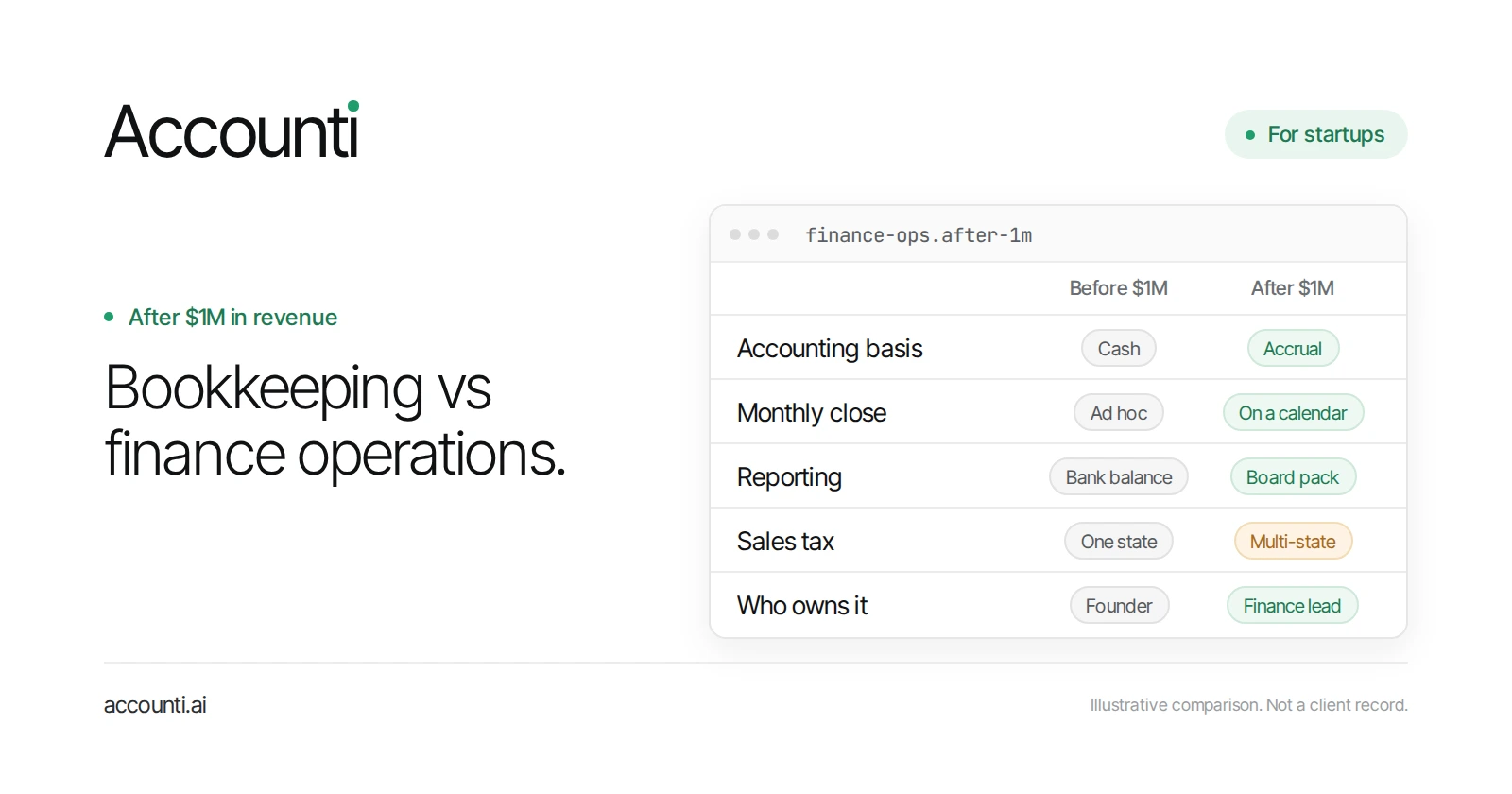
Startup bookkeeping records what happened, such as transactions, reconciliations and a monthly profit and loss statement. Finance operations makes those records timely, checked and useful for decisions, with a close that finishes on a fixed date, revenue recorded under the right rules, a forward view of cash and reporting investors can trust. Bookkeeping alone usually works until about $1M to $2M in revenue. Late closes, revenue that doesn't match your payment processor, or an investor asking for accrual statements are the signs to add a finance operations layer.
Somewhere around $1M in revenue, the books stop being a back-office chore and start being a document that investors and lenders read closely. The number is a rough marker rather than a switch. Timing shifts with funding, hiring speed and cross-border sales, so some companies feel the strain well before $1M and others well after it.
Finance terms used in this guide
| Term | What it means |
|---|---|
| P&L | Profit and loss statement, showing revenue, costs and profit for a period |
| Close | The monthly process of checking, adjusting and locking the books so the numbers stop changing |
| Cash basis | Recording revenue and expenses when money moves |
| Accrual basis | Recording revenue when it is earned and expenses when they are incurred, whatever the payment date |
| Deferred revenue | Cash a customer paid upfront for service you haven't delivered yet |
| Controller | The person who owns the close, accruals and accuracy of the books |
| Fractional CFO | A part-time finance leader who handles forecasting, fundraising and planning |
What does startup bookkeeping cover?
Startup bookkeeping covers the recording side of finance. That means logging and categorizing transactions, reconciling bank and card accounts, and tracking invoices you send and bills you owe. The output is a monthly P&L and balance sheet, plus a clean set of records so your CPA can file taxes without a scramble in March.
In the early stages, startup bookkeeping is usually enough. Revenue comes from one or two sources, spending runs through a handful of cards, and cash-basis books are often acceptable. A founder can read the P&L and understand it. A bookkeeper's job is to keep a clean record of past activity, and for a young company that record is the right deliverable.
Good bookkeeping also matters later. Consistent categories, a sensible chart of accounts and timely reconciliations are what every later layer of finance depends on, and a company that skips them pays for it during its first diligence review.
The role has a natural limit, because a bookkeeper records transactions but rarely reviews them. Nobody owns the close calendar or checks whether a Stripe payout matches booked revenue, and nobody turns the numbers into a forecast. Rubric Financial notes that bookkeeping often carries a startup to roughly $1M to $2M in revenue when operations stay simple. Past that range, the gaps start costing money.
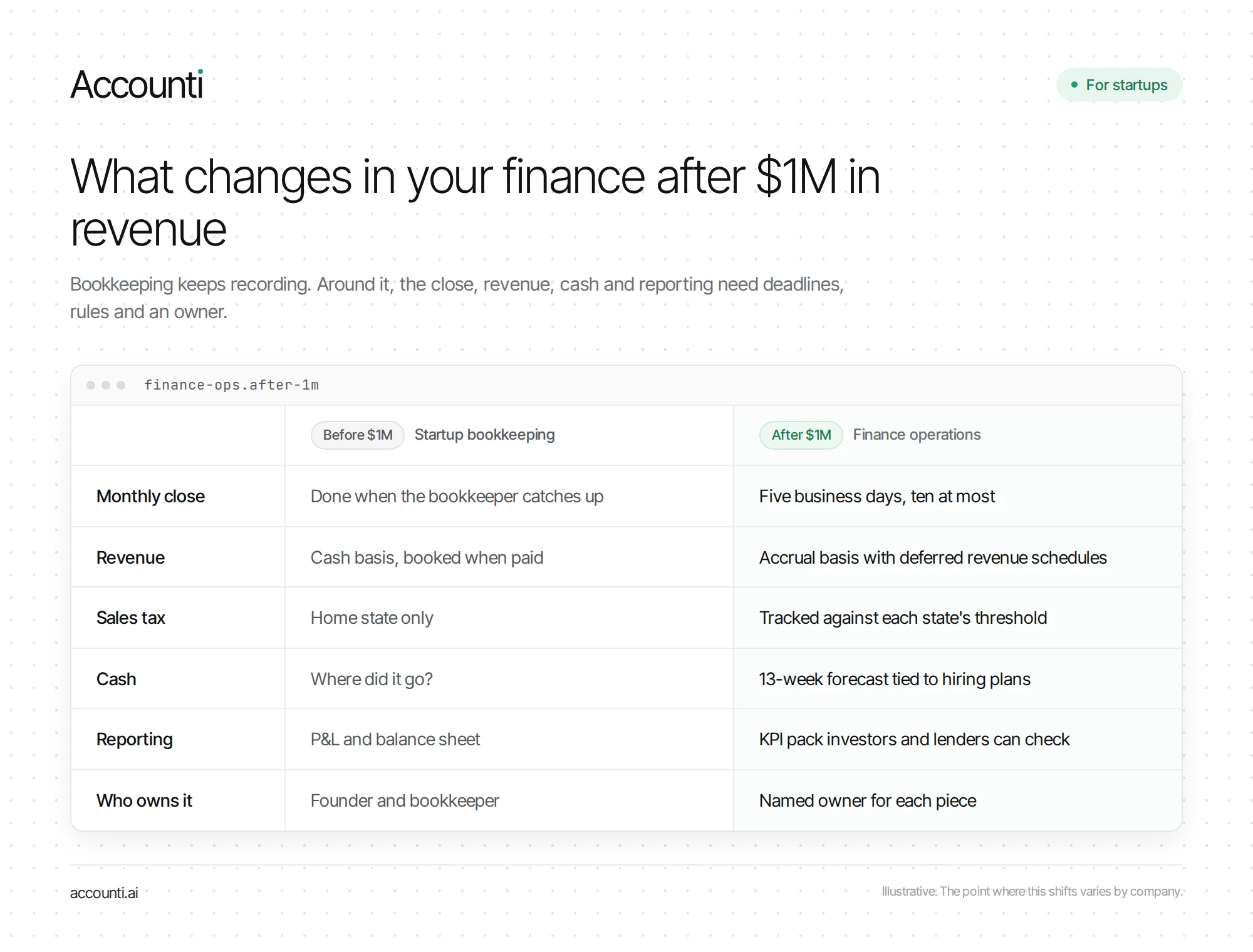
What changes as revenue passes $1M?
The close, revenue tracking, cash planning and outside scrutiny all change around this point, and they tend to change together. Founders often notice only when something breaks, such as a late board report or a sales tax notice.
The close needs a deadline
Under $1M, a close that finishes whenever the bookkeeper catches up is tolerable. Beyond it, leadership wants numbers within a week or two of month-end. CurrentCFO suggests a five-day close as a practical target for companies at this stage, with ten business days as a reasonable outer limit while the process matures. A typical rhythm collects documents in the first days, reconciles bank, Stripe and payroll next, then reviews unusual changes against last month before reporting goes out.
Revenue and tax get more complicated
Annual contracts and usage billing mean cash received no longer equals revenue earned. Say a customer signs a $36,000 annual contract in December and pays upfront. Cash-basis books show $36,000 of December revenue. Accrual books show $3,000 a month for twelve months, with the rest recorded as deferred revenue. Investors and lenders expect the second view, and a bookkeeper working transaction by transaction isn't set up to build and review those schedules.
Sales tax adds another layer. Since the 2018 Wayfair decision, US states can require out-of-state sellers to collect sales tax even without a physical presence there, once sales cross a threshold called economic nexus. Thresholds vary by state, with $100,000 in sales or 200 transactions common as of 2022, while larger states such as California, New York and Texas set $500,000. Several states have since dropped the transaction count, so check current rules before relying on any figure. A startup selling nationally can cross several of these lines without anyone tracking it.
Cash needs a forward view
Bookkeeping tells you where cash went, and finance operations tells you where it will be in thirteen weeks. That takes budget-versus-actual reporting, a cash forecast tied to hiring plans and a regular review of software subscriptions nobody approved. Strong sales with tight cash is a common symptom of a company that has outgrown its reporting. Payroll adds pressure too, because contractors, benefits and multiple pay cycles make labor costs hard to analyze without a structured review.
Investors read the books differently
Early investors may accept rough management accounts, but a Series A round or a credit line usually brings diligence. Reviewers ask for accrual-basis statements and reconciled balances, along with KPI definitions that hold up to questions. Companies with entities in more than one country also need records of money moving between those entities. Reporting that is audit-ready from the start shortens that process.
What this means for founders: Crossing $1M doesn't make your bookkeeper less useful. It means more of your numbers now need a second person to review them, a deadline and a forward view.
The table below shows how three layers of finance divide the work once a startup outgrows bookkeeping alone.
| Bookkeeping | Controller layer | Fractional CFO | |
|---|---|---|---|
| Main question | What happened? | Are the numbers right and on time? | What should we do next? |
| Typical output | Monthly P&L and balance sheet | Close calendar, accruals, controls | Forecast, budget, investor materials |
| Time focus | Past | Past, checked | Future |
| Usual trigger | Company formation | Late or unreliable closes | A raise, pricing or hiring decisions |
When does a company need finance operations?
A company needs finance operations when its numbers must be reliable on a schedule and used for decisions, and bookkeeping alone can't deliver both. A simple test is whether leadership waits for numbers or argues about them.
Nexacc groups the warning signs into revenue complexity, financing events and decision pressure, and suggests that two of those together mean bookkeeping alone is no longer enough. These symptoms make it concrete:
- The month-end close slips past mid-month, or the P&L changes after someone reviews it.
- Stripe or payment processor totals don't match recognized revenue.
- A founder spends ten or more hours a week on finance tasks instead of running the business.
- A lender or investor asks for accrual statements or a cash forecast you can't produce quickly.
- A second entity, a new state or a foreign subsidiary has appeared without a matching change in process.
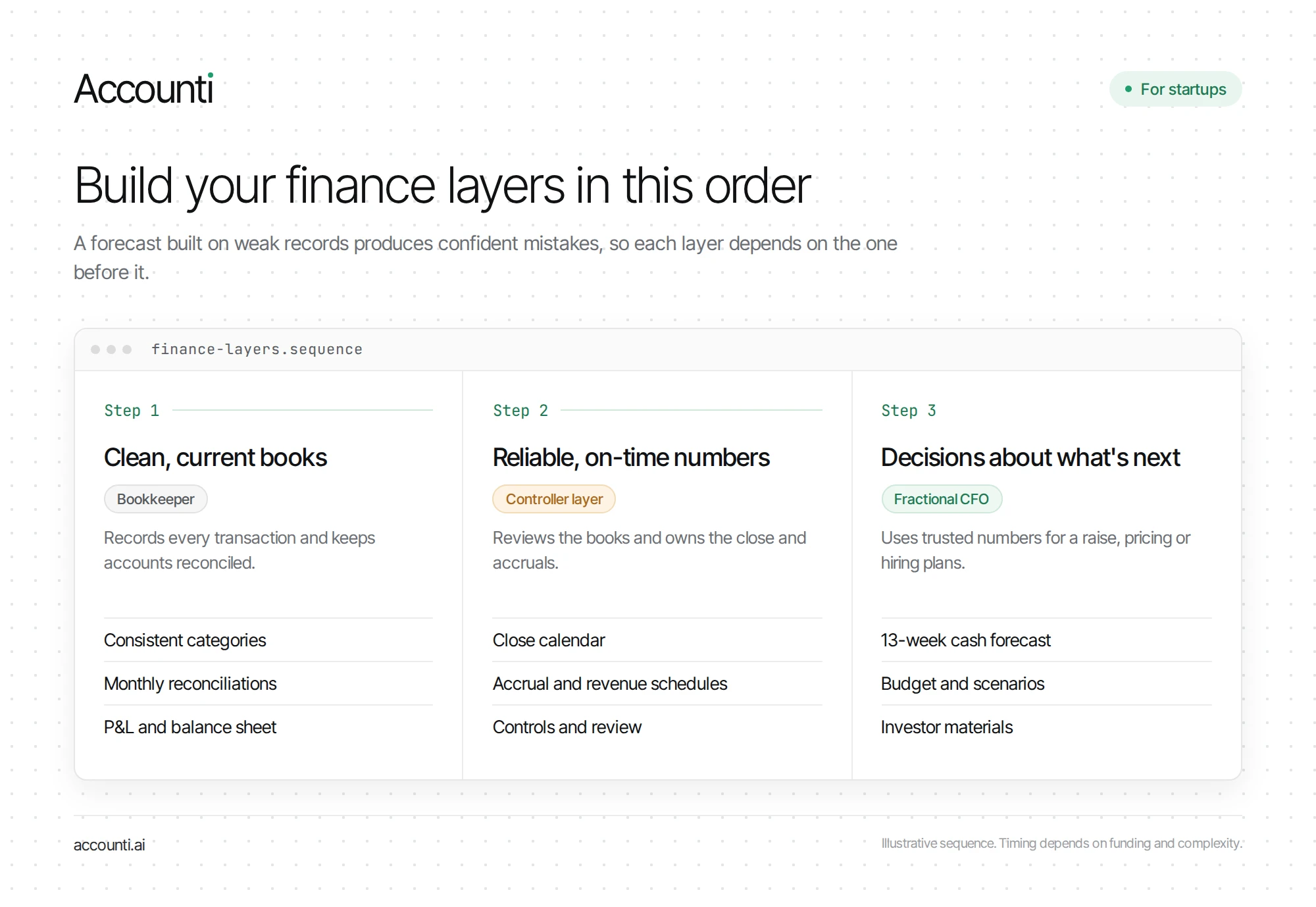
The order of the next steps matters as much as the timing. Rubric Financial argues that unreliable books should be fixed at the controller level before forecasting begins, since a forecast built on weak records produces confident mistakes. A controller owns accruals, close discipline and reporting for investors or lenders. A fractional CFO comes in for events such as a raise or a major pricing change, often for a few hours a month.
What this means for founders: A CFO hired before the books are reliable spends their time fixing records instead of planning, so get the close right before you add forecasting.
What does a finance operations setup deliver?
A working finance operations setup produces a repeatable close, reconciled accounts and reviewed revenue. It also defines how bills get paid and invoices get collected, and it adds a cash model and a monthly KPI pack. Each piece has a named owner, so the same numbers arrive on the same day every month with an explanation attached.
Nexacc's benchmark for the first 90 days is a useful check. It expects a 13-week cash model, an annual budget built on business drivers such as hiring and pricing, unit economics leadership trusts, and a reporting pack fit for lenders and investors. A provider that hasn't produced these after a quarter is giving advice without output.
Founders often worry that adding finance operations means replacing the person who already knows the books, but that rarely happens. In a typical setup the bookkeeper keeps recording transactions while a finance operations team reviews, controls and reports on that work. Accounti's Finance Operations is built this way for US startups from seed to Series B, so the numbers hold up when an investor or auditor checks them. Our guide to accounting services for startups by stage compares the wider options.
Next steps for your startup bookkeeping
Run a quick self-audit this week:
- Count how many business days your last close took.
- Check whether last month's revenue ties to your payment processor.
- Add up the hours founders spent on finance tasks last month.
- List the states and countries where you sell or have entities.
Two or more red flags mean startup bookkeeping has done its job and your finance needs a layer of review and planning above it.
Want to know whether your books would hold up in diligence? Talk to Accounti about getting your finance investor-ready before your next raise.

Frequently asked questions
When should a startup move beyond bookkeeping?
For many startups it happens somewhere between $1M and $2M in revenue, though funding, hiring pace and cross-border sales can move it earlier. Late closes, revenue that doesn't match payment processor totals, and investor requests for accrual statements are the clearest signals.
What is the difference between a bookkeeper, a controller and a fractional CFO?
A bookkeeper records transactions and keeps accounts reconciled. A controller owns the monthly close, accruals and reporting accuracy. A fractional CFO is a part-time finance leader who uses those numbers for forecasting, pricing, fundraising and other forward-looking decisions.
Do I need accrual accounting once I pass $1M?
Often, yes. Annual contracts, deferred revenue, lender requirements and investor diligence tend to call for accrual-basis statements, which record revenue when it is earned rather than when cash arrives. Your CPA should confirm the right method for your tax situation.
Can I keep my bookkeeper when I add finance operations?
Yes. A bookkeeper can keep recording transactions while a finance operations team adds review, controls, cash forecasting and reporting on top of that work.
Written by
Co-founder and COO
Harsha Baisya is a finance professional with over seven years of experience across startups and established organizations. Her expertise spans financial management, business finance, financial analysis, and building effective finance processes that support business growth. As Co-Founder and COO of Accounti, Harsha brings a practical understanding of the financial and operational challenges businesses face as they scale. Her experience includes working with finance teams to improve financial visibility, streamline processes, manage costs, and strengthen financial reporting. She focuses on helping businesses build reliable financial systems that support informed decision-making, operational efficiency, and sustainable growth.