How to Set Up Financial Planning and Analysis for a Growing Company Before a Full-Time CFO

Quick Answer
- Financial planning and analysis (FP&A) is the routine of forecasting cash, comparing actual results with the plan and turning the gap into decisions. A startup can run it well before it hires a CFO.
- Reconciled books and a fixed monthly close date come before any forecast.
- A rolling 13-week cash forecast and a small driver-based model answer the questions founders and early investors ask first.
- Each assumption needs one named owner, and that matters more than how sophisticated the model is.
- A full-time CFO starts to make sense when decisions outgrow what a part-time finance lead can review once a month.
Financial planning and analysis (FP&A) is the process of forecasting a company's cash and results, comparing them with what actually happened and using the difference to decide on hiring, spending and fundraising. A seed or Series A company can run this without a chief financial officer (CFO). What it needs is a small, repeatable system where every number has an owner.
This guide builds that system in order, from clean books to a monthly review. It ends with the signs that a full-time CFO is due.
What financial planning and analysis includes
Accounting records what happened last month. FP&A looks ahead and asks what those numbers mean for the next two quarters. Before a CFO arrives, the work produces four outputs.
| Output | What it answers | How often |
|---|---|---|
| Cash forecast | How much cash will we have each week, and when does it run out? | Weekly |
| Operating plan | What revenue, hiring and spending do we expect this year? | Built yearly, updated monthly |
| Variance report | Where did actual results differ from the plan, and why? | Monthly |
| Management summary | What decisions do the numbers call for? | Monthly |
A minimum working setup has five parts: one accounting system with reconciled bank data, one monthly close date, one rolling cash forecast, one owner for each major assumption and one recurring review that ends in decisions.
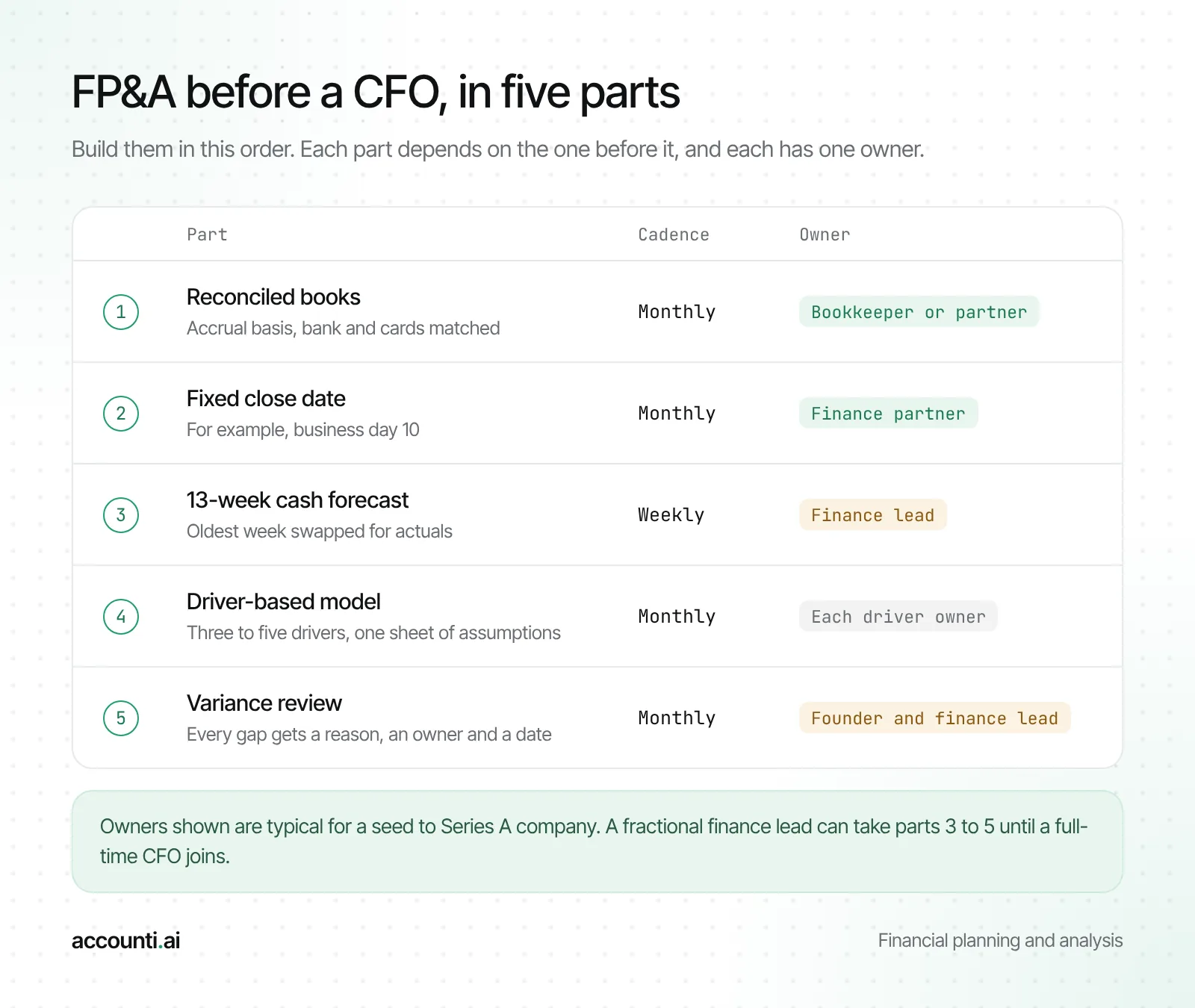
Five-part FP&A setup for a startup before a CFO, from reconciled books to a monthly variance review, with the cadence and owner of each part
How FP&A differs from bookkeeping
Bookkeeping produces accurate records of past transactions. FP&A uses those records to answer forward-looking questions, such as how long runway lasts if you add two engineers in January. Burn is the net cash a company spends each month, and runway is the number of months it can operate before that burn uses up its cash. FP&A depends on reliable bookkeeping underneath it.
Start with books you can trust
A forecast built on unreconciled data produces confident wrong answers. Get the accounting basics right first, with a closed month and a clean audit trail, then add planning on top. Outsourced or part-time support can cover this at the earliest stages.
The books are ready for planning when:
- Bank and card accounts reconcile every month.
- Payroll and contractor payments land in the right expense categories.
- Revenue is recognized on a consistent basis, in line with ASC 606, the US revenue recognition standard.
- The books use accrual accounting, which records revenue and expenses when they are earned or incurred instead of when cash moves.
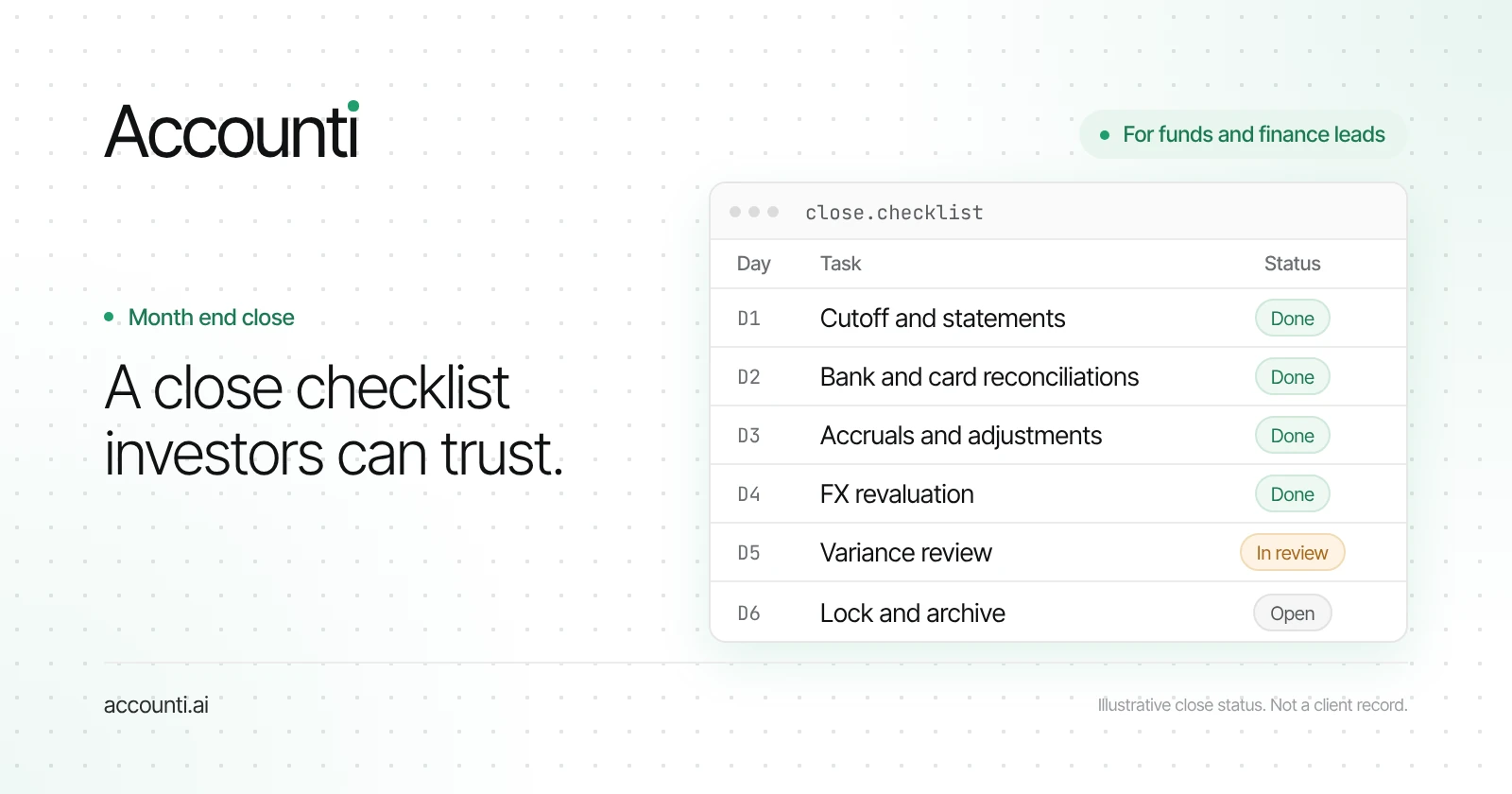
Our month end close checklist sets out the steps for a reliable close.
Clean books pay off again later, because investors ask for them during diligence. Our guide on preparing for financial due diligence before a fundraise shows how much of that work uses the same habits.
What this means for founders. Fix the books before buying a planning tool. A tool connected to messy data only produces messy forecasts faster.
Build a 13-week cash forecast
Cash comes first because running out of it is what ends a startup. A rolling 13-week cash forecast covers one quarter, week by week, and is updated every week. It tracks cash coming in from customers and cash going out for payroll, vendors, rent, software and taxes.
Build it as a spreadsheet with one column per week:
- Start with the current bank balance.
- Add expected customer receipts, invoice by invoice.
- Subtract payroll, rent, software, taxes and known one-off payments.
- Each week, replace the oldest forecast column with actual figures and add a new week at the end.
Keep the receipts line honest. Use the date a customer is likely to pay, based on their payment history, instead of the invoice due date. Late collections are a frequent reason a cash forecast misses.
Create a driver-based operating model
Once cash is visible, build a model that explains it. A driver-based model links the plan to a few inputs, called drivers, that move results the most. It usually covers revenue by product or customer segment, a headcount plan, an operating expense forecast and unit economics. Unit economics compare what it costs to win and serve one customer with what that customer brings in.
Pick three to five drivers
Choose the inputs that move the outcome most and assign each one to a person. A sample set for a software-as-a-service (SaaS) company might look like this:
| Driver | What it controls | Suggested owner |
|---|---|---|
| New customers per month | Revenue growth | Head of sales or founder |
| Net revenue retention | Recurring revenue base | Customer success lead |
| Hires and start dates | Payroll cost | COO or founder |
| Gross margin | Cost of delivery | Operations lead |
| Collection days | Cash timing | Finance lead or bookkeeper |
Net revenue retention measures how much recurring revenue a company keeps from existing customers after upgrades, downgrades and cancellations. Collection days is the average number of days customers take to pay an invoice.
Keep the model small
A model with forty tabs will not get updated. For a company at this stage, three parts are enough: one sheet of assumptions, one sheet with the monthly profit and loss statement (P&L), balance sheet and cash flow statement, and one summary page. Build it on the accrual basis so revenue and expenses line up across the three statements.
Set a monthly close and review rhythm
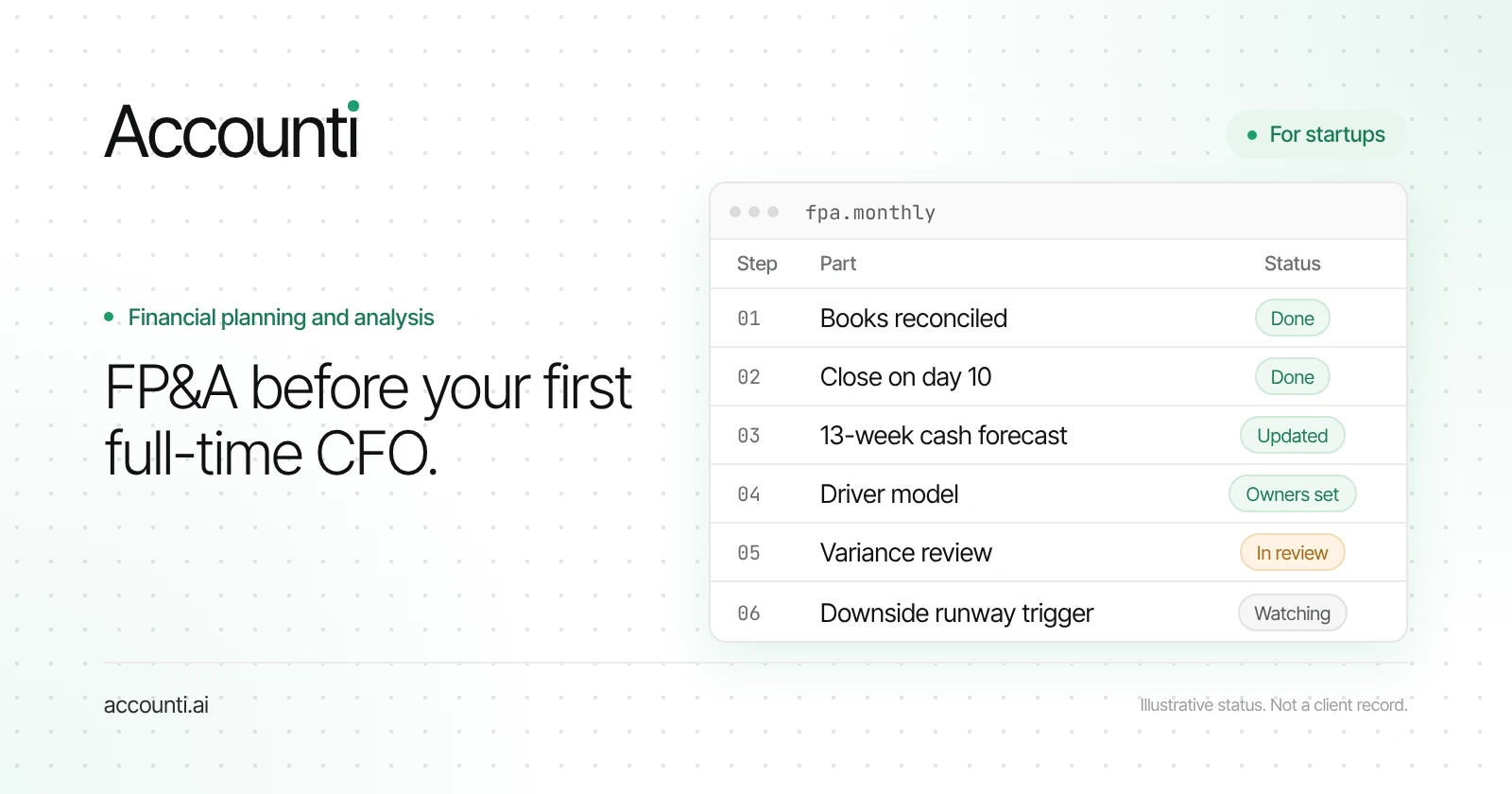
A forecast only helps when someone reviews it on a schedule. Pick a close deadline, such as the tenth business day of the month, and hold a review meeting a few days after it. A simple monthly cycle looks like this:
| Step | What happens | Typical owner |
|---|---|---|
| 1 | Reconcile bank and payment accounts | Bookkeeper or finance partner |
| 2 | Record material accruals | Bookkeeper or finance partner |
| 3 | Review revenue drivers | Head of sales or founder |
| 4 | Update headcount assumptions | COO or founder |
| 5 | Refresh the 13-week cash forecast | Finance lead |
| 6 | Compare actual results with the plan | Finance lead |
| 7 | Send a short management pack | Finance lead |
The variance review is where the value comes from. For every line that is off by a meaningful amount, record the reason, the person who owns the fix and the date it is due. A variance with no owner or date rarely gets fixed.
Run scenarios and set decision thresholds
Build three versions of the plan: a base case, a downside case and an upside case. The downside case should change the assumptions you worry about most, such as slower collections or a delayed sales hire.
Then agree on actions in advance. One example is pausing a planned hire whenever runway in the downside case drops below six months. The right threshold depends on the company, and setting it while things are calm keeps the team from arguing about it during a cash squeeze.
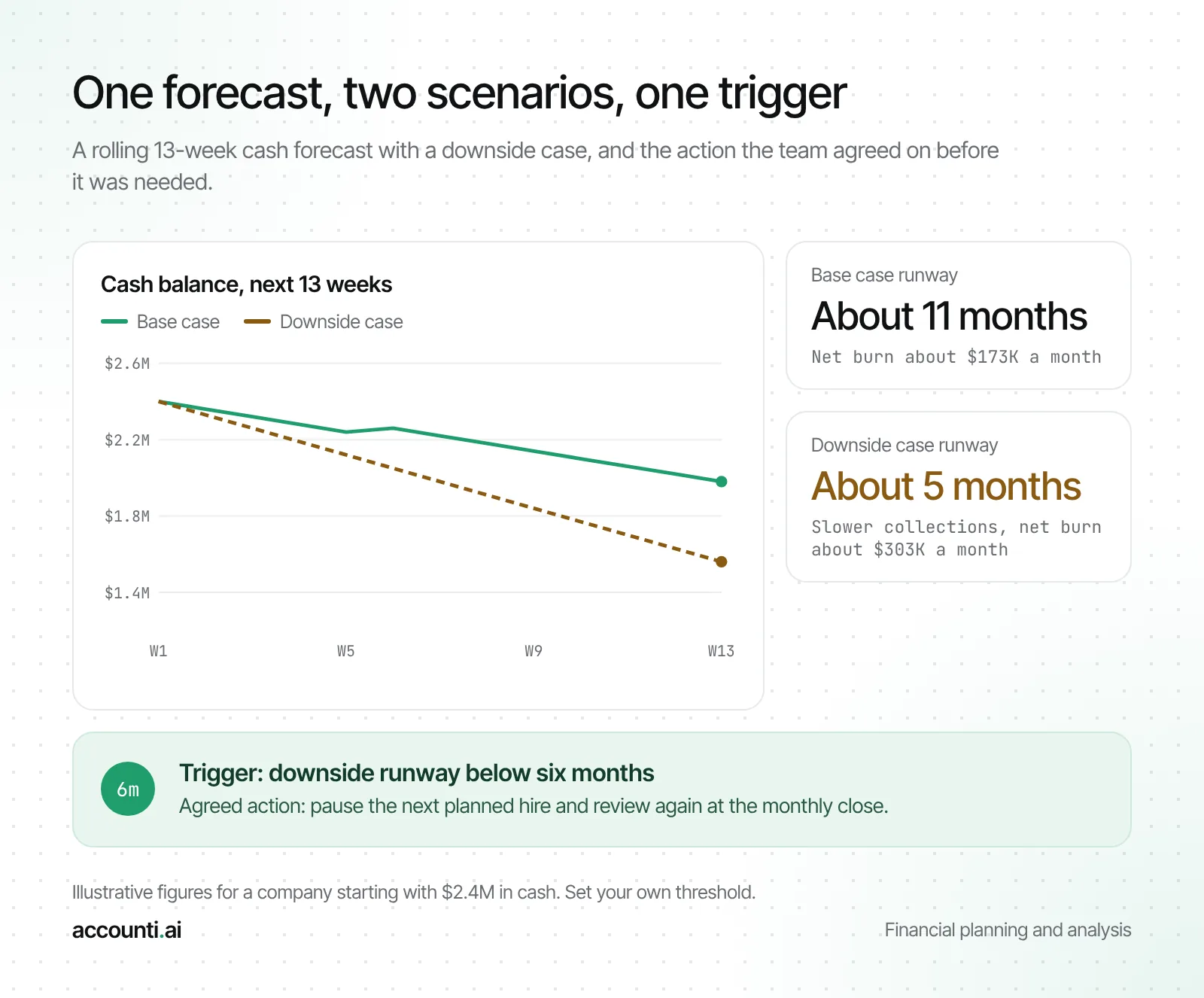
Illustrative 13-week cash forecast with base and downside cases, showing runway of about 11 and 5 months and a six-month trigger to pause hiring
What this means for founders. A pre-agreed trigger turns a hard conversation into a scheduled one. Investors also tend to trust a plan more when it shows what management will do if results slip.
Who should own the monthly process
Someone has to run the process every month. At this stage there are three realistic setups.
| Setup | Who does what | Trade-off |
|---|---|---|
| Founder or COO alone | The founder owns assumptions, the forecast and the review | Works at the earliest stage but takes time from selling and building |
| Founder with an outsourced finance partner | The partner runs reconciliation, close and reporting, and the founder owns assumptions | Reliable books and reports without a finance hire |
| Founder with a fractional finance lead | The lead adds forecasting and board materials on top of the close | Senior judgment without a full-time salary |
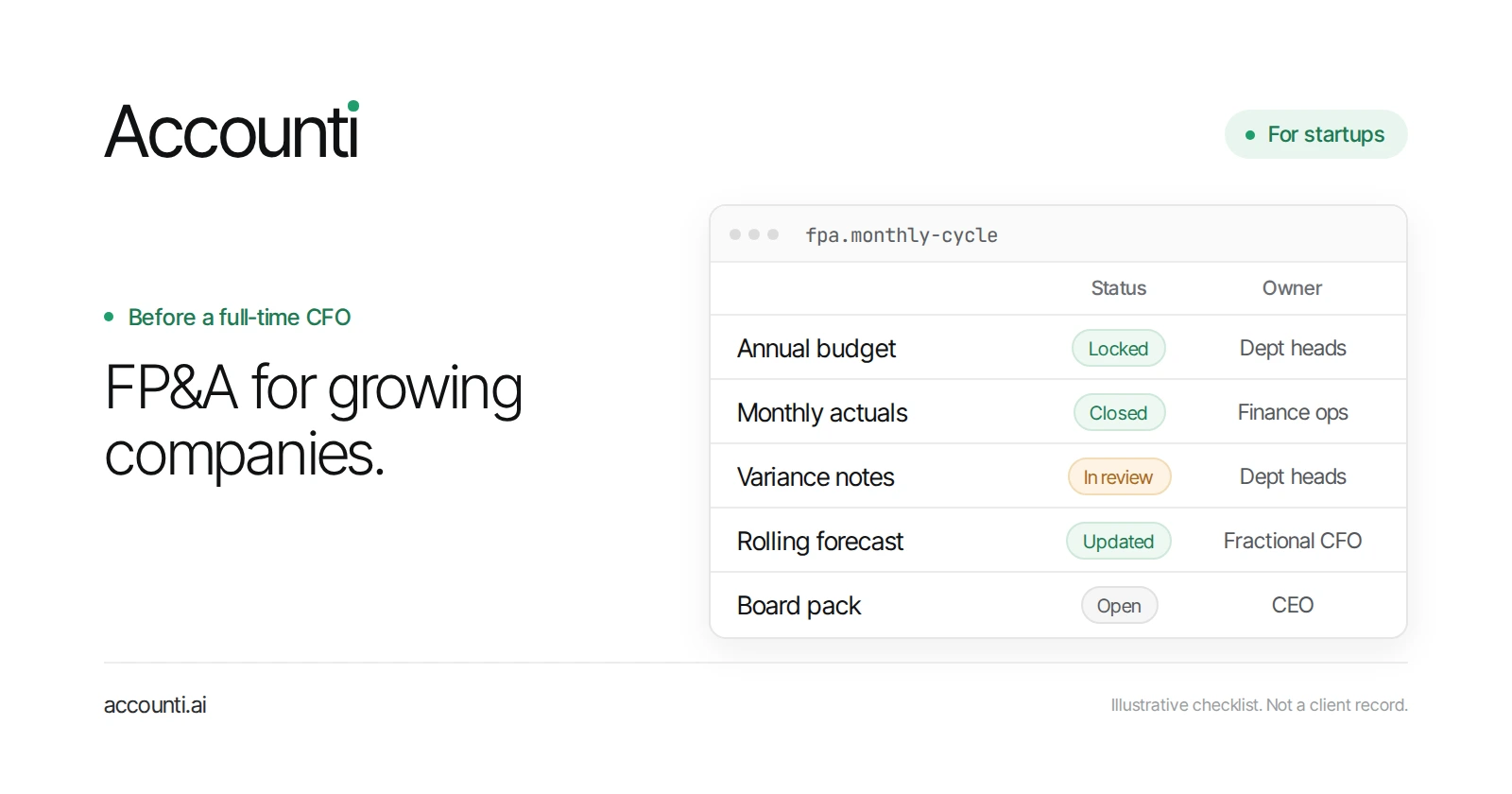
A fractional finance lead is a part-time finance executive who also works with other companies. Whichever setup you choose, the rule from earlier still applies. Each input has one named owner, and each owner has a deadline.
Accounti runs finance operations for US startups from seed to Series B, including accrual bookkeeping, reconciliations, payments and financial reporting. That gives founders a reliable close and monthly reports to plan from. A short consultation is the quickest way to see which setup fits your stage.
Know when to hire the full-time CFO
The system above buys time, and it also shows when that time is running out. Many startups formalize FP&A as a Series A approaches, because investors at that stage expect clear numbers on burn, runway and forward projections. Treat that as a guide, since complexity matters more than round size.
Signs that a full-time CFO is due:
- The company has multiple legal entities or operates in more than one currency.
- Board reporting takes more than a few days to produce.
- Debt facilities or complex equity need active management.
- Strategic decisions need a finance leader in the room every week.
A CFO who joins a company that already has a working forecast and named owners can spend the first month on strategy instead of cleanup.
Start small and keep it running
A growing company can go a long way on a small FP&A routine, as long as it runs every month. Pick the close date this week, build the first 13-week forecast next week and schedule the first variance review before the month ends.
Frequently asked questions
What is financial planning and analysis?
Financial planning and analysis (FP&A) is the process of forecasting cash and results, comparing them with actual results and using the gap to guide decisions on hiring, spending and fundraising.
Who should own FP&A without a CFO?
A founder or COO usually owns the assumptions, while a bookkeeper, outsourced finance partner or fractional finance lead handles reconciliation, close and reporting. Each input should have one named owner with a deadline.
What is a 13-week cash forecast?
It is a week-by-week forecast of cash coming in and going out over the next quarter. Each week, the oldest week is replaced with actual figures and a new week is added, which gives early warning of a cash shortfall.
What should a startup's first FP&A model include?
One sheet of assumptions built around three to five drivers, one sheet with the monthly P&L, balance sheet and cash flow statement, and one summary page. It should run on accrual accounting so the three statements line up.
When should a startup formalize FP&A?
Many startups formalize it as a Series A approaches, because investors then expect clear numbers on burn, runway and forward projections. Multiple entities, currencies or complex financing can make it necessary sooner.
Written by
Co-founder and COO
Harsha Baisya is a finance professional with over seven years of experience across startups and established organizations. Her expertise spans financial management, business finance, financial analysis, and building effective finance processes that support business growth. As Co-Founder and COO of Accounti, Harsha brings a practical understanding of the financial and operational challenges businesses face as they scale. Her experience includes working with finance teams to improve financial visibility, streamline processes, manage costs, and strengthen financial reporting. She focuses on helping businesses build reliable financial systems that support informed decision-making, operational efficiency, and sustainable growth.