The Month-End Close Checklist for Growing Companies

Quick Answers
- A month end close checklist is a dated list of tasks, owners and sign-offs that turns a month of ledger activity into financial statements a fund can rely on.
- Publish a close calendar with a hard cutoff, because one missed cutoff delays every step after it.
- Finish reconciliations, accruals and adjusting entries before the variance review, since the review only means something once the ledger is clean.
- Entities in more than one country add currency revaluation, intercompany matching and local tax filings to the close.
- A locked period with archived evidence is what investors and auditors ask for during due diligence.
A month end close checklist is the list of tasks a finance team completes to finish one accounting period and produce statements it can stand behind. For a foreign fund CFO overseeing portfolio companies in India, the UAE or the US, that checklist decides whether the numbers arriving each month can be trusted. A late or loose close leaves investors working from old data and leaves compliance teams guessing about filings.
This guide walks through each stage of the close in order. It then covers the extra steps that cross-border entities need.
What is a month end close checklist?
A month end close checklist records every step between the last transaction of the month and a locked set of financial statements. For each task, it names the owner, the due date and the evidence that proves the task is done. The month end close process commonly takes five to ten business days, depending on transaction volume and the number of entities.
Teams also choose between a soft close and a hard close.
| Soft close | Hard close | |
|---|---|---|
| Purpose | Internal management reporting | Investor, lender and audit reporting |
| Depth | Faster pass, with some estimates left in place | Every step completed and every estimate documented |
| Period status | Usually left open | Locked in the accounting system |
| Typical frequency | Monthly | Quarterly and at year end |
Growing companies often run a soft close each month and a hard close each quarter. The hard close is the version investors and auditors rely on.
The core month end close steps, in order, are:
- Set the cutoff and chase missing documents.
- Reconcile bank, card and payment processor accounts.
- Review payables and receivables.
- Record accruals and adjusting entries.
- Review variances and approve.
- Lock the period and archive the evidence.

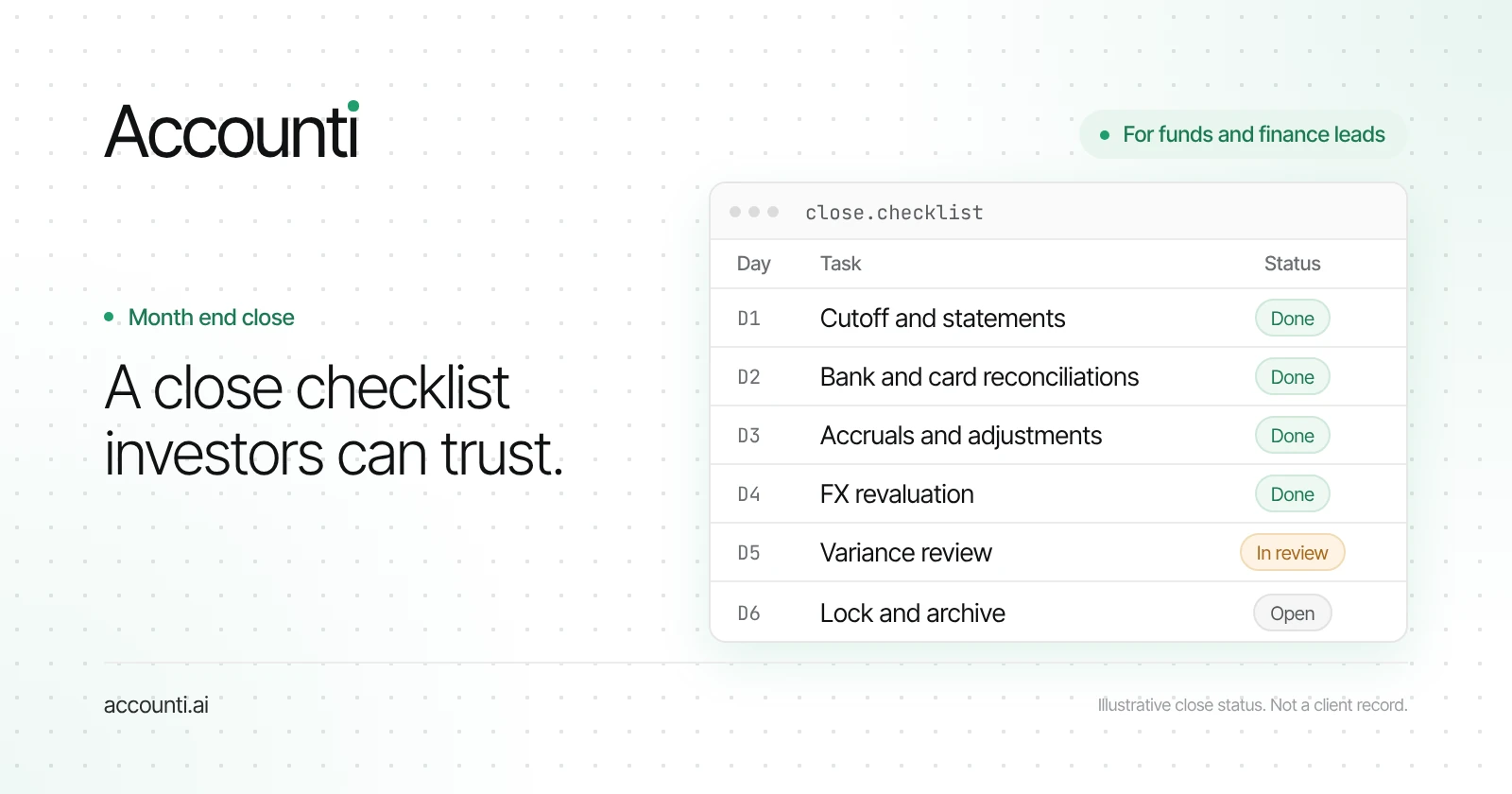
Six-day month end close timeline showing each step, its business day and its owner, from cutoff to a locked period
Set the close calendar first
A close calendar fixes the date of every close task before the month begins. Publish it once a year and adjust it for public holidays in each country where you have an entity, because a calendar built in the middle of a close tends to slip.
The calendar should show four dates: the cutoff for expense submissions, the day bank statements are due, the day journal entries freeze and the day the controller reviews. The submission cutoff comes first, since no later task can finish while new invoices and receipts are still arriving.
A compact version of the working schedule is below. AP stands for accounts payable, the money a company owes its suppliers. AR stands for accounts receivable, the money customers owe the company.
| Business day | Task | Owner |
|---|---|---|
| Day 1 | Submission cutoff, bank and card statements pulled | AP and finance operations |
| Day 2 to 3 | Reconciliations, AP and AR review | Accountant |
| Day 3 to 4 | Accruals and adjusting entries | Accountant |
| Day 5 | Variance review | Controller |
| Day 6 | Sign-off, lock and archive | CFO or head of finance |
Pre-close steps for the last week
The work that shortens a close happens before the month ends. A few days ahead, send reminders for outstanding receipts and unapproved expense reports, and confirm that recurring journal entries are scheduled. A short pre-close meeting with every task owner gives each person a chance to flag a problem while there is still time to fix it.
Also confirm that the accounting team knows about this month's payroll runs, invoices due for services already received and any large contracts signed. A surprise in the second week of close usually traces back to something finance heard about too late.
Reconcile cash, cards and bank accounts
Reconciliation means matching the balance in the ledger to an outside record, such as a bank statement. It is the first close step that should be finished in full. Every bank account, corporate card and payment processor needs a reconciled balance, with each unmatched item explained in writing.
Match each account to its statement, then clear or document every difference. Start with the largest unmatched amounts, since they carry the biggest risk of a misstatement. Reconciliations can run alongside expense approvals, so two people can work at the same time without waiting on each other.
Funds holding shares in Indian companies should add their demat holdings to this stage. A demat account holds shares in electronic form, and the holding statement from the depository participant (the bank or broker that maintains the account) should match the fund's investment records. Accounti's India Demat Pro service opens and manages these accounts for foreign investors. A mismatch caught at this stage stays out of investor statements.
Review payables, receivables and accruals
Once cash is reconciled, review the AP and AR aging reports. An aging report lists unpaid invoices by how long they have been outstanding. Look for duplicate invoices, overdue balances and credits that were never applied. At the same time, confirm that payroll, bonus and commission liabilities are recorded, since missing ones are a common cause of understated expenses.
Then record accruals. An accrual puts an expense or revenue in the month it happens, even before the invoice arrives or goes out. Accrue expenses for goods or services received but not yet billed by the supplier, and record revenue earned but not yet invoiced to the customer. US GAAP (Generally Accepted Accounting Principles) and IFRS (International Financial Reporting Standards) both work on this accrual basis. A skipped accrual makes one month look better and the next one look worse.
Write a short note beside each estimate explaining how it was calculated, so a reviewer can retrace it later.
What this means for the investor. Accruals are where judgment enters the numbers. Ask portfolio companies to send their accrual workings with the monthly pack, so you can see how each estimate was built.
Teams weighing outside help for this work can compare accounting services for startups before deciding what to keep in-house.
Post adjusting entries and subledger checks
Adjusting entries bring the ledger in line with what actually happened during the month. They usually cover the items below.
| Adjustment | What it does |
|---|---|
| Prepaid expenses | Moves the used part of an advance payment, such as annual insurance, into this month's expense |
| Depreciation | Spreads the cost of a fixed asset over its useful life |
| Deferred revenue | Recognizes revenue that was billed or collected in advance as it is earned |
| Accrual reversals | Reverses last month's accruals once the actual invoices arrive |
| Corrections | Fixes errors found during reconciliation |
Run depreciation from the fixed asset register, and confirm that this month's additions and disposals match purchase and sale records. A subledger is a detailed record, such as the fixed asset register or an inventory listing, that supports one line in the general ledger. Tie each subledger back to its general ledger control account.
Every journal entry should carry a preparer, an approver and a supporting document. An entry with no support is the first thing an auditor will question.
Accounting close checklist for cross-border teams
Entities in more than one country need steps that a single-entity checklist leaves out. These steps matter most to foreign investors, because currency and local compliance differences affect every number that reaches the fund.
Multi-currency revaluation
Revalue foreign currency balances, such as cash, receivables and payables, at the month-end exchange rate and record the gain or loss. ASC 830 under US GAAP and IAS 21 under IFRS set the rules for this. Document the rate source and use the same source every month.
A fund reporting in US dollars on a portfolio in Indian rupees or UAE dirhams also needs the translation method written down. A method that changes without a note makes one month impossible to compare with the next.
Intercompany balances
Reconcile balances between related entities before consolidation. Both sides should agree on the amount and the currency, and any difference should be traced to timing, a fee or an error. Unreconciled intercompany balances are a frequent reason a consolidated close runs over schedule.
India and UAE filing dates
The close needs to finish in time for local filings that draw on its numbers. For Indian and UAE entities, the main dates are:
| Filing | Who files | Due date |
|---|---|---|
| TDS deposit (India) | Indian entities that deduct tax on payments | 7th of the following month under Rule 218 of the Income-tax Rules, 2026, with March deductions due April 30 |
| GSTR-1 (India) | Monthly GST filers | 11th of the following month |
| GSTR-3B (India) | Monthly GST filers | 20th of the following month, with payment |
| FC-GPR (India) | Indian companies that issue shares to foreign investors | Within 30 days of allotment |
| VAT return (UAE) | VAT-registered businesses | 28 days after the tax period ends, with payment |
TDS (tax deducted at source) is tax withheld from payments such as salaries and professional fees. GST (goods and services tax) is India's indirect tax on sales. Smaller GST filers under the quarterly QRMP scheme follow different dates.
FC-GPR is the form an Indian company files with the Reserve Bank of India (RBI) after it allots shares to a foreign investor. It is a reporting requirement under FEMA, the Foreign Exchange Management Act. The company must allot the shares within 60 days of receiving the funds, so track receipt and allotment dates in the close. Whether an investment counts as FDI (foreign direct investment) or FPI (foreign portfolio investment) changes what gets reported, and our guide on FDI versus FPI explains the difference.
For UAE entities, the Federal Tax Authority (FTA) assigns each business its VAT tax period, which is usually a quarter. Check that the VAT records for the month are complete, so the quarter's return is ready when it falls due.
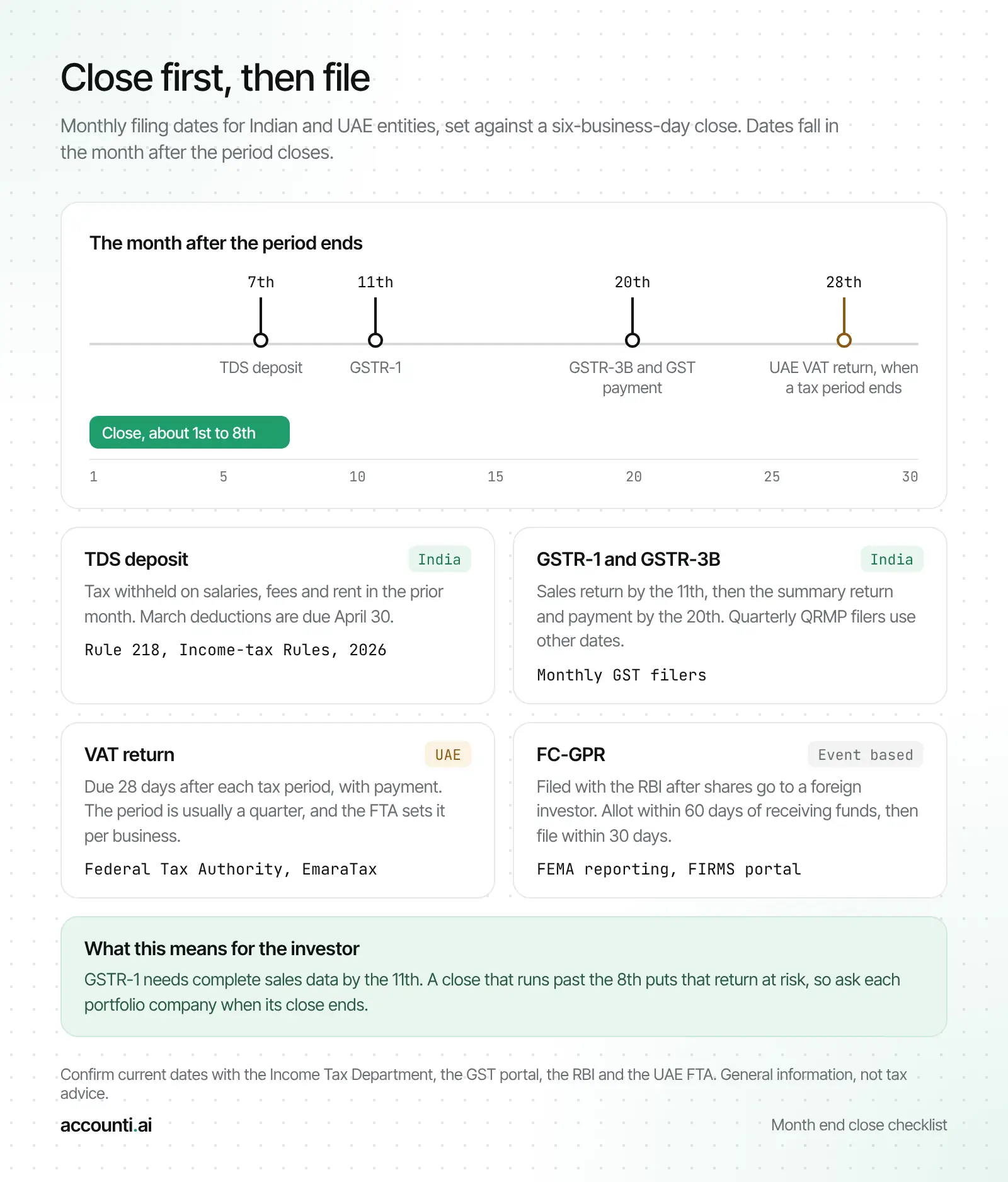
Monthly filing calendar for Indian and UAE entities showing the TDS, GSTR-1, GSTR-3B and VAT due dates after a six-day close
What this means for the investor. GSTR-1 needs complete sales data by the 11th. A close that runs past the first week puts that return at risk, so ask each portfolio company when its close ends. Rules and forms change, so confirm current requirements with the Income Tax Department, the GST portal, the RBI and the UAE FTA.
Variance review and sign-off
Compare actual results to budget and to the prior month, and write an explanation for every material variance. Set a materiality threshold in advance, such as a fixed percentage of the line item or a fixed dollar amount, so reviewers apply the same standard each month.
The controller or head of finance then reviews the trial balance, the key reconciliations and the three financial statements: the income statement, balance sheet and cash flow statement. Record the approval with a name and a date in the close file, where an auditor can find it later.
Lock the period and archive evidence
Close the period in the accounting system so that no one can post to it without a documented reopening. Store reconciliations, accrual workings, approvals and bank statements in one folder organized by month. This archive saves days when an investor asks for support behind a figure, and it is the starting point for any financial due diligence before a fundraise.
Is your close investor ready?
A close is investor ready when someone outside the team could open the monthly folder and trace any number back to its source. In practice, each sign-off carries a date and each estimate has written workings behind it. The period stays locked once approved, and the same calendar runs every month.
Accounti handles accrual bookkeeping, reconciliations and monthly financial reporting for growing companies, and helps foreign investors open and manage demat accounts in India. Talk to the team at accounti.ai about a close your investors can rely on.

Frequently asked questions
How long should a month end close take?
Growing companies commonly finish in five to ten business days. A fixed close calendar, clean reconciliations and fewer entities move the figure toward the lower end.
Who owns the month end close checklist?
The controller or head of finance owns it. Accountants prepare the reconciliations and entries, and the CFO gives the final sign-off.
What is the difference between a soft close and a hard close?
A soft close is a lighter pass for internal reporting that may leave estimates in place. A hard close completes every step and locks the period for investors and auditors.
What extra close steps do cross-border entities need?
Entities in more than one country revalue foreign currency balances at the month-end rate, reconcile intercompany balances before consolidation, and check that the close finishes before local filing dates, such as India's GST returns or a UAE VAT return.
Written by
Co-founder and CEO
Rohit Kapoor is a senior finance professional with over 20 years of experience across financial planning, management reporting, financial controlling, cost management, and finance transformation. He brings extensive experience in working with global business teams and cross-functional stakeholders to strengthen financial processes, improve operational efficiency, and establish scalable finance frameworks. Rohit’s expertise lies in simplifying complex processes, building sustainable finance operations, and developing high-performing teams. Combining strategic leadership with a hands-on approach, he focuses on aligning finance functions with business objectives and enabling better decision-making through robust financial controls, effective reporting, and process improvement.