How to Do a Flux Analysis: Steps, Tools and When to Outsource It

Quick answer
- A flux analysis explains why each significant line in the financial statements moved between two periods, in writing.
- Run it after the books are closed and reconciled, and before reports go to management, the board or investors.
- Set a threshold for which movements need an explanation, then trace each flagged line to its source documents.
- A spreadsheet is enough for a single entity. Multiple entities and currencies make the work heavier.
- Outsource it when nobody on the team has the time or experience to write commentary that stands up to questions.
A flux analysis compares each significant balance across two periods and explains in writing why it moved. To do one, close and reconcile the books, then pull a comparative trial balance. Set a threshold for which movements need investigating. Trace each flagged line to its source, write the reason, and have someone review it before the numbers are released.
The same exercise is also called variance analysis or fluctuation analysis. This guide covers the steps, the tools that support them and the signs that the work should move to an outsourced team.
What a flux analysis covers
A flux analysis turns a set of numbers into answers a board or investor can use. It covers both the income statement and the balance sheet, and compares one period with another. The usual comparisons are month on month, quarter on quarter and the same month a year earlier.
It differs from a budget versus actuals review. A budget review compares results with the plan. A flux analysis compares results with a prior period, so it shows what changed in the business and the books. Many finance teams run both. Our guide to budget versus actuals covers the planning side.
The output is a short written explanation for each line that crossed the threshold. Good commentary names the cause, the amount and whether the movement will recur.
Why the work is worth doing
A question about why a line moved should take minutes to answer. In companies without a flux analysis, it often takes days. Someone has to dig through the ledger after the board meeting has already happened.
The analysis also catches errors before they leave the finance team. A doubled vendor bill, a missed accrual or revenue posted to the wrong month shows up as an unexplained movement. Auditors review significant fluctuations during fieldwork, and diligence teams ask the same questions. Commentary written at the time of the close answers them without a scramble.
Flux analysis in 6 steps
1. Close and reconcile first
A flux analysis on unreconciled books explains movements that are not real. Finish the month-end close before you start, including bank reconciliations, accruals and supporting schedules for significant accounts. Our month-end close checklist lists the steps.
2. Pull comparative balances
Export the trial balance for the current period and the comparison period into one sheet. Line them up by account, then calculate the movement in currency and as a percentage. Keep the chart of accounts consistent between periods, or the comparison breaks. An account that was split or renamed needs mapping before the numbers mean anything.
3. Set thresholds for investigation
Not every movement needs a paragraph. Set a rule that combines an amount and a percentage. That catches small accounts with large swings and large accounts with small ones. For example, a company might investigate any line that moves by more than $10,000 and more than 10%. The right levels depend on the company's size, so agree them with whoever reviews the analysis and write them down.
Apply the same thresholds every month. Changing them to avoid awkward lines defeats the purpose.
4. Investigate each flagged line
Open the general ledger detail behind each flagged account. Sort the entries by size and look for the transactions that explain most of the change. Check them against source documents such as invoices, contracts, payroll registers and bank statements. Ask the budget owner when the cause sits outside finance, such as a new hire or a renegotiated contract.
5. Write commentary that explains the cause
Commentary should answer three questions a reader will ask. What drove the movement, how much did each driver contribute, and will it continue? A line that restates the number adds nothing.
| Weak commentary | Useful commentary |
|---|---|
| Hosting costs rose 18% this month. | Hosting rose $9,400. A new customer's data migration added $7,100 of one-off compute. Usage-based costs added $2,300 and will recur. |
| Accrued expenses increased. | Accrued expenses rose $42,000 because the annual audit fee was accrued in full this month. It will reverse when the invoice arrives in March. |
6. Review, sign off and follow up
A second person should read the commentary before it goes out. The reviewer checks that each explanation ties to the numbers and asks about anything that sounds vague. Record the sign-off with a name and date. Movements that point to an error go back into the close as corrections, and the analysis is updated.
A worked example
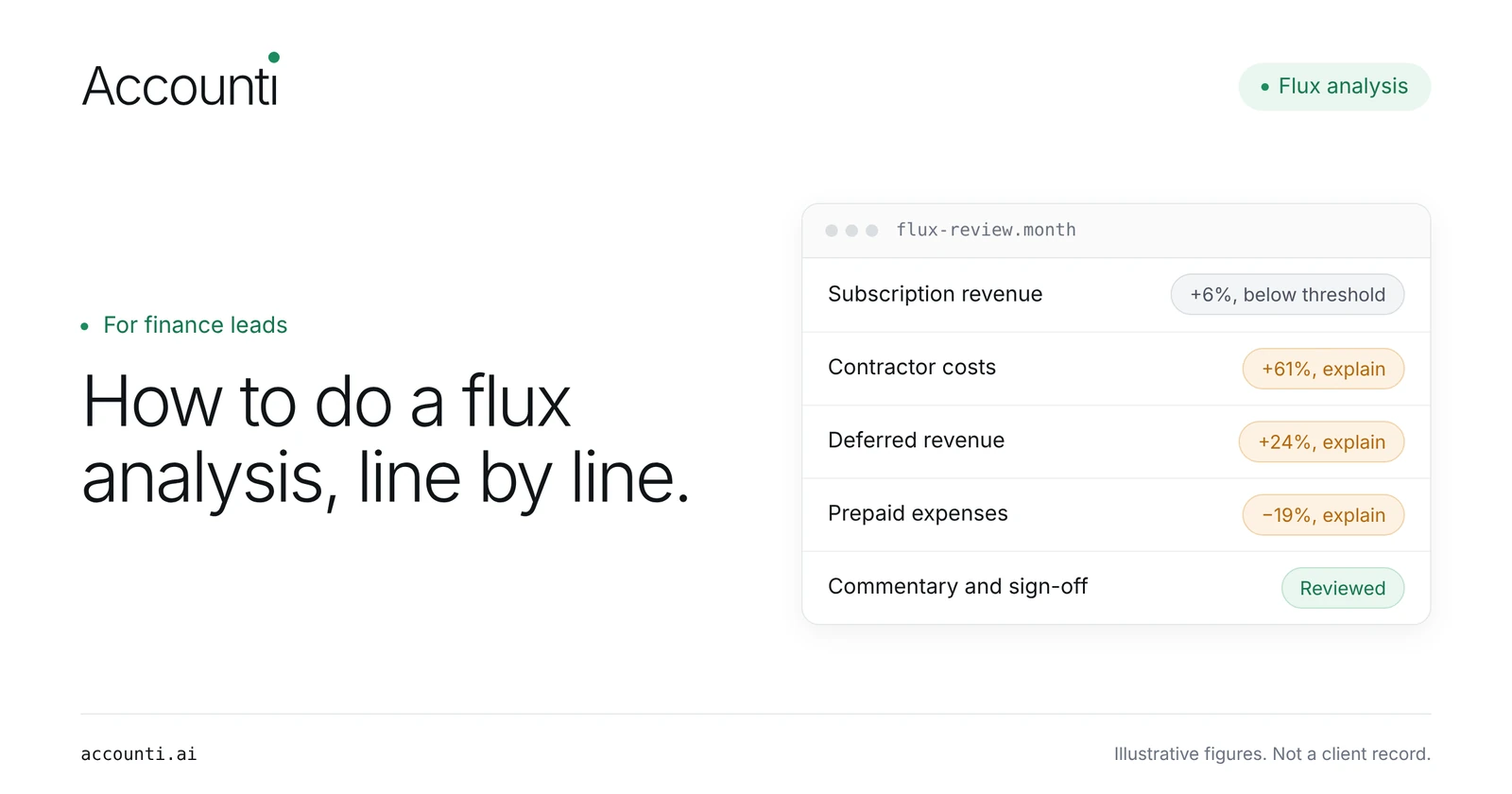
The table below is illustrative. It shows a monthly flux analysis for a software company using the example threshold above.
| Line | Prior month | Current month | Movement | Over threshold? | Commentary |
|---|---|---|---|---|---|
| Subscription revenue | $410,000 | $436,000 | +$26,000 (6%) | No | Below the percentage threshold. No commentary needed |
| Contractor costs | $38,000 | $61,000 | +$23,000 (61%) | Yes | Two contractors engaged for the mobile release. Contracts end in June |
| Deferred revenue | $820,000 | $1,015,000 | +$195,000 (24%) | Yes | Three annual contracts invoiced upfront in the month. Revenue will be recognised monthly over 12 months |
| Prepaid expenses | $64,000 | $52,000 | −$12,000 (19%) | Yes | Normal monthly amortisation of the annual insurance and software prepayments |
The deferred revenue line is a common one to check carefully. An annual contract invoiced upfront should increase deferred revenue, not revenue. A flux analysis that finds revenue jumping in the month an annual invoice went out has usually found a recognition error.
Tools for flux analysis
The work needs a comparative trial balance, a place to write commentary and a record of who reviewed it. Three kinds of tools cover that.
| Tool | Where it fits | Watch for |
|---|---|---|
| Spreadsheet | A single entity with a stable chart of accounts | Manual exports, broken formulas and lost version history |
| Comparative reports in your accounting system | Quick period comparisons without exporting | Limited room for commentary and review sign-off |
| Close management or reporting software | Several entities, currencies or reviewers | Set-up time, and the analysis still needs a person to write it |
Whatever you use, the tool flags the movement and a person explains it. A spreadsheet with clear thresholds and good commentary is worth more than software that produces variances nobody reads.
Companies with entities in more than one country add two steps. Balances in foreign currencies should be revalued before the comparison, so exchange movements are separated from business movements. Intercompany balances should be reconciled first, so they do not show up as unexplained swings.
When to outsource it
Keep flux analysis in-house when your finance lead has the time and the close already runs to a calendar. Consider outsourcing it when one of these is true:
- Nobody can tell the founder or the board why a number moved without days of digging.
- The close runs, but flux analysis is always the first task dropped.
- An audit or a fundraise is coming and the commentary needs to hold up to outside questions.
- The team is junior and has not written commentary for a reviewer before.
What you outsource is the analysis and the first draft of the commentary. Your team still owns the business decisions behind each movement and answers the questions only they can.
When choosing a provider, ask for a sample of the commentary it writes. Ask too how it handles a movement it cannot explain from the ledger alone. Our checklist for hiring an outsourced accounting firm covers the wider questions.
How Accounti runs flux analysis
Flux analysis with written commentary for management is part of the close and reporting work in Accounti's Finance Operations service. A company with a working close and no flux analysis can take flux alone. A company with neither can take both. Accounti also runs balance sheet reviews and keeps reconciliations and supporting schedules for critical accounts.
Accounti takes responsibility for whether the numbers are correct and explainable. Strategy and capital allocation decisions stay with the founders and the board. Finance Operations starts from $3,000 a month.
Next step
Pick last month's close and run steps 2 and 3 on it. The number of lines over your threshold tells you how much commentary each month will need. To hand the work over, talk to Accounti about flux analysis as a single service.
Frequently asked questions
What is a flux analysis?
A flux analysis explains why each significant line in the financial statements moved between two periods, with written commentary. It is also called variance analysis or fluctuation analysis.
How is flux analysis different from budget versus actuals?
A flux analysis compares results with a prior period. A budget versus actuals review compares results with the plan. Many finance teams run both each month.
How do you set a flux analysis threshold?
Combine an amount and a percentage, for example lines that move by more than $10,000 and more than 10%. Set the levels to suit the company's size, agree them with the reviewer and apply them every month.
When should a flux analysis be done?
After the month-end close and reconciliations are complete, and before management, board or investor reports are released.
Can flux analysis be outsourced on its own?
Yes. A company with a working close can take flux analysis alone under Accounti's Finance Operations service. Your team still answers the business questions behind each movement.
Written by
Co-founder and COO
Harsha Baisya is a finance professional with over seven years of experience across startups and established organizations. Her expertise spans financial management, business finance, financial analysis, and building effective finance processes that support business growth. As Co-Founder and COO of Accounti, Harsha brings a practical understanding of the financial and operational challenges businesses face as they scale. Her experience includes working with finance teams to improve financial visibility, streamline processes, manage costs, and strengthen financial reporting. She focuses on helping businesses build reliable financial systems that support informed decision-making, operational efficiency, and sustainable growth.