
How to Run Portfolio Monitoring Across 100+ Portfolio Companies

Quick Overview
- Portfolio monitoring across 100+ companies works when you collect a small, fixed set of metrics on a predictable schedule.
- One written definition per metric keeps revenue, burn and runway comparable across the whole portfolio.
- Tiering companies by runway concentrates review time on the companies most likely to need a decision.
- Spot checks against financial statements make the data credible to LPs and auditors.
Portfolio monitoring across 100 or more companies runs on four habits. The fund collects a short metric list and fixes each definition in writing. It runs collection to a fixed calendar and checks numbers against the books. Software helps once those habits are in place.
A fund with 20 portfolio companies can monitor them with email and a spreadsheet. At 100, the same approach produces late updates, mismatched metrics and a scramble before every LP letter.
This guide is for fund managers, operating partners and finance leads. It also matters to founders, because every request a fund sends lands on a small team that is already stretched.
What portfolio monitoring covers
Portfolio monitoring is the ongoing work of collecting performance data from portfolio companies and analysing it for progress and risk. The fund then acts on what the data shows.
The work runs as a cycle each reporting period. The fund collects and standardises the data, then analyses company and fund performance. It then acts through interventions, reserve decisions and exit timing.
The same numbers feed LP reports. A weak first stage passes its errors to the next two, so this guide spends its time on collection and verification.
Choose a small core metric set
Over-collection is the fastest way to lose founder goodwill. Every extra field adds work for a founder or a finance team of one or two people. Keep the quarterly request short enough that a founder can finish it in one sitting.
The financial core
Start with revenue, cash balance, net burn, runway and headcount. These answer the two questions that matter at portfolio scale: is the company growing, and how long can it operate? Runway is usually cash divided by net burn, so the fund can calculate it instead of asking for it.
Gross margin can join the set for later-stage companies. Valuation, round status and material events complete the picture for ownership records and LP reporting.
Qualitative prompts
Pair the numbers with two open questions. A highlights and lowlights summary gives context the figures miss. Asking how the fund can help this quarter gives the founder a reason to reply. A short request with two prompts takes a founder minutes, which is why it gets answered.
Standardise definitions before collecting
Two companies can both report ARR and mean different things. One counts signed contracts, and another counts only recognised revenue. Across 100 companies, gaps like these turn benchmarking into guesswork.
Adopt a single written definition per metric, and document the edge cases. These include fiscal year-end, reporting currency and the treatment of one-time revenue. India's fiscal year, for example, runs from 1 April to 31 March.
Send a one-page metric guide during onboarding. Keep a version history so that a definition change never silently rewrites past trends. Portfolios that span the US, India and the UAE should also name the exchange rate source in the guide.
Under Global Portfolio Operations, Accounti agrees this metric dictionary with the fund at onboarding. It covers revenue and growth, gross margin, burn, cash balance, runway and headcount, plus valuation, round status and material events.
Set a cadence and tier by risk
A single schedule for every company wastes effort on healthy ones and under-serves the risky ones. Two layers fix that.
Quarterly baseline and monthly watchlist
Run structured quarterly updates for the whole portfolio, with collection closing a few weeks after quarter end. Accounti's collection window under Global Portfolio Operations covers the 18 days after quarter close.
Add monthly cash and burn reports for companies that need closer attention. In a 100-company book, one workable split is about 85 companies quarterly and 15 on a monthly watchlist. The right numbers depend on your fund.
Runway tiers and triggers
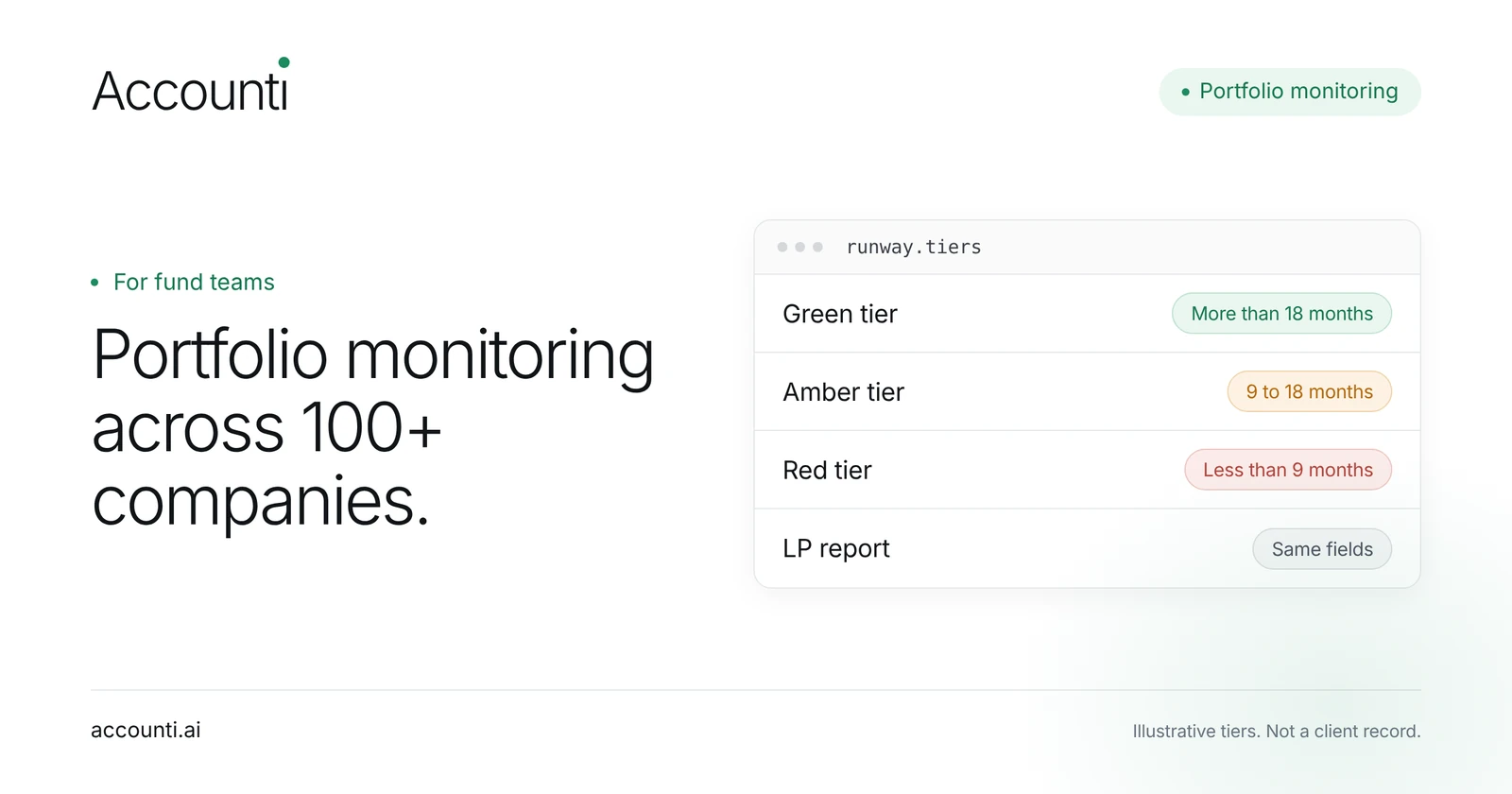
Assign each company a tier based on runway. For example, green covers more than 18 months, amber covers 9 to 18 and red covers less than 9.
Tie each tier to an action. An amber company gets a fundraising readiness check, while a red company moves to a monthly cash report. The lead partner calls each red company within a week of the change.
Here is the time maths, assuming 45 minutes of analyst time per company update. A 100-company quarter costs 75 hours. Tiering leaves collection time unchanged and concentrates review time on the 15 or so companies where a decision is likely.
Verify data against financial statements
Self-reported numbers drift when a formula breaks or a definition quietly changes between quarters. Periodic spot checks against board materials and financial statements separate a dashboard people trust from one they ignore.
Build the check into the calendar. Each quarter, pick a sample of companies plus every red-tier company. Reconcile reported revenue and cash to bank statements and the general ledger, and send anything that fails back with a specific question.
Ownership needs the same discipline. A fund's position changes when a company raises a round, converts a SAFE or expands its option pool, often without notice. Accounti updates each position within five business days of learning of an event. It reconciles every holding against source documents once a year, and Indian holdings against Ministry of Corporate Affairs filings and depository records.
This is where the quality of a portfolio company's books becomes your problem. Companies with clean monthly closes answer reconciliation questions quickly, and those without can take weeks. Our guide to the best accounting services for startups covers what founders should look for in a provider. Our walkthrough on preparing for financial due diligence before a fundraise applies the same discipline to investor scrutiny.
Decide who runs the process
With the metric set and definitions fixed, someone has to send requests, chase non-responders and reconcile what comes back. Funds have two broad options.
Portfolio monitoring software suits a fund that wants its own team to run the process, with dashboards between quarters. When evaluating software, check for:
- Integrations with accounting systems and banks, so data flows in without manual entry.
- Validation that flags outliers and missing fields before they reach your dashboard.
- Permissions that separate LP-facing data from internal notes.
- Support for multiple currencies and fiscal calendars.
A managed service suits a fund whose team does not have the hours to chase founders. Accounti's Global Portfolio Operations team does the collection, follow-up, standardisation and reconciliation itself. Accounti commits to 90% portfolio coverage or better each quarter and delivers the LP reporting pack on day 25 after quarter close. It can also work alongside a fund's existing software.
Better Capital, which is also an investor in Accounti, uses Global Portfolio Operations for its 200-plus company portfolio across the US, Singapore and India.
Cross-border holdings add another layer, because investment structure shapes what a fund tracks and discloses. Our explainer on FDI versus FPI covers how that classification works for India.
Turn data into decisions
Collected data pays off only when it drives choices. Review the tier list at a fixed monthly meeting, and note which companies changed tier. Use the same meeting to decide where follow-on reserves should go.
The standardised data should also feed quarterly and annual LP reports. Build the LP template from the monitoring fields, so nobody rebuilds it each quarter.
Start with the metric set and the definitions guide. Then assign tiers and run one reconciliation round next quarter. To hand over collection, standardisation and the LP reporting pack, talk to Accounti about Global Portfolio Operations.
Frequently asked questions
What metrics should a VC track for portfolio monitoring?
Start with revenue, cash balance, net burn, runway and headcount. Add gross margin for later-stage companies, plus valuation, round status and material events, and pair the numbers with two qualitative prompts.
How often should you collect portfolio company data?
Quarterly works as a baseline, with collection closing a few weeks after quarter end. Collect cash and burn monthly for watchlist companies with short runway.
How many KPIs should each portfolio company report?
Keep the set small enough that a founder can finish it in one sitting. Five financial metrics and two open questions cover the core for most stages.
What is VC portfolio management?
It is the ongoing work of tracking portfolio company performance, managing risk and reserves, and reporting results to LPs from the same standardised data.
How do you check that reported numbers are accurate?
Reconcile a quarterly sample of companies, plus every high-risk company, to bank statements, the general ledger and board materials. Send discrepancies back with specific questions.
Is Accounti's Global Portfolio Operations a software product?
No. It is a managed service run by Accounti's team, which collects updates, standardises the data and delivers the LP reporting pack on day 25 after quarter close. It can work alongside a fund's existing software.
Written by
Co-founder and CEO
Rohit Kapoor is a senior finance professional with over 20 years of experience across financial planning, management reporting, financial controlling, cost management, and finance transformation. He brings extensive experience in working with global business teams and cross-functional stakeholders to strengthen financial processes, improve operational efficiency, and establish scalable finance frameworks. Rohit’s expertise lies in simplifying complex processes, building sustainable finance operations, and developing high-performing teams. Combining strategic leadership with a hands-on approach, he focuses on aligning finance functions with business objectives and enabling better decision-making through robust financial controls, effective reporting, and process improvement.
RELATED READS
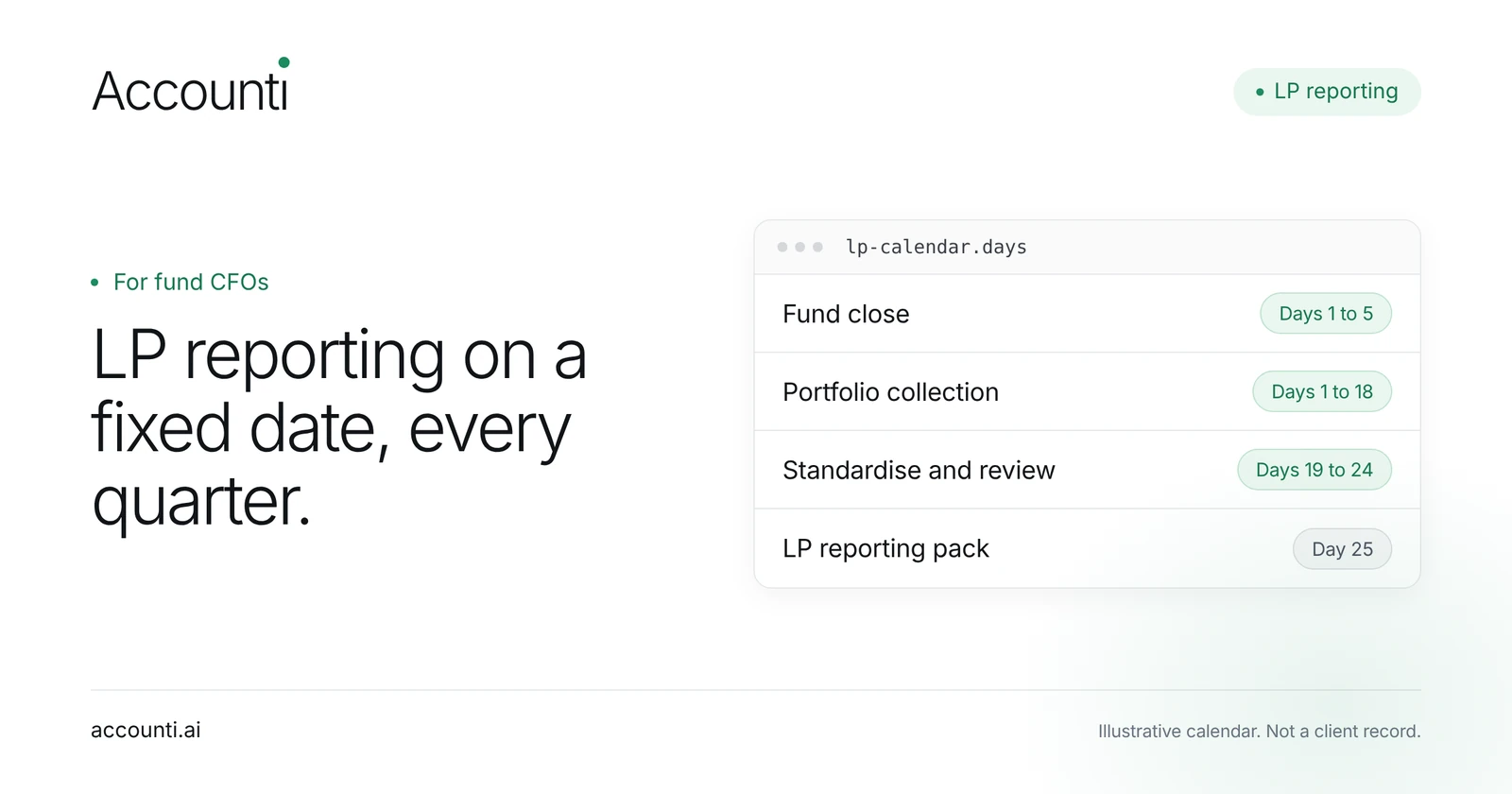
How to Deliver LP Reporting on a Fixed Date Every Quarter
 Harsha BaisyaNov 10, 20268 min read
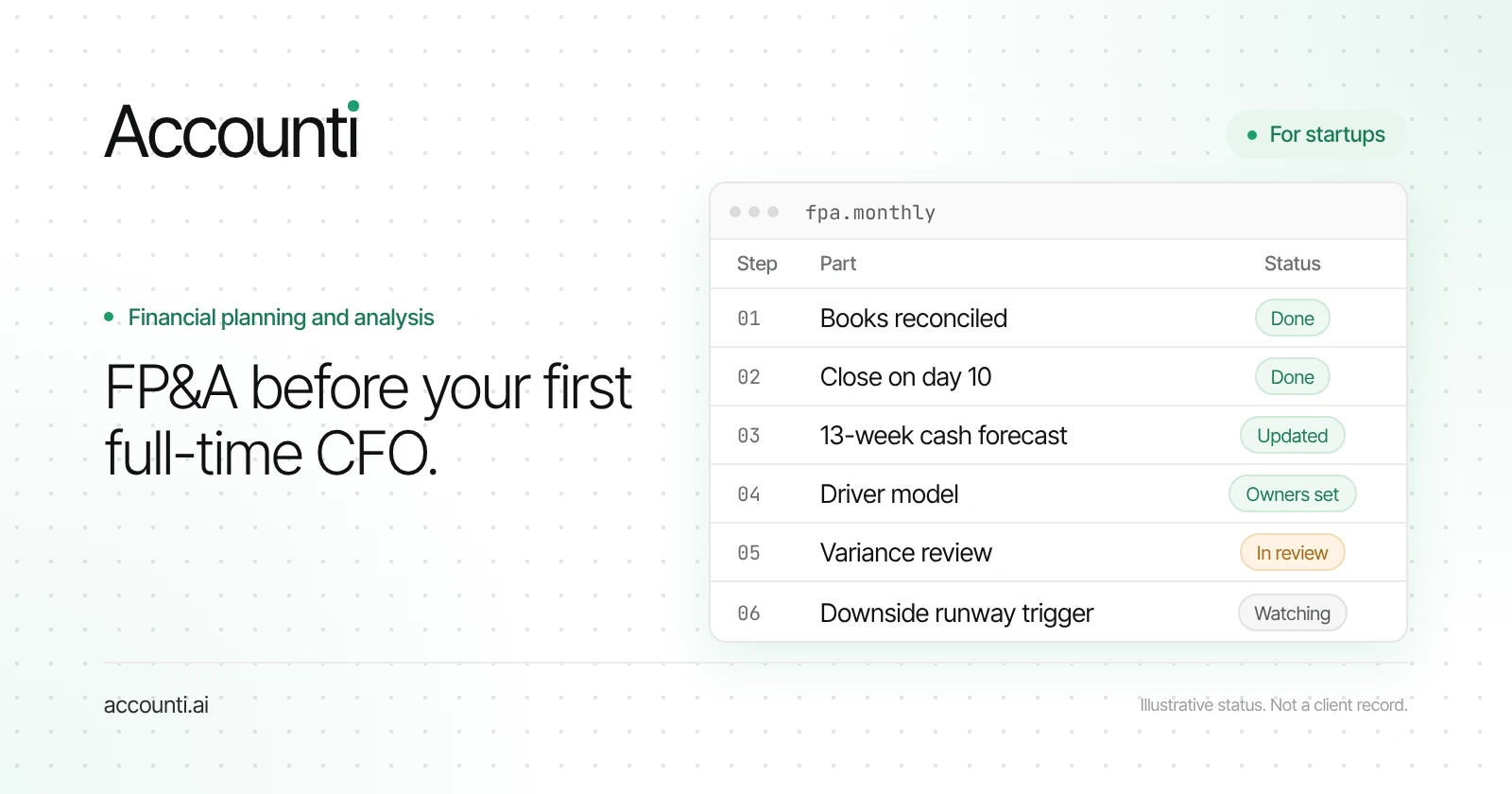
How to Set Up Financial Planning and Analysis for a Growing Company Before a Full-Time CFO
Harsha BaisyaNov 5, 20268 min read
The Month-End Close Checklist for Growing Companies
Rohit KapoorNov 5, 20268 min read