Published November 10, 2026•Updated November 16, 2026•8 min read
Quick Overview
Set one LP reporting date from your limited partnership agreement, then build the quarterly calendar backward from it.
ILPA's suggested guidance gives direct funds 60 days after Q1 to Q3 and 120 days after year-end. Day 25 leaves a wide margin.
Delivery slips at portfolio data collection, which needs a fixed window, a metric dictionary and a rule for non-responders.
Accounti's Global Portfolio Operations service delivers the quarterly LP reporting pack on day 25 after quarter close.
LP reporting lands on the same day each quarter when the fund fixes one delivery date. The calendar is then built backward from that date. Portfolio companies get a hard collection window, and the fund decides in advance how to treat companies that do not respond. This guide covers each step, and what has to be true behind the scenes for the date to hold.
Foreign fund CFOs often inherit an LP reporting process that runs on goodwill. Updates arrive when portfolio founders get to them, and the pack is assembled in a rush. The delivery date shifts every quarter, and LPs notice.
Why a fixed LP reporting date matters
A fixed LP reporting date is a delivery day, counted from quarter close, that the fund commits to and meets every quarter. It lets LPs plan their own consolidation and gives your team a deadline to work back from. The quarterly debate about whether the pack is ready also goes away.
For GPs and managing partners, predictability signals control. An LP who receives the pack on day 25 four quarters running stops chasing it and reads it instead. Compliance and legal stakeholders benefit too, because a fixed date can be written into side letters and investor communications.
Set the date from the LPA
Start with the limited partnership agreement (LPA). It sets the outer limit, and a side letter with an institutional LP may tighten it. ILPA's January 2025 guidance gives direct funds 60 days after the end of Q1 to Q3 and 120 days after year-end. Fund-of-funds get 120 and 180 days. Your own documents may differ, so check them first.
With the outer limit known, choose a delivery day well inside it. Day 25 after quarter close is a workable target for a venture fund. Against a 60-day deadline, it leaves 35 days of buffer. That buffer absorbs a late administrator statement or a portfolio company that restates its numbers.
Put the date in writing. A commitment communicated to LPs is far harder to let slide than an internal target.
Build the reporting calendar around quarter close
LP reporting depends on two streams of data: the fund's own books and the figures portfolio companies send. Both streams need one calendar, with an owner for each step. A fund close with no defined end date drags the pack with it. A written month-end close checklist gives the close that end date.
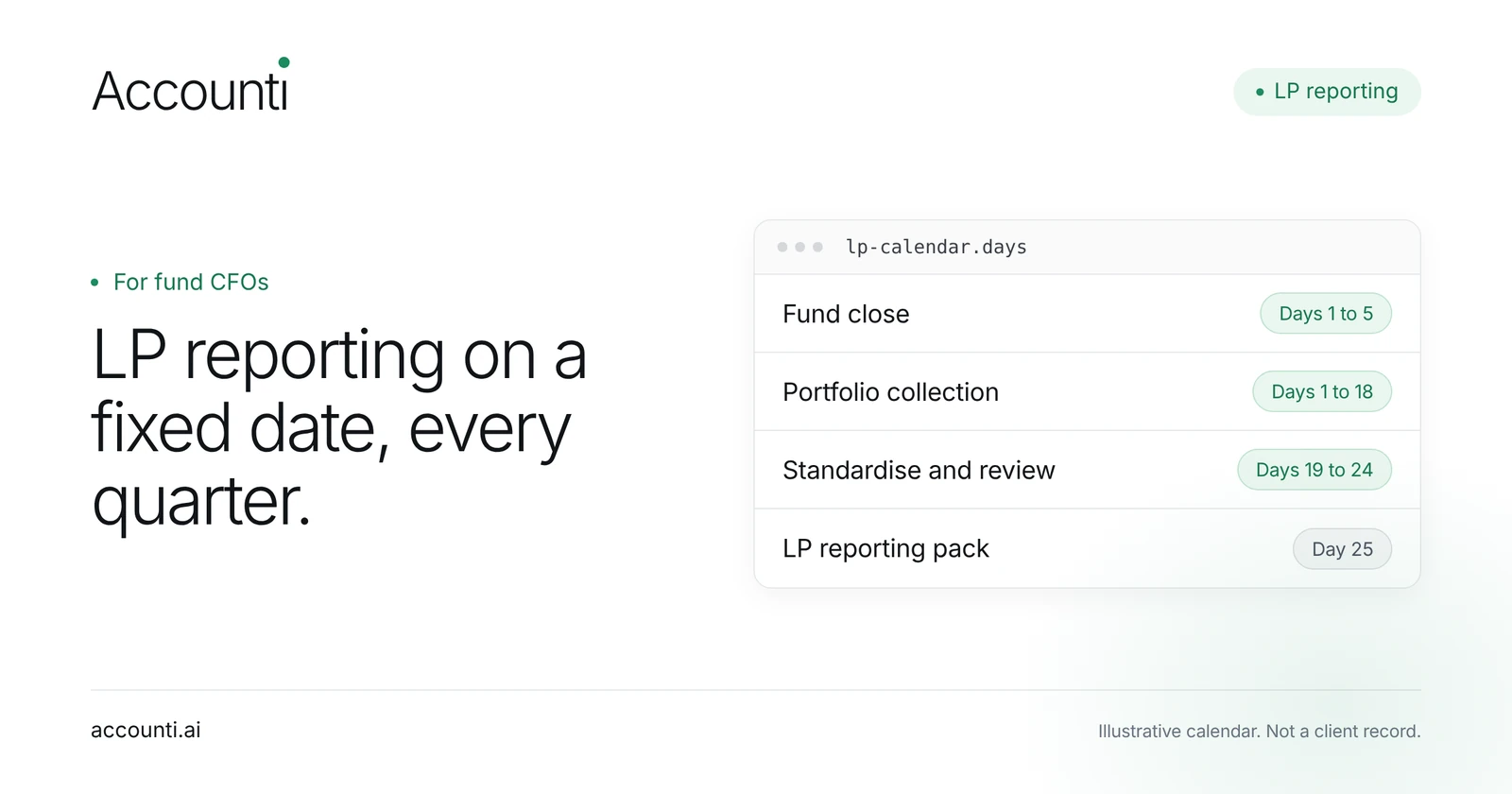
Sample 25-day timeline
Work in blocks, each with a named owner and a hard stop:
Days 1 to 5: fund close, and administrator confirmation of capital activity and valuations.
Days 1 to 18: portfolio update collection, with the first request sent on day 1 under the fund's name.
Days 19 to 22: standardisation, reconciliation and variance review.
Days 23 to 24: commentary, partner review and sign-off.
Day 25: the pack goes to LPs.
Collection and the fund close run in parallel, which keeps the schedule short. Review time is protected because nothing new enters the pack after day 18.
Collect portfolio data and standardise metrics
Collection is where LP reporting calendars usually fail. Response rates fall as a portfolio grows, and each company reports in its own format, on its own timeline.
Fix the window and the follow-up
Send each portfolio company a single request with a deadline and one place to respond. Escalate on a schedule, from reminders to direct contact from an analyst. The last step is a personal note the fund sends to the founder.
Under Global Portfolio Operations, Accounti runs this process over the 18 days after each quarter closes. Accounti commits to 90% portfolio coverage or better each quarter.
Write the metric dictionary down
Two companies can both report "revenue" and mean different things, such as bookings versus recognised revenue. Gross versus net of refunds is another common gap. A metric dictionary agreed at onboarding closes these gaps.
The dictionary should define revenue and growth, gross margin, burn, cash balance, runway and headcount. It should also cover valuation, round status and material events. Accounti normalises every submission into that single format, so figures compare across companies and quarters.
The incoming numbers are only as reliable as each company's books. A portfolio company with a clean startup bookkeeping foundation answers follow-up questions faster.
Update ownership before the pack is built
Your position changes when a company raises a round, converts a SAFE or note, or expands its option pool. Secondaries and restructurings can change it too, and investors are seldom told at the time. Stale ownership makes every company profile in the pack wrong.
Accounti tracks these events through quarterly updates, public filings and fund notifications. It updates the position within five business days of learning of an event. Each holding is reconciled against source documents once a year. For Indian holdings, that reconciliation runs against Ministry of Corporate Affairs (MCA) filings and depository records.
Handle non-responders without slipping
Some companies will not respond, whatever the follow-up. The date must hold anyway, so set the rule before the quarter starts.
The workable rule is to carry forward the last reported figures, date them and flag them in the pack. LPs accept a clearly marked stale figure. A late pack, or a stale figure presented as current, erodes trust. Accounti applies this carry-forward rule so the cycle closes on schedule every quarter.
Track coverage as a number. A drop below your threshold is a conversation for the partner responsible for those companies, well before the next cycle begins.
What the LP reporting pack should contain
A quarterly LP reporting pack gives investors a full account of the portfolio. The portfolio summary covers capital deployed, portfolio health, notable events and follow-on activity. Each company then gets a profile with standardised metrics, trends against prior quarters, current ownership and written commentary.
Fund-level financials sit alongside the pack. Capital account statements, fees, expenses and measures such as IRR, TVPI and MOIC usually come from the fund administrator. Institutional LPs may ask for these in ILPA formats. ILPA's updated Reporting Template applies to funds still in their investment period during Q1 2026. It also applies to funds starting operations on or after 1 January 2026. Adoption is voluntary, but it raises what LPs expect to see.
Keep the division of work clear. The administrator produces fund-level statements, and the portfolio pack covers the companies. Accounti's pack contains the portfolio summary and a one-page profile per company, in the fund's own branding. Fund-level capital accounts and ILPA templates stay outside the service.
How Accounti delivers on day 25
Global Portfolio Operations is a fully managed service for venture funds with many portfolio companies across countries. Accounti's team does the work, and the fund receives the outputs. The service has five components:
Portfolio update collection over the 18 days after quarter close
Data standardisation into a consolidated MIS, built on the agreed metric dictionary
The quarterly LP reporting pack, delivered on day 25 after quarter close
Ownership records and position tracking, with annual reconciliation to source documents
Annual audit and valuation support, as supporting documentation only
The fixed delivery date lets the fund commit to its own LPs on the reporting timeline. Better Capital, which is also an investor in Accounti, uses Global Portfolio Operations for its 200-plus company portfolio across the US, Singapore and India. Pricing starts from $10,000 a year.
Sometimes the bottleneck sits inside a portfolio company whose own close keeps slipping. Accounti's Finance Operations and Finance Orchestration services help growth-stage companies run the close against a defined calendar. Founders comparing their options can start with this guide to the best accounting services for startups.
Next step
To see how a day-25 calendar would work for your portfolio, talk to the team at Accounti about Global Portfolio Operations. You will speak with Accounti's founders, and the scope is set around your fund.
Frequently asked questions
When are LP reports due?
The deadline sits in your limited partnership agreement and any side letters. ILPA's January 2025 guidance suggests direct funds deliver within 60 days after the end of Q1 to Q3 and 120 days after year-end, with longer windows for fund-of-funds. Set an internal date well inside that limit.
What should a quarterly LP report include?
A portfolio summary covering capital deployed, portfolio health, notable events and follow-on activity, and a profile of each company with standardised metrics, trends, current ownership and commentary. Fund-level capital accounts and performance usually come from the fund administrator.
How do you handle portfolio companies that do not send data on time?
Escalate on a schedule, then carry forward the company's last reported figures. Date them and flag them in the pack so the delivery date holds.
Does Accounti produce fund capital account statements?
No. Fund-level capital accounts stay with the fund administrator. Accounti's Global Portfolio Operations covers portfolio update collection, the LP reporting pack, ownership records and audit support.
When does Accounti deliver the LP reporting pack?
On day 25 after quarter close, every quarter. Collection runs over the 18 days after quarter close, and Accounti commits to 90% portfolio coverage or better.
Harsha Baisya is a finance professional with over seven years of experience across startups and established organizations. Her expertise spans financial management, business finance, financial analysis, and building effective finance processes that support business growth.
As Co-Founder and COO of Accounti, Harsha brings a practical understanding of the financial and operational challenges businesses face as they scale. Her experience includes working with finance teams to improve financial visibility, streamline processes, manage costs, and strengthen financial reporting. She focuses on helping businesses build reliable financial systems that support informed decision-making, operational efficiency, and sustainable growth.


 Rohit KapoorNov 11, 20268 min read