How to Sell Shares in an Indian Private Company as a Foreign Investor

Quick answer
- A foreign investor can sell shares in a covered Indian private company only once those shares sit in a demat account.
- Where one side is resident in India, the price must stay within FEMA fair value limits. The transfer is then reported on Form FC-TRS within 60 days.
- The buyer withholds Indian tax from the payment, and buyers often ask the seller for a Section 281 certificate before closing.
- The seller then files an Indian income tax return for the tax year of the sale.
- Starting from paper shares and no account, expect roughly 5 weeks before the shares can move.
A foreign investor sells shares in an Indian private company in a fixed order. The shares must first be held in a demat account. Buyer and seller agree a price within the foreign exchange rules, and the shares move through an off-market transfer. The buyer withholds tax from the payment. The seller then files an Indian tax return.
This guide walks through each step as the rules stand in November 2026. It is written for fund CFOs, GPs and individual foreign investors selling a stake in an Indian startup. It explains how the rules work and is not tax or legal advice for any specific sale.
A fund with an India-based operations team that knows this sequence can work directly with a depository participant. The steps below show what that team will need to run.
Why the shares must be demat
India's Ministry of Corporate Affairs made dematerialisation mandatory through Rule 9B, inserted on 27 October 2023 (MCA, G.S.R. 802(E)). It covers private companies other than small companies. The final compliance date for most private companies was 30 June 2025. Since then, a shareholder in a covered company must hold shares in demat form before transferring them.
A private company stays outside the rule only if it is a small company. From 1 December 2025, that means paid-up capital up to ₹10 crore and turnover up to ₹100 crore (G.S.R. 880(E)). That is about $1.06 million and $10.6 million, at roughly ₹94 to the dollar in November 2026. Holding companies and subsidiaries cannot be small companies, so an Indian subsidiary of a foreign group is covered regardless of size.
The practical result is simple. A foreign investor in a covered company who still holds paper certificates cannot sell. The investor can also hold up the deal for the buyer.
Open a demat account first
A demat account is held with a depository participant (DP), such as a regulated bank, broker or custodian. The DP connects investors to India's two depositories, NSDL and CDSL. A foreign investor needs an Indian tax number, called a PAN, before or alongside the account. Our guide to the PAN application for foreign investors covers that step.
The DP will typically ask for identity and entity documents, beneficial ownership details and a board resolution or equivalent. It may also ask for a tax residency certificate. Documents are usually notarised, then apostilled or legalised depending on the investor's country. A demat account typically takes about three weeks to become operational. Our full guide on opening a demat account as a foreign investor lists the documents by investor type.
Foreign VCs and angels investing in unlisted companies use the FDI route and do not need SEBI registration for this account. The difference between the routes is explained in our guide to FDI vs FPI.
Convert paper shares to demat
Dematerialisation converts paper certificates into electronic holdings. The issuing company must have an ISIN and a registrar and transfer agent (RTA) in place first. The investor's DP sends the request and the original certificates to the RTA. The company and RTA verify them against the register, and the shares are credited to the account.
The steps that stall are usually the ones that depend on the company and its RTA. Dematerialisation typically takes about 2 weeks after the account opens. Our guide on transferring shares to demat form covers the detail.

Agree a price within FEMA limits
The Foreign Exchange Management (Non-Debt Instruments) Rules, 2019 set a price limit on some sales. They apply when unlisted Indian shares move between a resident and a non-resident. A sale between two non-residents does not trigger this pricing rule.
| Direction of sale | Price rule |
|---|---|
| Resident sells to a non-resident | Price not less than fair value |
| Non-resident sells to a resident | Price not more than fair value |
For an unlisted company, fair value is set using an internationally accepted pricing method on an arm's-length basis. A chartered accountant, a SEBI-registered merchant banker or another permitted professional certifies it. The rules sit in the RBI's Master Direction on Foreign Investment in India, updated January 2025.
Indian income tax law has its own fair market value rules for unquoted shares. A price can satisfy FEMA and still raise a tax question, so both valuations matter.
Check land-border ownership rules
Some funds have limited partners or beneficial owners connected to a country that shares a land border with India. Those countries are China, Pakistan, Bangladesh, Nepal, Myanmar, Bhutan and Afghanistan. Press Note 2 (2026 Series), issued by DPIIT on 15 March 2026, amended the rules first set in 2020. A transfer that shifts beneficial ownership to such a person still needs prior government approval. Raise the question with counsel before agreeing the sale.
Run the off-market transfer
A private sale of demat shares runs as an off-market transfer. The seller instructs its DP with a Delivery Instruction Slip (DIS). The buyer's account details are verified, and the depository processes the instruction. A share transfer typically takes about 10 days once the shares are in demat form and a buyer is agreed.
Where one party is resident in India, that party files Form FC-TRS through its bank on the RBI's FIRMS portal. The deadline is 60 days from the transfer or the receipt or remittance of funds, whichever is earlier (RBI circular). Late filing attracts a late submission fee.
Expect the buyer to withhold tax
India replaced its income tax law on 1 April 2026. The Income-tax Act, 2025 now governs sales, and many section numbers changed. Buyers, sellers and lawyers still use the old numbers, so both appear below.
A buyer paying a non-resident for shares must deduct tax at source from the payment. That obligation now sits in section 393(2) of the Income-tax Act, 2025, Table serial number 17, which replaced section 195. Before the money leaves India, the remitter files Forms 145 and 146, which replaced Forms 15CA and 15CB.
The withholding follows the tax rate on the gain. As of November 2026, the main rates for a non-resident are:
| Type of gain | Holding period | Rate |
|---|---|---|
| Long-term, unlisted shares | More than 24 months | 12.5% without indexation, for transfers on or after 23 July 2024 (section 197, Income-tax Act, 2025) |
| Short-term, unlisted shares | 24 months or less | Normal rates: slab rates for individuals, 35% for a foreign company |
Surcharge and a 4% health and education cess apply on top. Where actual tax will be lower than the standard deduction, a seller can apply for a lower or nil withholding certificate. That certificate now sits under section 395(1), formerly section 197 of the old Act. Without one, the buyer may withhold more than the final tax, and the seller recovers the difference through a refund.
A tax treaty can change the rate. Section 159 of the 2025 Act lets a non-resident use the treaty where it is more beneficial. The seller needs a tax residency certificate and the prescribed declarations to claim it. Treaties with Mauritius and Singapore were amended so that shares acquired on or after 1 April 2017 are generally taxable in India. Which treaty benefit applies to a sale is a question for your tax adviser.
Provide a Section 281 certificate
Buyers often ask for a Section 281 certificate before closing. The provision was section 281 of the Income-tax Act, 1961, and is now section 499 of the Income-tax Act, 2025. It can make a transfer void against the tax department if the seller made it while tax proceedings were pending. The tax department could then treat the shares as still belonging to the seller for recovery.
There are two exceptions. One is a transfer for adequate consideration without notice of the proceedings. The other is a transfer made with the Assessing Officer's prior permission. The rule applies only where the tax payable exceeds ₹5,000 and the asset exceeds ₹10,000 in value. At about ₹94 to the dollar in November 2026, those amounts are roughly $53 and $106.
| Document | What it is |
|---|---|
| Permission or NOC from the Assessing Officer | Formal prior permission from the tax department, which takes time and depends on the department |
| Report on the seller's tax position | A professional review of pending proceedings and outstanding demands, often accepted with contractual protections |
Buyers commonly pair the report with seller indemnities, an escrow of part of the price or tax clearances where available.
File the Indian return after selling
A sale of Indian company shares creates an obligation to file an Indian return, whether it made a gain or a loss. This applies to foreign individuals, funds and SPVs. Filing reports the transaction, matches the tax the buyer withheld and is the route to any refund.
Due dates are set by section 263(1) of the Income-tax Act, 2025, formerly section 139(1). India's tax year now runs from 1 April to 31 March. A sale on or after 1 April 2026 falls in tax year 2026-27, with the return due in 2027. Missing it can bring penalties and notices from the tax department.
How long the full sale takes
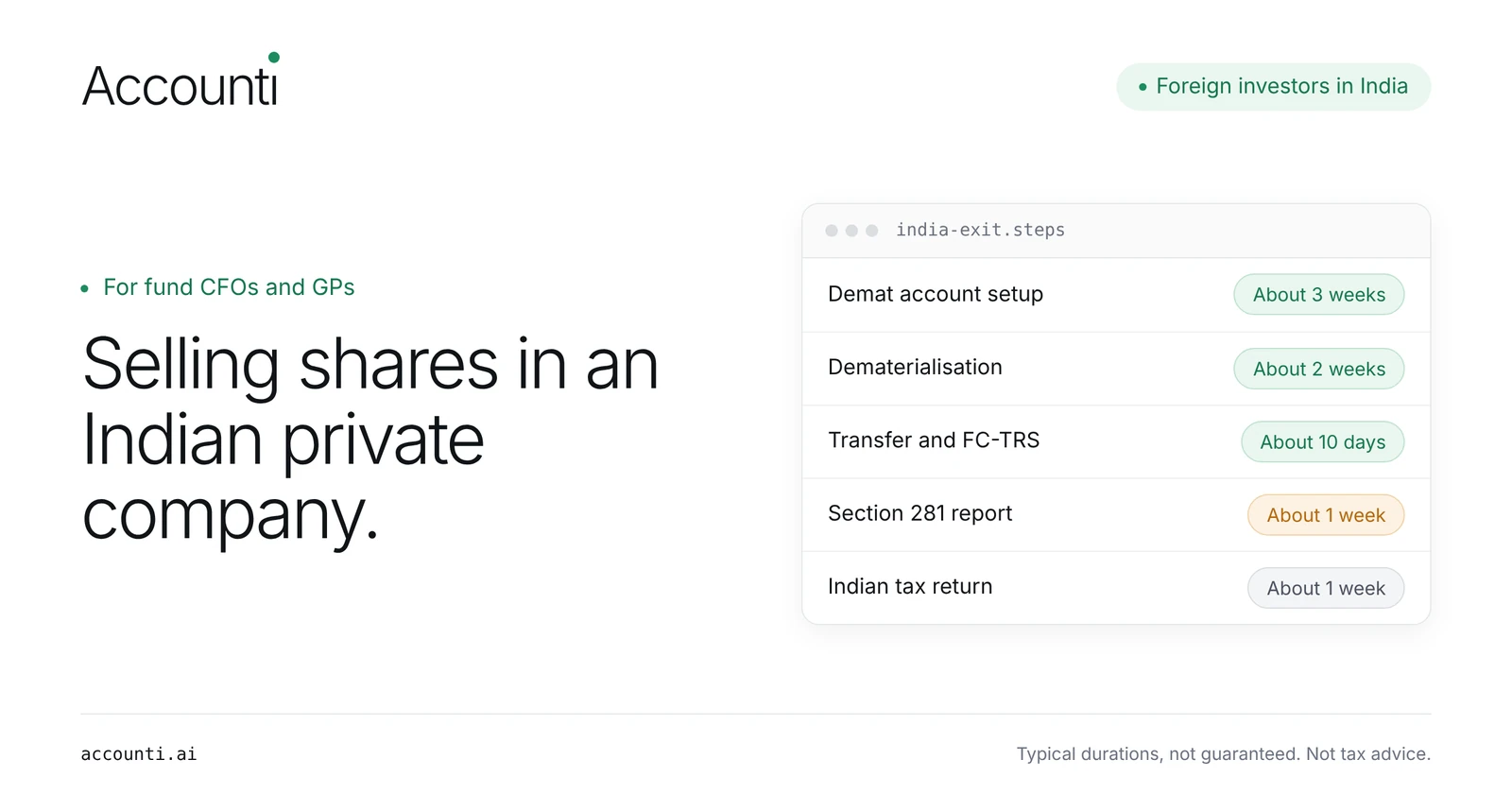
The steps overlap where they can, but the first two cannot be skipped. The durations below are typical, not guaranteed.
| Step | Typical duration | Depends on |
|---|---|---|
| Demat account setup | About 3 weeks | Notarised or apostilled documents |
| Dematerialisation | About 2 weeks | The issuing company and its RTA |
| Transfer or sale | About 10 days | Demat shares, an agreed buyer, FEMA pricing where relevant |
| Section 281 report | About 1 week | Access to the seller's tax records, often alongside the transfer |
| Tax return filing | About 1 week | A completed sale and cost records |
An investor starting from paper shares and no account should expect roughly 5 weeks before the shares can move. The most common failure is starting after the buyer has set a closing date.
How Accounti runs the sale
Accounti's India Demat Pro is a fully managed service covering this lifecycle. It runs the demat account setup, dematerialisation, share transfer, Section 281 report and exit tax return. You arrange your documents and sign where required. Accounti coordinates the banks, depository participants, the issuing company, its registrar and the tax filing.
Accounti has opened and managed more than 200 demat accounts, with a 100% success rate for eligible clients. It has served more than 30 large entities across more than 11 countries. Clients include VersionOne, FJ Labs, AngelList and Gaingels.
Accounti is not a depository participant, custodian or bank, and it works with them as partners. It prepares the report on the seller's tax position and does not obtain a formal NOC from the tax department. Demat account setup costs $2,000 to $3,000 per account. Dematerialisation costs $500 per ISIN, and the exit process costs $2,500 per exit.
Next step
Your tax adviser and counsel confirm the position for your specific sale, including treaty benefits and any land-border question. Book a call with Accounti to map the operational steps against your closing date.
Frequently asked questions
Can a foreign investor sell shares in an Indian private company without a demat account?
Not in a company covered by Rule 9B. Since 30 June 2025, a shareholder in a covered private company must hold shares in demat form before transferring them. Subsidiaries and holding companies cannot use the small company exemption.
Who files Form FC-TRS when a foreign investor sells shares?
The party resident in India files it through its AD Category-I bank on the RBI's FIRMS portal. The deadline is 60 days from the transfer or the receipt or remittance of funds, whichever is earlier.
Will the buyer withhold tax when a non-resident sells Indian shares?
Yes. A buyer paying a non-resident must deduct tax at source under section 393(2) of the Income-tax Act, 2025, formerly section 195. The seller can apply for a lower withholding certificate where actual tax will be lower.
What is a Section 281 certificate?
A report or clearance on the seller's Indian tax position. Buyers ask for it because Indian law can treat a transfer as void against the tax department if the seller had proceedings pending. The rule is now section 499 of the Income-tax Act, 2025.
How long does it take a foreign investor to sell shares in an Indian private company?
Starting from paper shares and no account, expect roughly 5 weeks before the shares can move. A demat account typically takes about three weeks, dematerialisation about 2 weeks and the transfer about 10 days. These durations are typical, not guaranteed.
Written by
Co-founder and CEO
Rohit Kapoor is a senior finance professional with over 20 years of experience across financial planning, management reporting, financial controlling, cost management, and finance transformation. He brings extensive experience in working with global business teams and cross-functional stakeholders to strengthen financial processes, improve operational efficiency, and establish scalable finance frameworks. Rohit’s expertise lies in simplifying complex processes, building sustainable finance operations, and developing high-performing teams. Combining strategic leadership with a hands-on approach, he focuses on aligning finance functions with business objectives and enabling better decision-making through robust financial controls, effective reporting, and process improvement.