Outsourced Accounting for Startups: A Checklist Before You Hire a Firm

Quick answer
- Write down what is broken in your accounting before you speak to any provider, so every firm quotes against the same scope.
- Ask each firm for its close calendar, its revenue recognition approach and a sample of the schedules it leaves behind.
- Confirm who answers for the numbers when an investor or auditor asks why a line moved.
- Check the handoffs to your tax adviser and auditor, because many providers cover only part of that chain.
- Agree exit terms before you sign, so your books, files and system access stay with you.
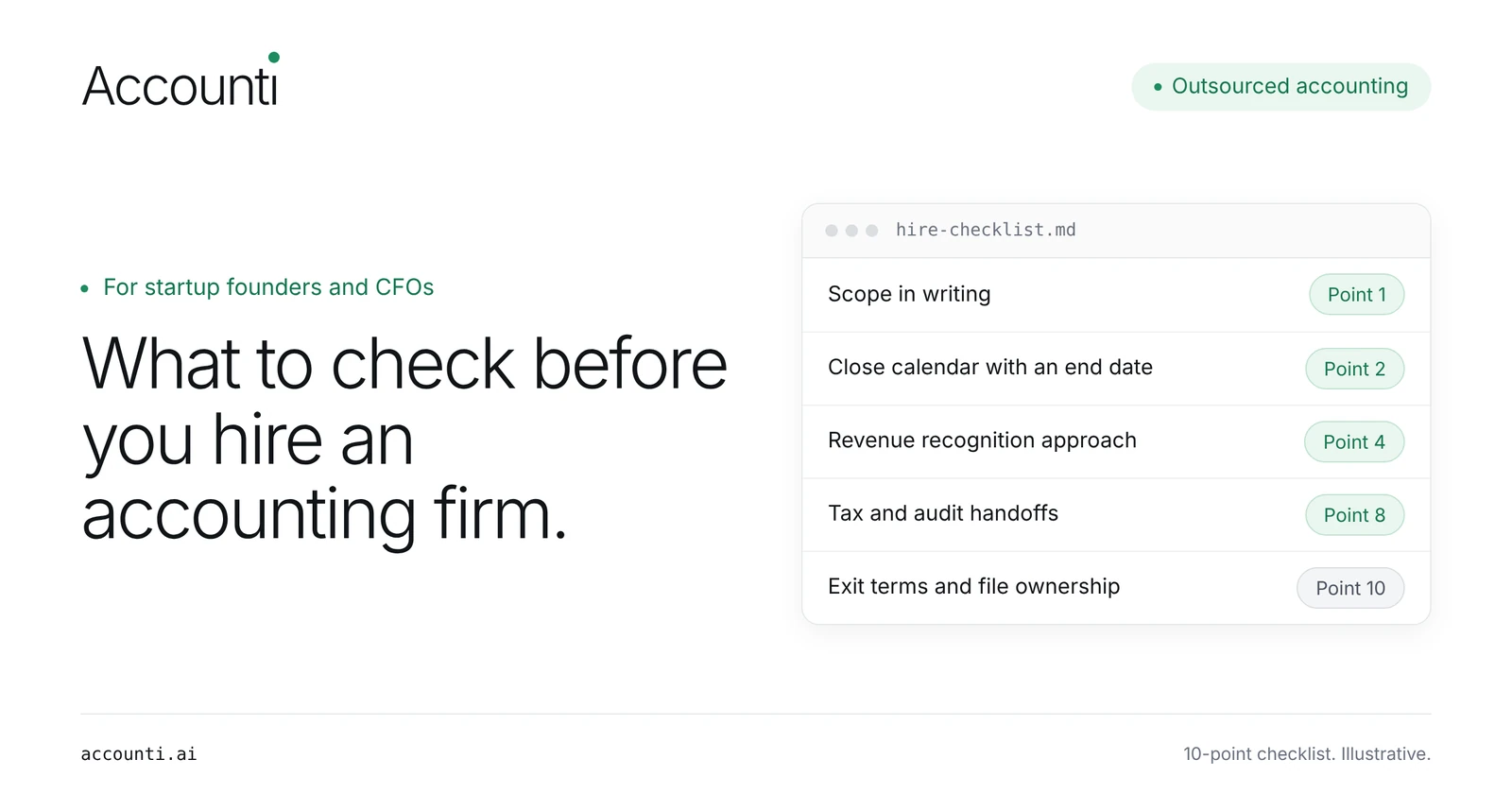
Outsourced accounting for startups works when the provider owns a defined scope and closes the books to a fixed calendar. It should also leave documentation you keep. Before you hire a firm, check 10 points. The first five cover scope, the close calendar, the accounting basis, revenue recognition and reconciliations. The other five cover policies, systems access, tax and audit handoffs, pricing and exit terms.
This checklist is for founders, CFOs and finance leads at companies with $1M or more in revenue. These companies are usually approaching a Series A or beyond. It explains what to ask on the first call and what a good answer looks like.
When outsourcing makes sense
A startup's finance function is rarely designed. It builds up over time, usually as a founder plus a bookkeeper, then a junior hire or two alongside a local accountant. Day-to-day processing and statutory filings tend to work at that stage. The weak points are revenue recognition, reconciliations, close discipline and management reporting.
Outsourcing usually starts with one of four moments:
- The current accountant has made mistakes, fallen behind or cannot keep the books investor-ready.
- A finance hire is leaving, or nobody has the bandwidth for the close.
- An audit is coming and the schedules and policies do not exist.
- A new revenue stream, a new entity or an auditor comment needs a written accounting position.
Some companies are better served elsewhere, and it is worth knowing that before you start calling firms. A pre-revenue company with a few transactions a month may need only a bookkeeper. A company whose main need is tax filing needs a tax adviser. An Indian company that needs only statutory compliance is well served by a local chartered accountant (CA) firm. Our guide to the best accounting services for startups, by stage maps each option to the stage where it fits.
Define the scope before you call
Providers price and staff against scope, so a vague brief produces quotes you cannot compare. Split the accounting function into areas, then mark which ones are broken today.
| Area | What it covers | Sign it needs attention |
|---|---|---|
| Assessment and planning | Current process, chart of accounts, how data reaches the ledger | You know something is wrong but not where to start |
| Transaction processing | Payables, invoicing, bank and card reconciliation, payroll entries | Volume has outgrown the person handling it |
| Close and reporting | Month-end close, schedules, management reports, flux analysis | The close has no end date, or nobody can explain a movement |
| Policy and documentation | Accounting policies, process notes, technical positions | Treatment changes with whoever handles the transaction |
| Audit support | Audit schedules, auditor queries, statutory reporting | An audit is approaching and the file is thin |
A good provider can take one area at a time. Starting with the most broken piece keeps the first engagement small. It also shows you how the firm works before you hand over more.
The checklist before you hire
Use these 10 points on every first call. Ask the same questions of each firm and write down the answers.
1. Scope in writing
The engagement letter should list each task, the output it produces and the date it is due. "Bookkeeping and monthly reporting" is too loose to hold anyone to. Ask the firm to name the schedules and reports you will receive each month.
2. A close calendar with an end date
A close without a defined end date drifts, and management reports arrive too late to act on. Ask for the firm's close checklist and the business day on which your books will be final. Our month-end close checklist shows what a complete close covers.
3. Accrual books from the start
Investors and auditors expect accrual accounting, which records revenue and expenses when they are earned or incurred. Cash-basis books have to be rebuilt before diligence. Ask whether the firm will keep your books on an accrual basis from the first month.
4. A written revenue recognition approach
Revenue recognition is one of the first things to break as a company grows. ASC 606 is the US standard, and IFRS 15 and Ind AS 115 apply elsewhere. Ask how the firm treats annual contracts paid upfront, setup fees and deals with several parts. For a SaaS company, our guide on fixing SaaS revenue recognition before a fundraise covers the usual problems.
5. Reconciliations and supporting schedules
A reconciliation checks a ledger balance against an independent source, such as a bank statement. A supporting schedule breaks a balance into its parts. Auditors and diligence teams ask for both first. Ask which accounts the firm reconciles every month and request a sample schedule.
6. Policies and process documentation
Written policies keep the accounting treatment stable when people change. Ask whether the firm drafts accounting policies and process notes, and whether you keep them after the engagement ends. Ask also whether it writes technical accounting papers, which auditors expect for significant judgements.
7. Access to your own systems
The ledger, bank feeds and supporting files should sit in accounts your company owns. The firm works inside them with its own user logins. Ask where documents are stored and who holds administrator rights.
8. Handoffs to tax and audit
Many providers cover accounting but not tax filing or the audit itself. The gap between them is where deadlines slip. Ask who prepares the audit schedules and who answers auditor queries. Ask too how tax adviser findings reach your financials.
9. Pricing tied to scope
A monthly fee should map to the scope in point 1. Ask what triggers a price change, such as transaction volume, a new entity or audit season. A fee with no defined scope behind it is hard to compare and harder to manage.
10. Exit terms and file ownership
Agree before you sign how the firm hands over if you part ways. That covers the files, the reconciliations, the policies and a written note on open items. A clean exit clause also makes it easier to hand the work to a full-time team later.
Questions that reveal ownership
The checklist tests process. Three further questions test whether the firm takes responsibility for the result.
Who answers when an investor asks why a number moved? A provider that owns correctness can show the schedule and commentary behind each significant line. Our guide on how to do a flux analysis explains what that commentary looks like.
What did you leave behind at your last client? Ask for anonymised examples of policies, close checklists or schedules.
What would you not take on? A firm that names its limits clearly is easier to plan around.
To see how these answers hold up under investor scrutiny, read our guide on preparing for financial due diligence before a fundraise.
How Accounti approaches outsourced accounting
Accounti's Finance Operations service works inside your accounting function to fix the part that is broken. It covers the five areas in the scope table above, and you can start with one service. A bookkeeper records transactions. Accounti takes responsibility for whether the result is correct, supported and explainable, and leaves the policies, schedules and documentation that prove it.
Accounti does not give audit opinions or file tax returns for companies. It prepares audit schedules, answers auditor queries and works alongside your tax adviser. Finance Operations starts from $3,000 a month.
A US B2B SaaS company moving from Seed to Series A cut monthly reporting time from more than 15 hours to 8. Its metrics had not reconciled and revenue had been recognised incorrectly. Accounti restructured the reporting and rebuilt the standard beneath it.
Some companies already have the people doing the work, spread across an in-house team, a vendor, a tax firm and an auditor. For them the gap is coordination. Accounti's Finance Orchestration sets one calendar and standard across all of them, from $2,500 a month. Our comparison of startup bookkeeping and finance operations explains where each fits.
Next step
Take the scope table and mark the area that is most broken today. Talk to Accounti about that one piece, and you will get a plan for fixing it first.
Frequently asked questions
What should a startup check before hiring an outsourced accounting firm?
Check 10 points: written scope, a close calendar with an end date, accrual books, a revenue recognition approach, monthly reconciliations and schedules, policies you keep, access to your own systems, tax and audit handoffs, pricing tied to scope and exit terms.
When does outsourced accounting make sense for a startup?
It usually makes sense from about $1M in revenue, when the close slips, an audit approaches, a finance hire leaves or the books stop matching the investor deck. A pre-revenue company with few transactions may need only a bookkeeper.
What is the difference between a bookkeeper and a finance operations partner?
A bookkeeper records transactions. A finance operations partner takes responsibility for whether the result is correct, supported and explainable. It leaves the policies, schedules and documentation that prove it.
Does an outsourced accounting firm handle tax and audit?
It depends on the firm, so ask on the first call. Accounti prepares audit schedules and answers auditor queries. It does not give audit opinions or file tax returns for companies, and it works alongside your tax adviser.
Can a startup outsource one part of accounting at a time?
Yes. Accounti's Finance Operations is sold one service at a time, such as the close, flux analysis or audit support. A company can start with one service and add others later.
Written by
Co-founder and COO
Harsha Baisya is a finance professional with over seven years of experience across startups and established organizations. Her expertise spans financial management, business finance, financial analysis, and building effective finance processes that support business growth. As Co-Founder and COO of Accounti, Harsha brings a practical understanding of the financial and operational challenges businesses face as they scale. Her experience includes working with finance teams to improve financial visibility, streamline processes, manage costs, and strengthen financial reporting. She focuses on helping businesses build reliable financial systems that support informed decision-making, operational efficiency, and sustainable growth.