How to Fix SaaS Revenue Recognition Before a Fundraise

Quick answer
- Investors rebuild revenue from your contracts during diligence, so recognition errors surface whether or not you find them first.
- Write one revenue recognition policy under ASC 606 and apply it to every contract, starting with annual prepaid deals and setup fees.
- Rebuild the revenue schedule contract by contract, then reconcile deferred revenue to the balance sheet each month.
- Define ARR, MRR and revenue in writing, and make the deck and the ledger use the same definitions.
- Agree any restatement of prior periods with your auditor before the data room opens.
To fix SaaS revenue recognition before a fundraise, write one revenue policy under ASC 606 and apply it to every customer contract. Rebuild the revenue schedule contract by contract and correct annual deals booked upfront. Then reconcile deferred revenue to the balance sheet. Finally, make the metrics in your investor deck use the same definitions as your ledger.
This guide is for founders and finance leads at SaaS companies with $1M or more in revenue. It assumes a Series A or later round is coming. It covers the common errors and the order in which to fix them. A company with an experienced in-house controller and a recent audit may need only a policy review with its auditor.
Why investors test revenue first
Revenue is the number every other metric depends on. Growth rate, gross margin, net revenue retention and burn multiple all start from it. A diligence team typically asks for revenue by customer, contract and period, along with your recognition policy. It then rebuilds the figures and compares them with your deck.
Financial records that do not tie to the investor deck are a common first-call problem for growing companies. The cause is usually one of two things. Metrics are defined differently in the deck and in the ledger, or revenue is recognised inconsistently from one contract to the next. Both are fixable, and both take longer to fix during diligence than before it.
The rules in brief
ASC 606 is the US standard for revenue from customer contracts. IFRS 15 applies internationally, and Ind AS 115 applies to Indian companies required to use Ind AS. All three follow the same five-step model, converged between the IASB and FASB.
| Step | What it means for a SaaS company |
|---|---|
| 1. Identify the contract | The signed order form, master agreement and any amendments |
| 2. Identify the performance obligations | Subscription access, implementation, training or support, where each is distinct |
| 3. Determine the transaction price | Fees, discounts, credits and any variable amounts |
| 4. Allocate the price | Split the price across obligations based on standalone selling prices |
| 5. Recognise revenue | As each obligation is satisfied, usually evenly over the subscription term |
For a subscription, step 5 usually means recognising revenue month by month across the term. Cash received ahead of that sits in deferred revenue, a liability on the balance sheet.
Common SaaS revenue errors
These problems turn up often in SaaS books that have not yet been audited. Each one moves revenue into the wrong month or the wrong line.
| Error | What happens | The fix |
|---|---|---|
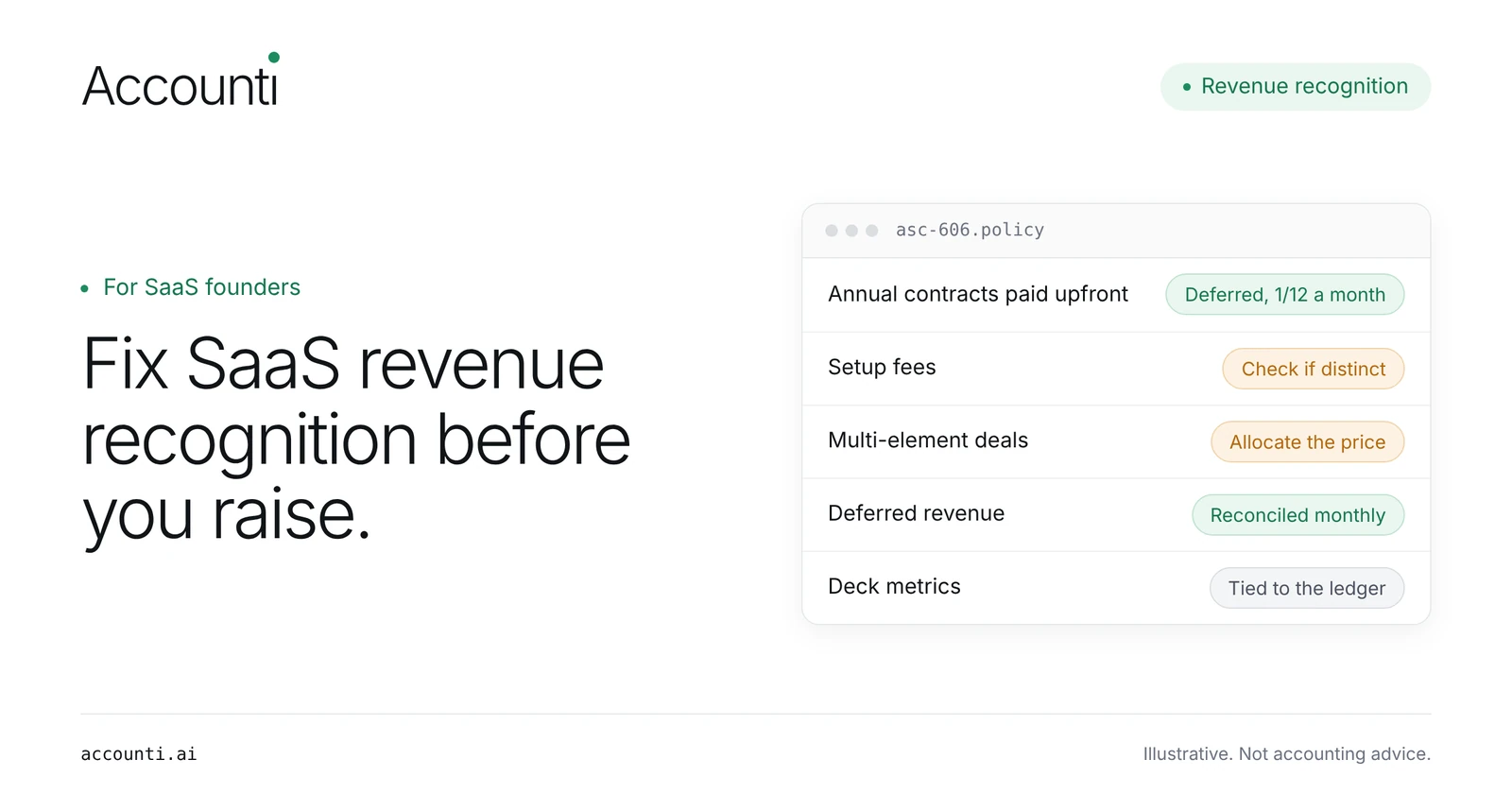
| Annual contract booked upfront | A 12-month contract invoiced in January shows as January revenue | Record the invoice to deferred revenue and recognise 1/12 each month |
| Setup fees recognised at signing | Implementation fees inflate revenue in the month a deal closes | Assess whether setup is a distinct service. Where it is not, recognise the fee over the contract period |
| Multi-element deals not split | Subscription, services and training are recorded as one amount | Allocate the price across obligations using standalone selling prices |
| Deferred revenue never reconciled | The balance drifts away from the contracts behind it | Keep a schedule by customer that ties to the ledger every month |
| Bookings shown as revenue | The deck reports contract value signed, and the ledger reports revenue earned | Report both, label them clearly and show the bridge between them |
Revenue recognition errors appear in both of Accounti's published case studies. One was a US SaaS company and the other operated in India and Dubai.
How to fix it in 6 steps
1. Write one revenue policy
Sales, engineering, delivery and finance often define revenue differently. A single written policy fixes the number at the source. It should state how the company treats each contract type, setup fees, discounts, refunds and usage charges. It should also say who approves a non-standard contract term before it is signed.
2. Inventory every customer contract
List every active and recently ended contract with its start date, end date, billing terms and price. Include order forms, amendments and side letters. Contracts that cannot be found are a diligence problem in their own right, so chase them now.
3. Rebuild the revenue schedule
Apply the policy to each contract and calculate revenue month by month. Build it as a schedule with one row per contract and one column per month. Compare the result with what the ledger shows. The difference, contract by contract, is the size of the problem.
4. Reconcile deferred revenue and receivables
Deferred revenue at month-end should equal the unearned portion of every invoiced contract. Receivables should match open invoices. Reconcile both to the ledger for every month you will show investors. A monthly flux analysis on these two lines catches new errors before they build up.
5. Decide how to correct prior periods
The rebuild may show prior months recorded incorrectly. How to correct them, through adjustments in the current period or a restatement, is a judgement to make with your auditor. Document the decision in a short technical accounting paper. Auditors expect a written position on significant judgements, and diligence teams read it too.
6. Align deck metrics with the ledger
Write down how the company calculates ARR, MRR, revenue, churn and net revenue retention. Then rebuild the deck figures from the corrected schedule using those definitions. Add a one-page bridge from bookings to recognised revenue. Our guide to gross churn vs net churn covers the retention definitions.
Who needs to agree on revenue
Revenue recognition is a finance task, but the inputs come from across the company. Sales writes the contract terms. Delivery decides when implementation is complete. Engineering often controls usage data. When each team uses its own definition, the board pack and the books disagree every month.
Put one owner on the policy and give each team a defined input with a date. Finance applies the policy at the close. Changes to standard contract terms go through finance before signature, so new deals do not reopen old problems.
What the data room needs
Prepare this revenue support before the data room opens:
- The written revenue recognition policy and any technical accounting papers.
- Revenue by customer, by contract and by month, tied to the ledger.
- A deferred revenue schedule by customer, reconciled to the balance sheet.
- Metric definitions for ARR, MRR, churn and retention.
- A bridge from the deck figures to the financial statements.
Our guide on preparing for financial due diligence before a fundraise covers the rest of the data room.
How Accounti fixes revenue recognition
The work splits in two, and Accounti covers both. Finance Orchestration aligns sales, engineering, delivery and finance on a single revenue recognition policy. It traces where each number originates, so revenue is right at the source. It also coordinates your auditor and advisers through diligence. Finance Orchestration starts from $2,500 a month.
Finance Operations does specific accounting work, one service at a time. That includes drafting accounting policies, writing technical accounting papers and rebuilding the schedules behind critical accounts. Finance Operations starts from $3,000 a month.
A US B2B SaaS company moving from Seed to Series A came to Accounti with revenue recognised incorrectly. Its metrics did not reconcile, and there was no reporting investors could depend on. Accounti restructured the reporting and rebuilt the standard beneath it. The company cut monthly reporting time from more than 15 hours to 8.
Accounti does not give audit opinions. Your auditor signs off on the treatment, and strategic calls stay with the founders and the board.
Next step
Pull your 10 largest contracts and rebuild their revenue for the last 12 months against the ledger. The gap tells you how much work sits between you and a clean data room. Talk to Accounti about closing it before your raise.
Frequently asked questions
Which revenue recognition standard applies to SaaS companies?
ASC 606 in the US, IFRS 15 internationally and Ind AS 115 for Indian companies required to use Ind AS. All three follow the same five-step model.
How should a SaaS company recognise an annual contract paid upfront?
Record the invoice to deferred revenue, then recognise the subscription evenly over the 12-month term, usually 1/12 each month.
How are SaaS implementation fees recognised under ASC 606?
It depends on whether the setup work is a distinct service. Where it is not distinct, the fee is recognised over the contract period with the subscription. Your auditor confirms the treatment.
Why don't my financials match my investor deck?
Usually because metrics are defined differently in the deck and the ledger, or revenue is recognised inconsistently. A written revenue policy and metric definitions applied in both places fix it at the source.
Does Accounti audit our revenue recognition?
No. Accounti writes the policy, rebuilds the schedules and coordinates your auditor. The audit opinion comes from your auditor.
Written by
Co-founder and COO
Harsha Baisya is a finance professional with over seven years of experience across startups and established organizations. Her expertise spans financial management, business finance, financial analysis, and building effective finance processes that support business growth. As Co-Founder and COO of Accounti, Harsha brings a practical understanding of the financial and operational challenges businesses face as they scale. Her experience includes working with finance teams to improve financial visibility, streamline processes, manage costs, and strengthen financial reporting. She focuses on helping businesses build reliable financial systems that support informed decision-making, operational efficiency, and sustainable growth.