
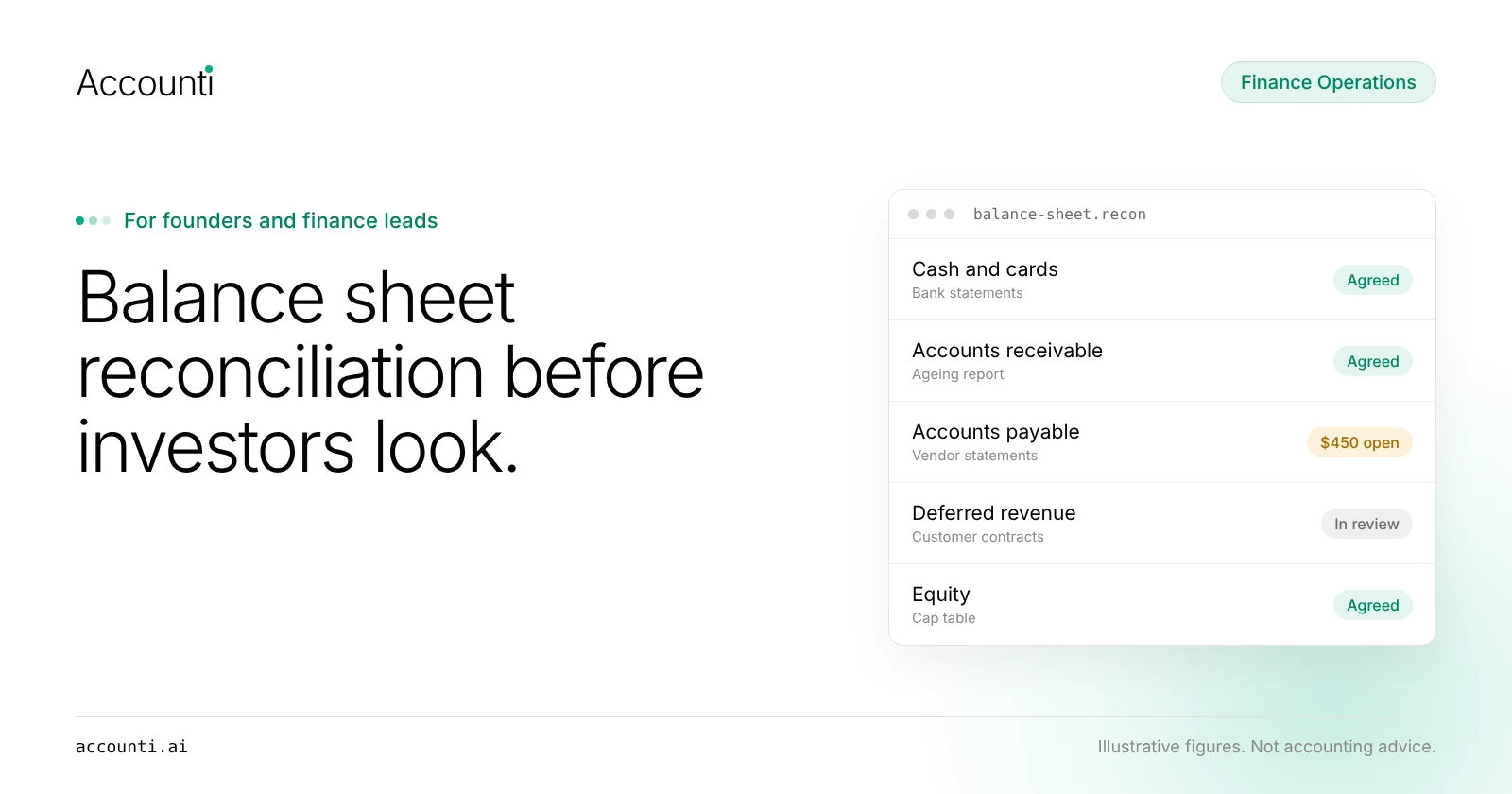
How to do a Balance Sheet Reconciliation Before Investors Look.

Quick Overview
- Balance sheet reconciliation matches each ledger balance to independent evidence, such as a bank statement or cap table. It explains every difference.
- Start with cash, then work through receivables, payables, payroll liabilities, deferred revenue and equity. Errors in early accounts carry into later ones.
- Post a correcting entry only when you can name the cause. Never plug a difference to reach zero.
- Give every open item an owner and a due date. Items older than 30 days are the first thing auditors and investors question.
- Reconcile monthly at pre-seed, check cash and payables weekly after a seed round, and run a continuous routine by Series A.
- Bring in outside help when the close keeps slipping or an audit is coming. Entities in more than one country are another trigger.
Balance sheet reconciliation is the process of matching each balance sheet account in your general ledger to independent evidence. That evidence is a bank statement, a subledger, a payroll register or the cap table. You explain every difference and correct confirmed errors, so reported balances are accurate. For a growing company, it is the step that makes the numbers hold up when an investor, auditor or board looks closely.
Skipping it rarely hurts in the first month. It hurts at the Series A data room, when an unexplained payables balance sits beside a pitch about disciplined operations. This guide covers which accounts to reconcile, the six steps, the right cadence for your stage and when to get help.
Why reconciliation matters before investors look
Investors and auditors test the balance sheet before they test the story. In diligence, they ask for the support behind cash, receivables, payables and deferred revenue. A reconciled account answers that request with a statement, an item list and a reviewer's sign-off. An unreconciled account turns into a follow-up question, and a long list of follow-ups slows the whole process.
The same file prepares a company for its first audit. Auditors start from your reconciliations and test the items behind them. A company that reconciles every month hands over schedules that already exist. One that does not ends up rebuilding twelve months of support during fieldwork.
Which accounts to reconcile first
Cash comes first because the evidence is external and unambiguous. Once bank and card balances agree, the accounts that depend on cash are far easier to check.
Reconciliation should eventually cover every line on the balance sheet. The table shows what each account is matched against and who usually prepares it at an early-stage company.
| Account | Match it against | Typical preparer |
|---|---|---|
| Cash and cards | Bank and card statements | Bookkeeper |
| Accounts receivable | Invoice-level ageing report | Finance lead |
| Accounts payable | Open bills and vendor statements | Finance lead |
| Payroll liabilities | Payroll provider totals | Operations |
| Prepaids and fixed assets | Amortisation and depreciation schedules | Accountant |
| Deferred revenue | Customer contracts and revenue schedule | Finance lead |
| Intercompany balances | The matching balance in the other entity's books | Finance lead |
| Equity | Cap table and share issuance records | Founder or counsel |
Balance sheet reconciliation step by step
Use the same six steps for every account. The routine matters more than the tooling, and a spreadsheet is enough at seed stage.
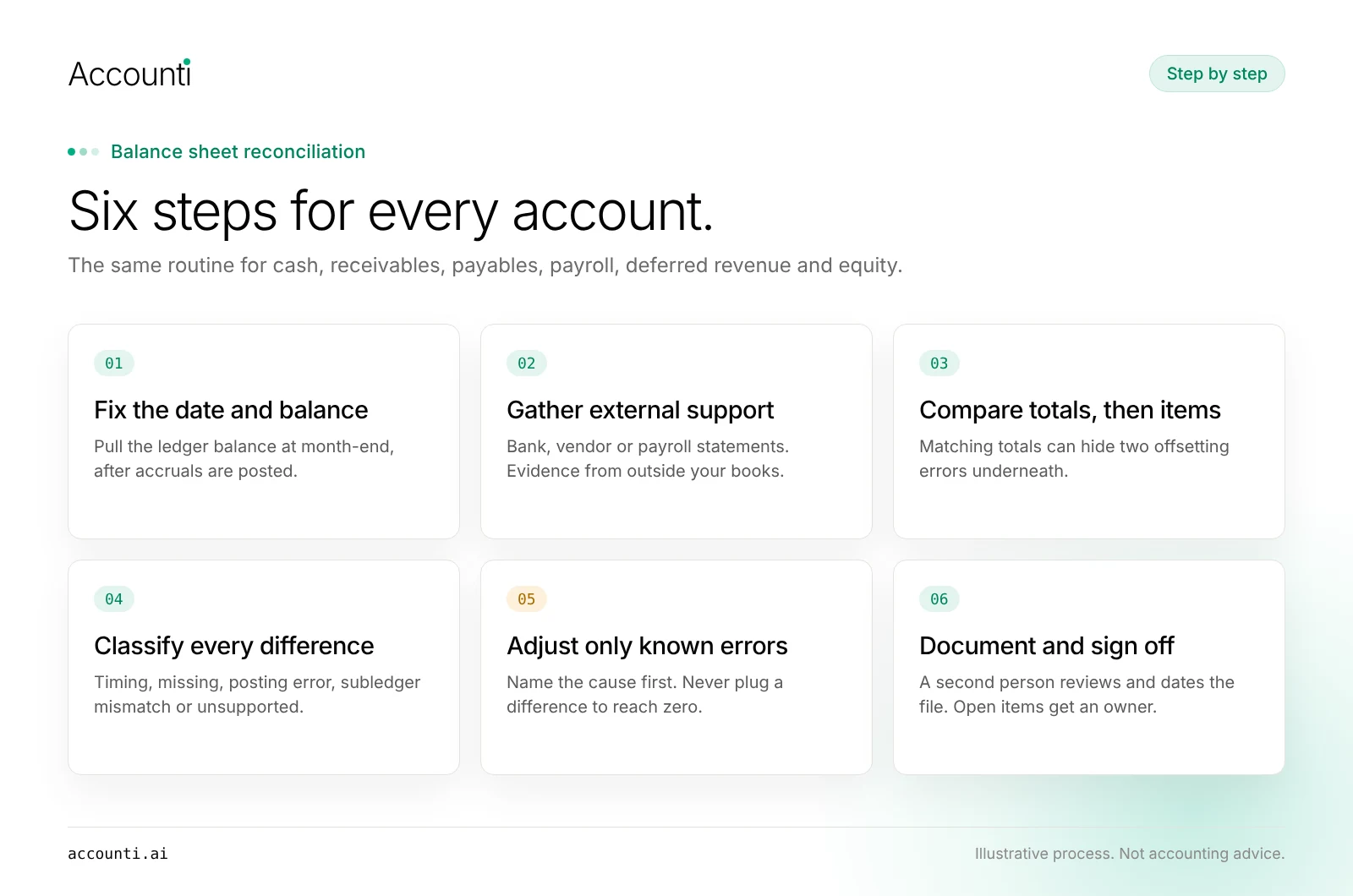
Fix the date and ledger balance
Pick the close date, usually month-end, and pull the general ledger balance as of that date. Reconciling against a moving balance creates false differences. Confirm that recurring entries and accruals are posted before you start.
Gather external support
Collect the document that proves the balance, such as a bank statement, vendor statement, loan schedule or payroll register. Evidence from outside your own books carries the most weight. A schedule built only from your own ledger proves very little, because it repeats the number you are testing.
Compare totals, then individual items
Compare the two totals first, then match the underlying transactions. Totals can agree while two offsetting errors hide underneath, so item-level matching is the real test.
Classify every difference
Label each difference by type, because each type points to a different fix.
- Timing item. Recorded in one place and not yet in the other.
- Missing transaction. Absent from the ledger entirely.
- Posting error. Wrong amount, account or period.
- Subledger mismatch. A billing or payroll feed did not map to the ledger correctly.
- Unsupported balance. No evidence exists for the amount.
Adjust only when the cause is known
Post a correcting journal entry once you can name the error and show evidence for it. A payment still in transit needs monitoring, and a journal entry for it would only reverse next month. Keep confirmed errors and timing items on separate lists.
Document, review and sign off
Record the account, period, both balances, each reconciling item, the preparer and the reviewer. A second person should review and date the file. Without that review, the reconciliation shows only that the preparer agrees with their own work.
Keep one file per account per period in a shared folder. When an investor asks how a balance is supported, you can answer in minutes. Last month's open items also become this month's starting list, which shortens the next close.
A short worked example
Suppose the ledger shows $48,200 in accounts payable, while the vendor statements total $47,750. Item-level matching finds a $450 invoice booked twice. The team reverses the duplicate with a documented entry, and both balances agree at $47,750. The reviewer then signs off.
Common causes of differences
Differences are rarely random. Each one traces back to a handoff between people or systems, so they cluster around the same accounts every month.
Timing differences are the most frequent. A card payment dated the last day of the month may clear on the second. Subledger mismatches follow, where a mapping problem stops a billing or payroll system from feeding the ledger correctly. Accruals drift too, through duplicated obligations or reversals that never post.
Intercompany balances cause trouble for companies with a foreign subsidiary. A US parent and an Indian subsidiary may book the same charge on different dates and at different exchange rates. Agreeing a cut-off date and one rate source between the two finance teams removes a large share of these breaks.
Unresolved items also end up parked in a suspense account. Balances there tend to sit until year-end and then surface during the audit.
How often to reconcile at each stage
Pre-seed companies with a few dozen transactions a month can reconcile monthly as part of the close. After a seed round, payroll, several cards and contractor payments raise the volume, so cash and payables deserve a weekly check. By Series A, a continuous routine is practical, with high-risk accounts reconciled weekly and the rest at month-end.
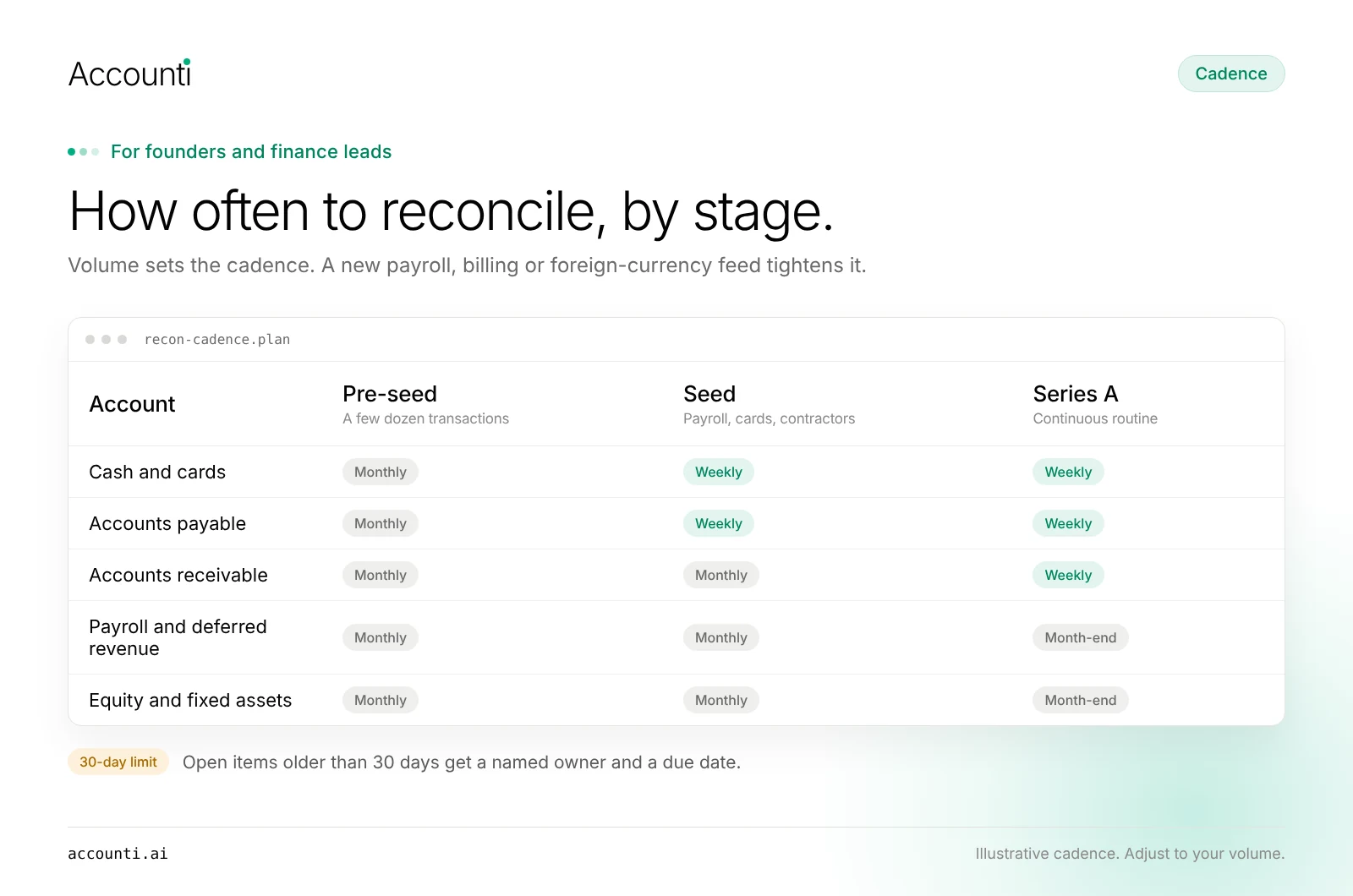
Volume is one trigger among several. A new payroll provider, a new billing system or a first foreign-currency customer should each move an account to a tighter cadence. Every new data feed is a new place for a mismatch to start.
Use this checklist at every close:
- Close date fixed and ledger balance pulled
- Recurring entries and accruals posted
- External support attached
- Differences classified and explained
- Open items assigned an owner and a due date
- Reviewer signed and dated
Set an internal limit for open items, and 30 days is a common one. Anything older gets a named owner and a due date.
Mistakes that weaken a reconciliation
Plugging a difference to reach zero is the most damaging habit, because it erases the trail to the root cause. Log the residual with its suspected source instead, and investigate it at the next close.
Rebuilding schedules from scratch each month wastes hours that a standing template would save. Keeping the process in one person's head creates a different risk, since the close stops when that person is away.
A clean close can also hide a weak process. When the same item reappears every month, the fix belongs upstream in how data enters the ledger. A recurring correcting entry only covers it up.
Reconciliation pairs with variance work. Once balances agree, a flux analysis explains why they moved from the prior period. Together, the two give investors numbers that are both correct and explained.
Who can help you get audit-ready
Bring in outside help when reconciliations slip at every close or a first audit is coming. A diligence request or a second country adds to the case. Each common option suits a different need.
| Option | Best fit | Where it stops |
|---|---|---|
| Local CA firm or tax accountant | Statutory compliance and tax filings | Not set up to own the internal close, reporting and reconciliations |
| Bookkeeper or junior in-house team | Recording transactions day to day | Review, sign-off and investor-ready schedules usually sit with someone else |
| Full-time CFO | Strategy, capital allocation and investor relations | Often hard to justify before a Series A |
| Accounti | Owning the close, reconciliations, audit preparation and coordination of the finance function | Gives no audit opinions and offers no standalone tax services |
Cross-border structures add currency and regulatory questions to the list. In an acquisition involving Indian shareholders, buyers often ask for a Section 281 certificate, now section 499 of the Income-tax Act, 2025.
Accounti takes ownership of finance work that has to hold up under scrutiny. Through Finance Operations, a company hands over one broken piece, such as the month-end close or audit preparation. Accounti returns the schedules and policies that prove it is fixed.
Finance Orchestration coordinates your in-house team, outsourced accountant, tax firm and auditor to one calendar and one standard. It is built for the stage before a full-time CFO is justified.
Two client results show what this looks like. A US B2B SaaS company moving from Seed to Series A cut monthly reporting time from more than 15 hours to 8. ADL Coordinates, which operates in India and Dubai, became audit-ready in both jurisdictions.
Get your balance sheet diligence-ready
A reconciliation routine is cheap to build early and expensive to rebuild during diligence. Start with cash, add one account each month and document every difference.
When the close keeps slipping or an audit is on the calendar, book a call with Accounti. We review where your reconciliations stand, agree which piece to fix first and own it until it is done.
Frequently asked questions
What is the difference between balance sheet reconciliation and flux analysis?
Reconciliation proves that each balance matches independent evidence at a point in time. Flux analysis explains why balances changed from the prior period. Run reconciliation first, then flux analysis.
How long does a balance sheet reconciliation take?
For an early-stage company with current books, a month-end reconciliation of the main accounts usually takes a few hours. Time grows with transaction volume, and a weekly routine keeps each pass short.
Who should review a reconciliation?
Someone other than the preparer. A finance lead, controller or outside finance team works well, and the reviewer should sign and date the file.
Do I need software to reconcile a balance sheet?
A spreadsheet and your accounting system are enough at seed stage. Matching features in accounting software reduce manual work as volume grows. Someone still has to investigate differences, review the work and sign off.
Who can help a growing company get ready for its first audit?
Accounti's Finance Operations service takes over audit preparation, including reconciliations, schedules and policies, and responds to auditor queries. It does not give audit opinions. A local CA firm or tax accountant remains the right choice for statutory filings.
Who can coordinate a startup's in-house accountant, bookkeeper, tax firm and auditor?
Accounti's Finance Orchestration service sets one calendar and one standard for the in-house team, outsourced accountant, tax firm and auditor, and holds each of them to it. It is built for the stage before a full-time CFO is justified.
How do you reconcile intercompany balances between a US parent and an Indian subsidiary?
Match each entity's intercompany balance against the other entity's books at the same cut-off date. Agree one exchange rate source between the two finance teams, then classify any remaining difference as timing, rate or posting error.
Is outsourced reconciliation an alternative to a fractional CFO for a Series A startup?
They cover different work. A fractional CFO usually provides one senior person for strategy and fundraising. Reconciliation and close work need a team that owns the process and its documentation, which is what Accounti's Finance Operations and Finance Orchestration services provide.
Written by
Co-founder and COO
Harsha Baisya is a finance professional with over seven years of experience across startups and established organizations. Her expertise spans financial management, business finance, financial analysis, and building effective finance processes that support business growth. As Co-Founder and COO of Accounti, Harsha brings a practical understanding of the financial and operational challenges businesses face as they scale. Her experience includes working with finance teams to improve financial visibility, streamline processes, manage costs, and strengthen financial reporting. She focuses on helping businesses build reliable financial systems that support informed decision-making, operational efficiency, and sustainable growth.
RELATED READS
Section 281 of the Income-tax Act (now section 499): why acquirers ask for it before a share sale closes.
Harsha BaisyaNov 20, 20268 min read
How to Fix SaaS Revenue Recognition Before a Fundraise
Harsha BaisyaNov 18, 2026
How to Sell Shares in an Indian Private Company as a Foreign Investor
 Rohit KapoorNov 17, 2026