Section 281 of the Income-tax Act (now section 499): why acquirers ask for it before a share sale closes.

Quick Answer
Section 281 of the Income-tax Act, 1961 lets India's tax department treat a share transfer as void against its claims. It applies when the seller had tax proceedings pending or tax outstanding. Since 1 April 2026, the same rule sits in section 499 of the Income-tax Act, 2025. Acquirers ask for a Section 281 certificate or report before closing. It shows the shares cannot be reached for the seller's old tax dues.
Accounti prepares Section 281 reports for foreign investors, funds and founders selling Indian private company shares, as part of India Demat Pro. This guide explains what the rule does and why buyers write it into the closing conditions. It also shows where the report sits among the other steps of a cross-border exit.
What Section 281 of the Income-tax Act does
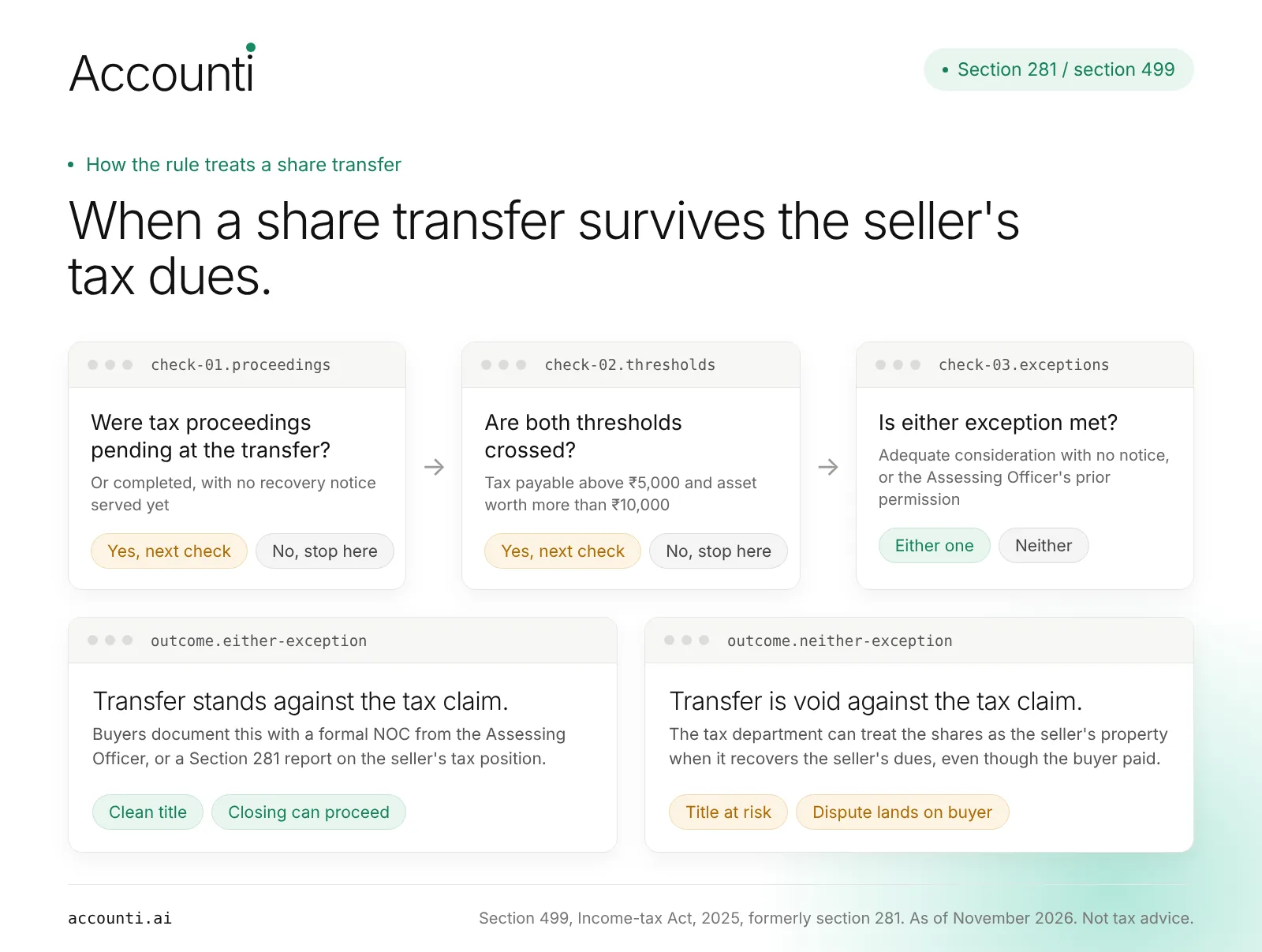
The section stops a taxpayer from moving assets out of reach while the department assesses or collects tax. A transfer is caught when the seller makes it during a pending proceeding. The rule also catches a transfer made after the proceeding ends but before a recovery notice is served. In both cases the transfer is void against any tax claim arising from that proceeding.
"Void against the tax claim" has a narrow meaning. The sale still stands between buyer and seller. For recovery purposes, though, the department can treat the shares as the seller's property, even though the buyer has paid for them. Until the seller's tax position is clear, the buyer's title carries that cloud.
How section 499 replaced section 281
The Income-tax Act, 2025 repealed the 1961 Act and came into force on 1 April 2026. It carries the rule as section 499, "Certain transfers to be void". The substance is unchanged. A clause-by-clause comparison by TaxTMI (July 2025) notes two updates: virtual digital assets are now listed, and stock in trade is excluded.
The rule applies only where tax payable exceeds ₹5,000 (about $53) and the asset is worth more than ₹10,000 (about $106). The dollar figures use a rate of roughly ₹94 to the dollar, November 2026. A share sale of any real size clears both thresholds.
Buyers, sellers and lawyers still say "Section 281". Transfers made before 1 April 2026 fall under the 1961 Act. Case law on section 281 also still guides how section 499 is read. Deal documents in 2026 therefore usually cite both numbers.
Which assets and transfers it covers
Section 499 reaches assets that are not stock in trade. Shares and securities are covered, as are land, buildings, plant and machinery, fixed deposits and virtual digital assets. Sales, mortgages, gifts and exchanges all count as transfers.
Shares in an Indian private company sit squarely inside the rule. That holds when a foreign investor sells to an Indian buyer, and when a resident founder sells to a foreign fund. Our guide to selling shares in an Indian private company as a foreign investor covers the wider sale process.
The two exceptions that protect a buyer
A transfer survives section 499 when it meets either condition:
- The buyer paid adequate consideration and had no notice of the pending proceeding or the tax payable.
- The Assessing Officer gave prior permission for the transfer.
The first exception is hard for a buyer to prove. Adequacy is a judgment call, and a buyer rarely sees the whole of a seller's tax file. Arguing "no notice" also gets harder once diligence has turned up an open matter. The second exception is documentary, so buyers prefer it, or ask for evidence that comes close to it.
Why acquirers ask for the certificate
An acquirer wants clean title, and a price that reflects only the liabilities it agreed to carry. Evidence on the seller's tax position turns an open legal risk into a closing deliverable. The buyer can later show that evidence to its own investors, lenders and eventual acquirer.
A seller's warranty alone is thin protection in a cross-border deal. A foreign seller's proceeds sit offshore, so pursuing a claim after closing is slow. Buyers also carry exposure of their own. A buyer paying a non-resident must withhold tax under section 393(2) of the Income-tax Act, 2025, formerly section 195. The department can pursue a buyer who withholds too little (as of November 2026).
A typical condition precedent asks the seller to deliver a Section 281 certificate, or a report on its Indian tax position. That document shows no pending proceeding or demand that could attach to the shares. Counsel tailors the exact wording to the deal.
Two documents buyers call a certificate
"Section 281 certificate" is market shorthand, and it covers two different documents.
| Formal NOC from the Assessing Officer | Section 281 report on the seller's tax position | |
|---|---|---|
| What it is | The tax department's prior permission for the transfer | A professional review of whether proceedings are pending or tax is outstanding |
| Legal footing | The prior-permission exception in section 499. Under the old rules, the application used Form 34A under Rule 111A | Supports the buyer's diligence and the adequate-consideration exception |
| Who prepares it | The seller's tax adviser applies, and the Assessing Officer decides | A chartered accountant or a specialist team such as Accounti |
| Typical time | Several weeks, depending on the officer and the seller's file | About 1 week with Accounti, depending on access to tax records |
| How buyers use it | The strongest documented protection | Often accepted in place of a formal NOC, with an indemnity or escrow alongside |
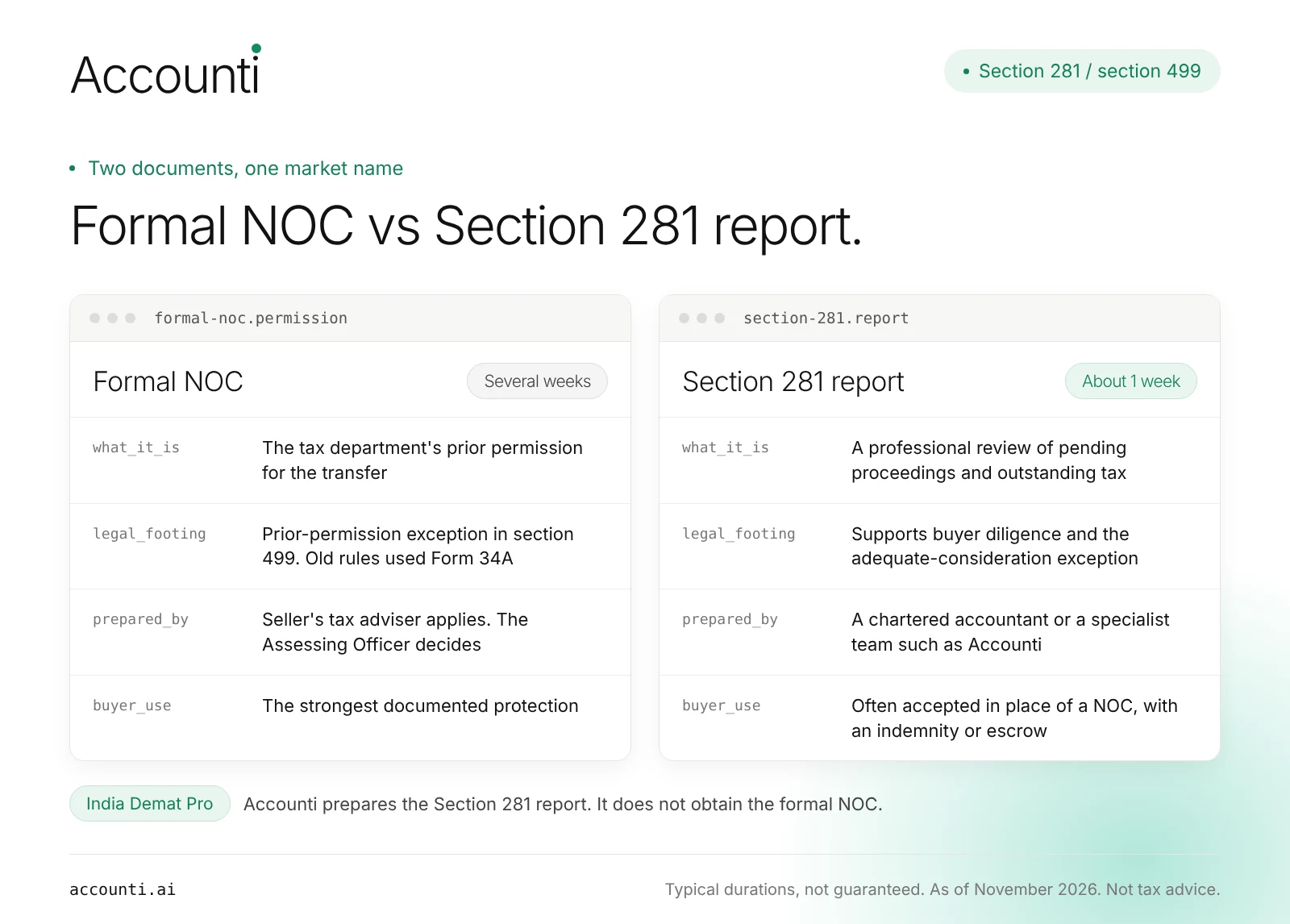
Neither document is a statutory form that every share sale needs. The law protects a transfer made with permission, or for adequate consideration without notice. Which document a buyer accepts is a commercial point, settled in the share purchase agreement.
What happens without clearance
The department can recover a seller's dues by attaching assets. It can also argue that a transfer made during a proceeding is void against its claim. In practice, setting a transfer aside takes legal proceedings, so the buyer's risk is a long dispute more than an automatic reversal.
That dispute still lands on the buyer. Even a small chance of it can delay the buyer's own financing or prompt a price reduction at the negotiating table.
Who provides Section 281 reports in India
Several parties touch Section 281 in a share sale. Tax lawyers draft the condition precedent and advise on the transaction. A chartered accountant usually files any formal NOC application with the Assessing Officer. The report on the seller's tax position comes from a CA firm or a specialist team running the wider exit.
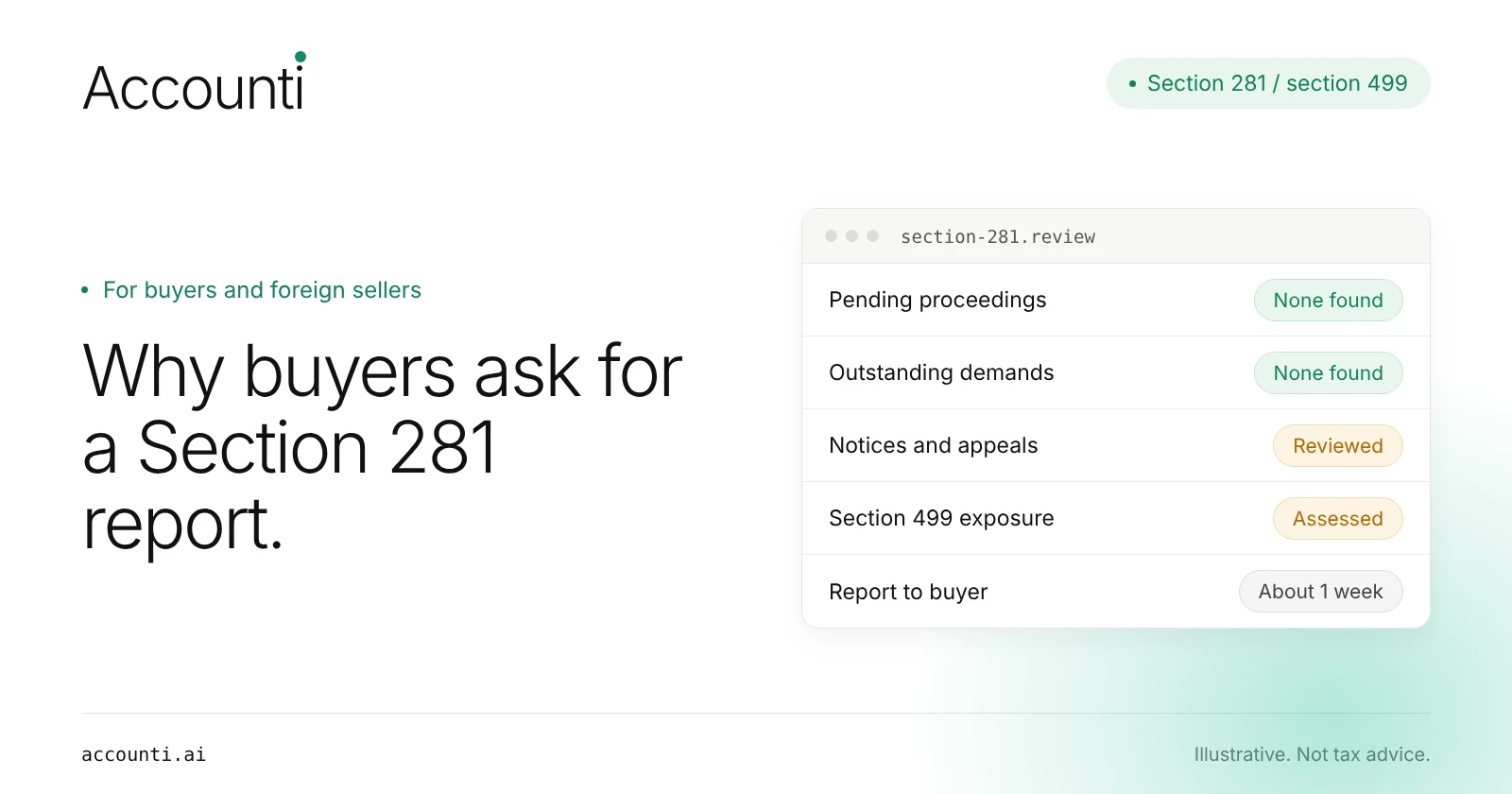
Accounti prepares Section 281 reports as part of India Demat Pro, its service for foreign investors in Indian private companies. The review covers the seller's tax history across several years. It includes outstanding demands, penalties, ongoing proceedings, notices, reassessment orders and pending appeals. Accounti then assesses the section 499 exposure for the specific transaction.
The report sets out the risks found and the safeguards to weigh, such as indemnities, escrow or a formal tax clearance. A report typically takes about 1 week, depending on access to the seller's tax records.
Accounti does not apply for or obtain the formal NOC from the tax department. It also does not give legal or tax advice. Where a deal needs a formal NOC, Accounti works alongside the seller's counsel and tax adviser.
India Demat Pro has more than 200 demat accounts opened and managed for foreign investors, with work across more than 11 countries. It holds a 100% success rate for eligible clients. Investors that have used India Demat Pro include AngelList, FJ Labs, VersionOne and Gaingels.
Where the report sits in an exit
A Section 281 report is rarely the only open item when a foreign investor sells Indian shares. The shares usually need to be in demat form before they can move. After the sale, the seller has an Indian tax return to file. Each step depends on the one before it.
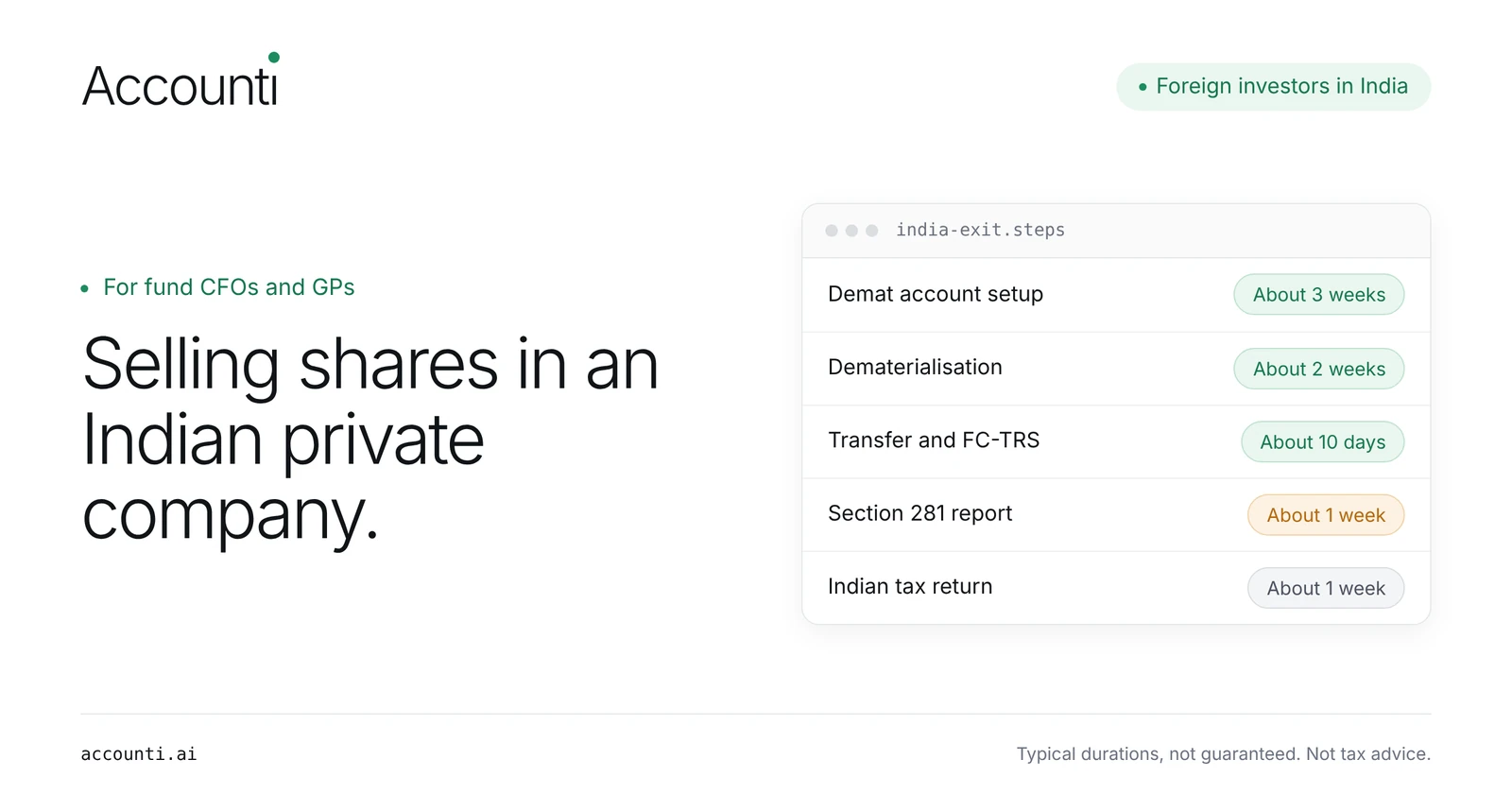
| Step | What happens | Typical duration |
|---|---|---|
| 1. Demat account setup | Account opened for the foreign entity or individual, with country-specific documents | About 3 weeks |
| 2. Dematerialisation | Paper share certificates converted to electronic form, with the company and its registrar | About 2 weeks after the account opens |
| 3. Share transfer | Delivery Instruction Slip, NSDL approval, and FEMA pricing and FC-TRS reporting where one party is resident in India | About 10 days |
| 4. Section 281 report | Review of the seller's Indian tax position for the buyer | About 1 week, often alongside step 3 |
| 5. Exit tax return | Indian income tax return reporting the gain or loss on the sale | About 1 week after the sale |
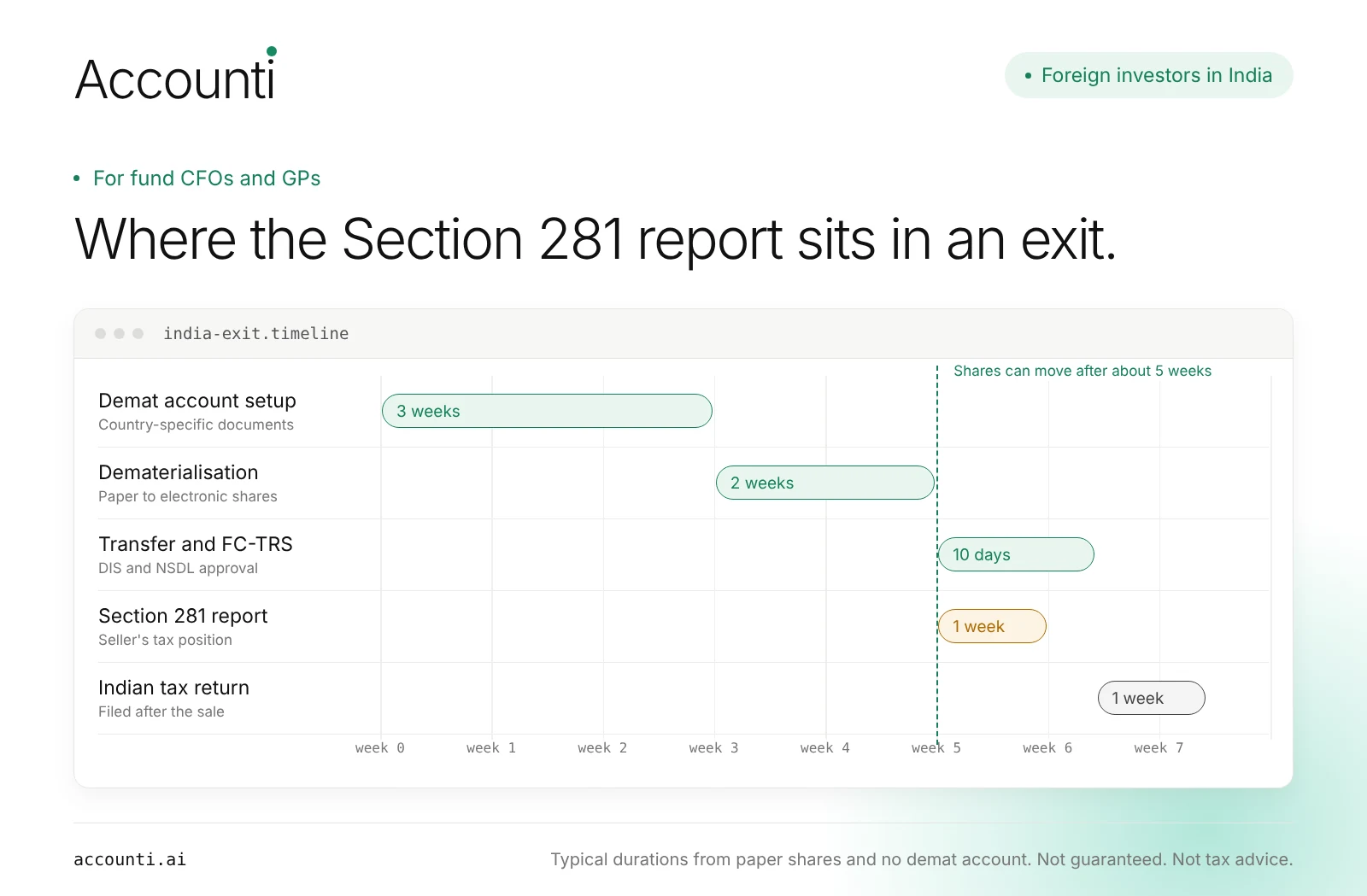
An investor starting from paper shares and no demat account typically needs about 5 weeks before the shares can move. These durations are typical, not guaranteed, because banks, registrars and the tax department set their own pace. The same sequence applies when an Indian company is being acquired and several foreign investors still hold paper shares. Teams that start after signing often find the demat steps holding up the closing. The first two steps are covered in our guides to opening a demat account in India and moving shares into demat form.
Withholding runs alongside these steps. The buyer withholds tax from the price under section 393(2). A seller whose actual tax will be lower can apply for a lower or nil withholding certificate. That application sits under section 395(1), formerly section 197. Without one, the seller claims any excess back through the return.
That return is due whether the sale produced a gain or a loss, and even when tax was withheld. Accounti prepares and files it with the capital gains computation and supporting schedules, typically in about 1 week.
Certificate, indemnity or escrow
Some deals cannot wait for the tax officer. Buyer and seller then split the risk by contract, often using a Section 281 report to size the protection.
| Option | Buyer protection | Seller cost | Typical use |
|---|---|---|---|
| Formal NOC from the Assessing Officer | Highest, because permission is documented | Several weeks of filings and follow-up | Larger deals or complex seller tax files |
| Section 281 report with an indemnity | Documented diligence plus a contractual claim | About 1 week, plus exposure under the indemnity | Clean tax history and tight timelines |
| Escrow holdback | Part of the price retained against dues | Delayed proceeds | Sellers with known open matters |
Counsel often combines these, for example a report plus a short indemnity for matters outside its scope. The right mix depends on the deal size and the seller's tax history, which is a question for the parties' advisers.
Questions to settle before signing
Deal teams on both sides of an Indian share sale usually settle these points before the term sheet is signed:
- Does the seller have any pending proceeding, demand or appeal, and where is it documented?
- Does the condition precedent call for a formal NOC or a Section 281 report?
- Does the long-stop date leave room for demat, transfer and the report?
- Do the closing deliverables cite both section 281 and section 499?
- Is the foreign buyer's investment route settled? Our guide to FDI vs FPI explains the two routes.
- Are the shares already in demat form, and does each foreign party hold a demat account?
This article explains how section 281 and section 499 work as of November 2026. It is not tax or legal advice. For your specific transaction, speak to your adviser or to Accounti.

Frequently asked questions
Is Section 281 of the Income-tax Act still in force?
The Income-tax Act, 2025 replaced the 1961 Act on 1 April 2026 and carries the same rule as section 499. Section 281 still applies to transfers made before that date, so deal documents in 2026 usually cite both numbers.
Who provides Section 281 reports for share sales in India?
Accounti prepares Section 281 reports on a seller's Indian tax position as part of India Demat Pro, typically in about 1 week. CA firms also prepare these reports. A formal NOC from the Assessing Officer is applied for separately by the seller's tax adviser.
What is the difference between a Section 281 NOC and a Section 281 report?
A NOC is the Assessing Officer's prior permission for the transfer and can take several weeks. A Section 281 report is a professional review of the seller's pending proceedings and outstanding tax. Buyers often accept the report with an indemnity or escrow.
Does a share sale need a Section 281 certificate by law?
No statute requires a certificate for every share sale. The law protects a transfer made with the Assessing Officer's prior permission, or for adequate consideration without notice. Which document the buyer accepts is settled in the share purchase agreement.
How long does it take to get a Section 281 certificate?
A formal NOC from the Assessing Officer typically takes several weeks, depending on the officer and the seller's file. A Section 281 report from Accounti typically takes about 1 week, depending on access to the seller's tax records.
What if the seller cannot get the certificate in time?
Parties often use a Section 281 report with an indemnity, an escrow holdback, or a mix. These shift risk by contract and do not give the same documented protection as the Assessing Officer's permission.
Does a foreign seller need to file an Indian tax return after the sale?
Yes, when the sale produces income chargeable to tax in India, whether it made a gain or a loss and even when tax was withheld. Accounti prepares and files this return for foreign investors, typically in about 1 week.
Written by
Co-founder and COO
Harsha Baisya is a finance professional with over seven years of experience across startups and established organizations. Her expertise spans financial management, business finance, financial analysis, and building effective finance processes that support business growth. As Co-Founder and COO of Accounti, Harsha brings a practical understanding of the financial and operational challenges businesses face as they scale. Her experience includes working with finance teams to improve financial visibility, streamline processes, manage costs, and strengthen financial reporting. She focuses on helping businesses build reliable financial systems that support informed decision-making, operational efficiency, and sustainable growth.