
How to run finance for a US company with an Indian subsidiary?

Quick Answer
- India closes its year on 31 March and a Delaware parent usually closes on 31 December. Both sets of books feed one consolidated view.
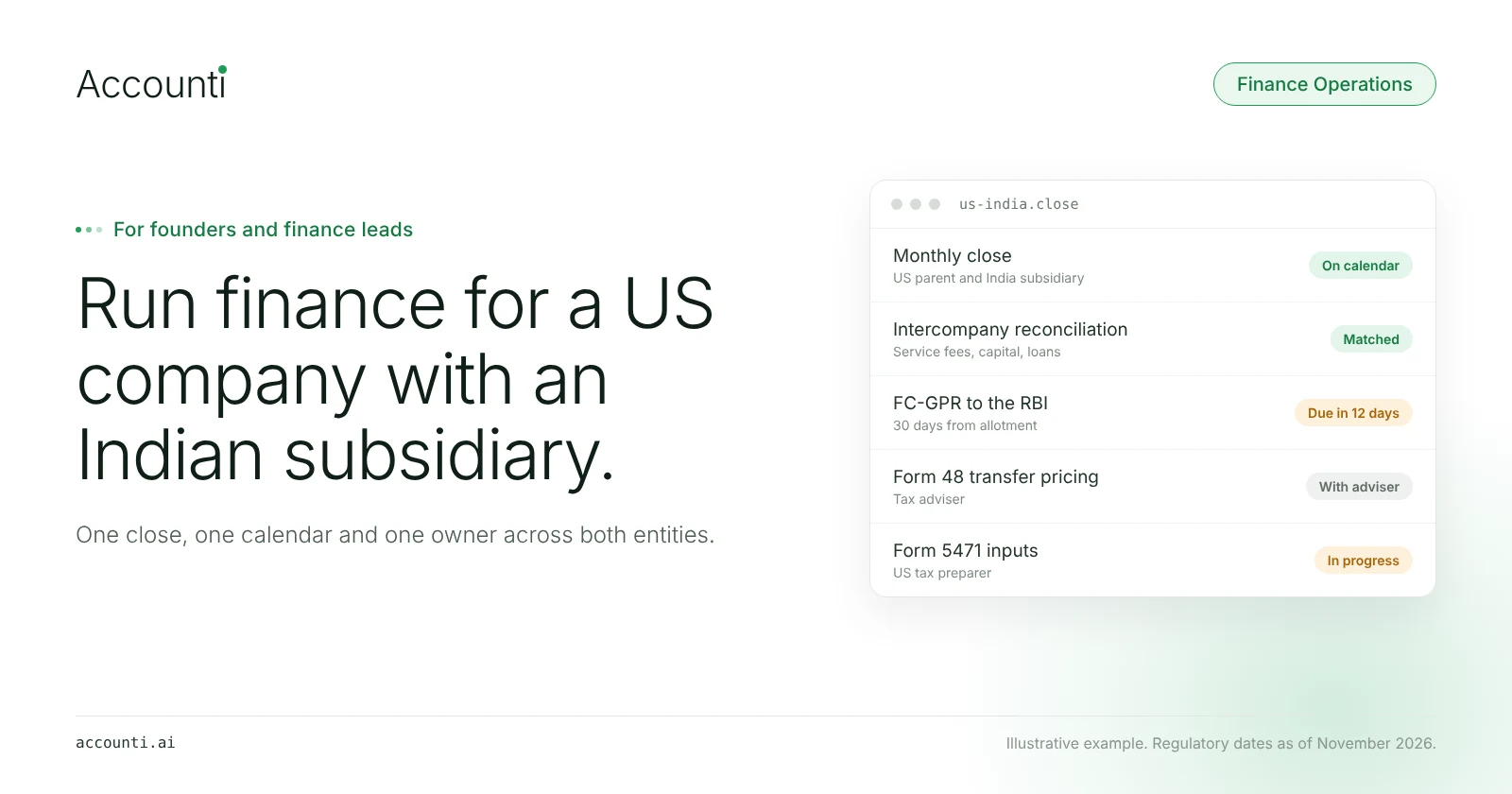
- New shares issued to the US parent are reported to the RBI in Form FC-GPR within 30 days of allotment. The annual FLA return is due by 15 July.
- Intercompany service charges need an arm's-length price, a signed agreement and an accountant's report in India (Form 48 from tax year 2026-27).
- The US parent attaches Form 5471 for the Indian entity to its own return. A missed filing carries a $10,000 penalty per foreign corporation per year.
- A local CA firm is the right fit when the only need is Indian compliance filings.
A US startup with an Indian engineering or operations team runs two sets of books on two filing calendars. Every transaction between the entities has to be explained on both sides, so the work grows faster than headcount. This guide covers how to set up the function so it holds up in diligence and at audit. It also covers where outsourced finance and accounting fits, and when a local CA firm is enough.
Why two entities need one finance function
The Indian subsidiary closes its year on 31 March, the end of India's tax year under the Income-tax Act, 2025. A Delaware parent usually closes on 31 December. Figures are in rupees on one side and dollars on the other. An Indian auditor and a US investor read the same invoice with different questions.
When separate teams own the two sets of books, the gaps show up late. Intercompany balances stop matching and the consolidated numbers take weeks to assemble. Give one owner responsibility for both entities, even when the work is split between people in two countries.
Signs the setup is already strained
- Intercompany balances differ between the two ledgers at month-end.
- The board pack does not reconcile to either set of books.
- The Indian statutory audit and the US review work from different numbers.
- A diligence request for intercompany agreements takes more than a week to answer.
Any one of these is the usual reason founders start looking for outside help.
Set up books both sides can read
Start with a chart of accounts that maps cleanly between the Indian statutory books and US GAAP. The subsidiary reports under Indian Accounting Standards (Ind AS) or Indian GAAP, depending on its size. Your investors expect US GAAP, so every Indian account needs a defined US counterpart.
Close both entities monthly against one checklist and one calendar. Form 5471 asks for the subsidiary's figures in US dollars, so agree the translation rate policy in writing during the first month. One rate source, applied the same way every month, saves a reconciliation exercise at year-end.
Keep intercompany accounts separate
Give every intercompany flow its own ledger account: capital, service fees, expense reimbursements and loans. A single "due to parent" balance hides the very items that auditors and tax officers ask about. Reconcile these accounts between the two entities every month, before either set of books is closed.
Fund the subsidiary and report it
Money moving from the US into India is regulated under FEMA, the Foreign Exchange Management Act, 1999. The subsidiary must allot shares within 60 days of receiving the parent's funds. It then reports the issue in Form FC-GPR within 30 days of allotment. The filing goes through its AD Category-I bank on the RBI's FIRMS portal. The issue price needs a valuation that meets the pricing rules in the Non-Debt Instruments Rules, 2019.
Transfers of existing shares between residents and non-residents are reported separately in Form FC-TRS, within 60 days. The procedure for both forms sits in the RBI Master Direction on Foreign Investment in India, updated up to 15 June 2026.
Each year the subsidiary also files the FLA return with the RBI by 15 July. It covers foreign investment held as of 31 March. Late filings can be regularised, but the process costs time and fees that a calendar would have avoided.
The funding mix also matters. Loans from the parent bring external commercial borrowing rules and separate reporting, while equity is simpler to report. That choice belongs with your Indian and US advisers, ideally in the same conversation.
Price intercompany services at arm's length
Indian subsidiaries of US startups typically provide development or support services to the parent. The charge for those services is a related-party transaction, so US India transfer pricing rules require an arm's-length price.
Sign an intercompany services agreement before the first invoice, covering the scope, the pricing method and the invoicing currency. India then requires an accountant's report on these transactions, filed ahead of the income tax return. From tax year 2026-27 that report is Form 48 under section 172 of the Income-tax Act, 2025. It replaces Form 3CEB, which still covers FY 2025-26 filings as of November 2026.
Your tax adviser prepares the benchmarking and signs the report. The finance team owns the agreement, the invoices and the ledger the report draws on. Review the markup every year. A markup set at launch and never revisited is one of the first things a tax officer questions.
Cover the Indian statutory calendar
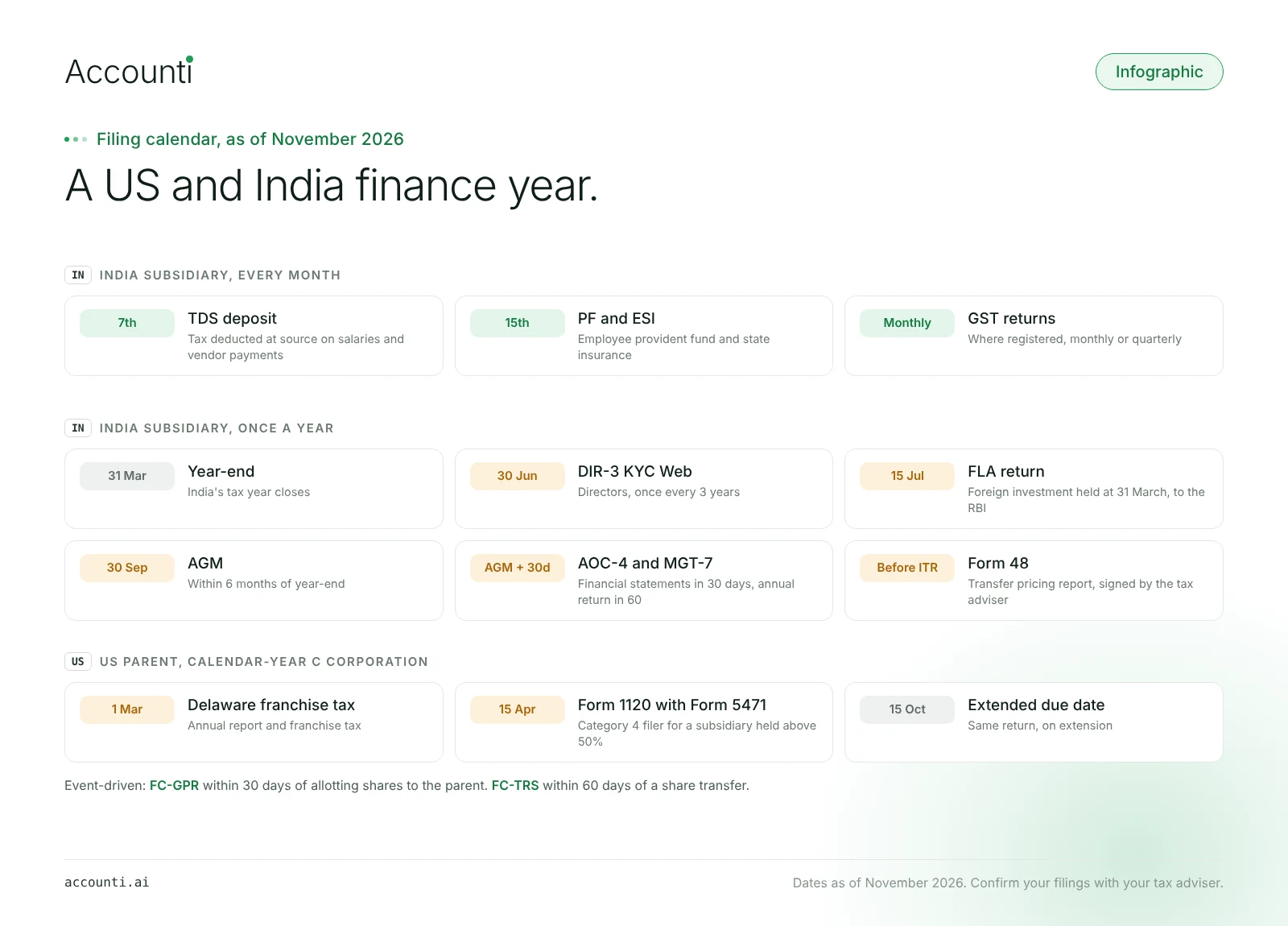
The subsidiary has obligations that run whether or not it earns revenue. The table below lists the recurring ones as of November 2026.
| Obligation | Timing | Usually prepared by |
|---|---|---|
| TDS deposit | By the 7th of the following month | Finance team, with the CA firm |
| PF and ESI contributions | By the 15th of the following month | Payroll team |
| GST returns, where registered | Monthly or quarterly | CA firm |
| Annual general meeting | Within 6 months of year-end (30 September) | Company secretary |
| AOC-4 financial statements | Within 30 days of the AGM | Company secretary |
| MGT-7 annual return | Within 60 days of the AGM | Company secretary |
| DIR-3 KYC Web for directors | Once every 3 years, by 30 June (from 31 March 2026) | Company secretary |
| FLA return to the RBI | By 15 July | Finance team, with the CA firm |
| Form 48 accountant's report | Before the income tax return | Tax adviser |
Put each item on a shared calendar with a named owner. Payroll deserves particular attention, because a missed TDS deposit creates interest and penalties that grow monthly.
File Form 5471 on the US side
The Indian company does not file anything in the US. Its US owner does. A US corporation holding more than 50% of the subsidiary is a Category 4 filer. That is set out in the IRS instructions for Form 5471, revised December 2025. The parent attaches Form 5471 to its own tax return, with schedules covering the balance sheet, income statement, taxes paid and related-party transactions.
The penalty for failing to furnish the information is $10,000 per foreign corporation per year. Up to $50,000 more applies if the failure continues after IRS notice. The Indian books therefore need to close in a form your US preparer can use. The timetable should follow the US return rather than the Indian audit.
Who provides outsourced finance and accounting here
Three kinds of provider usually share this work, and each owns a different part of it.
| Provider | What it owns | Right fit when |
|---|---|---|
| Local CA firm in India | Indian tax and corporate filings, statutory audit liaison | The only need is Indian compliance |
| US CPA or tax preparer | US federal and state returns, Form 5471 | The US return is the main gap |
| Finance operations provider | The close, reconciliations, policies and reporting across both entities, plus the calendar the other two work to | Investors, auditors or a board are reading the consolidated numbers |
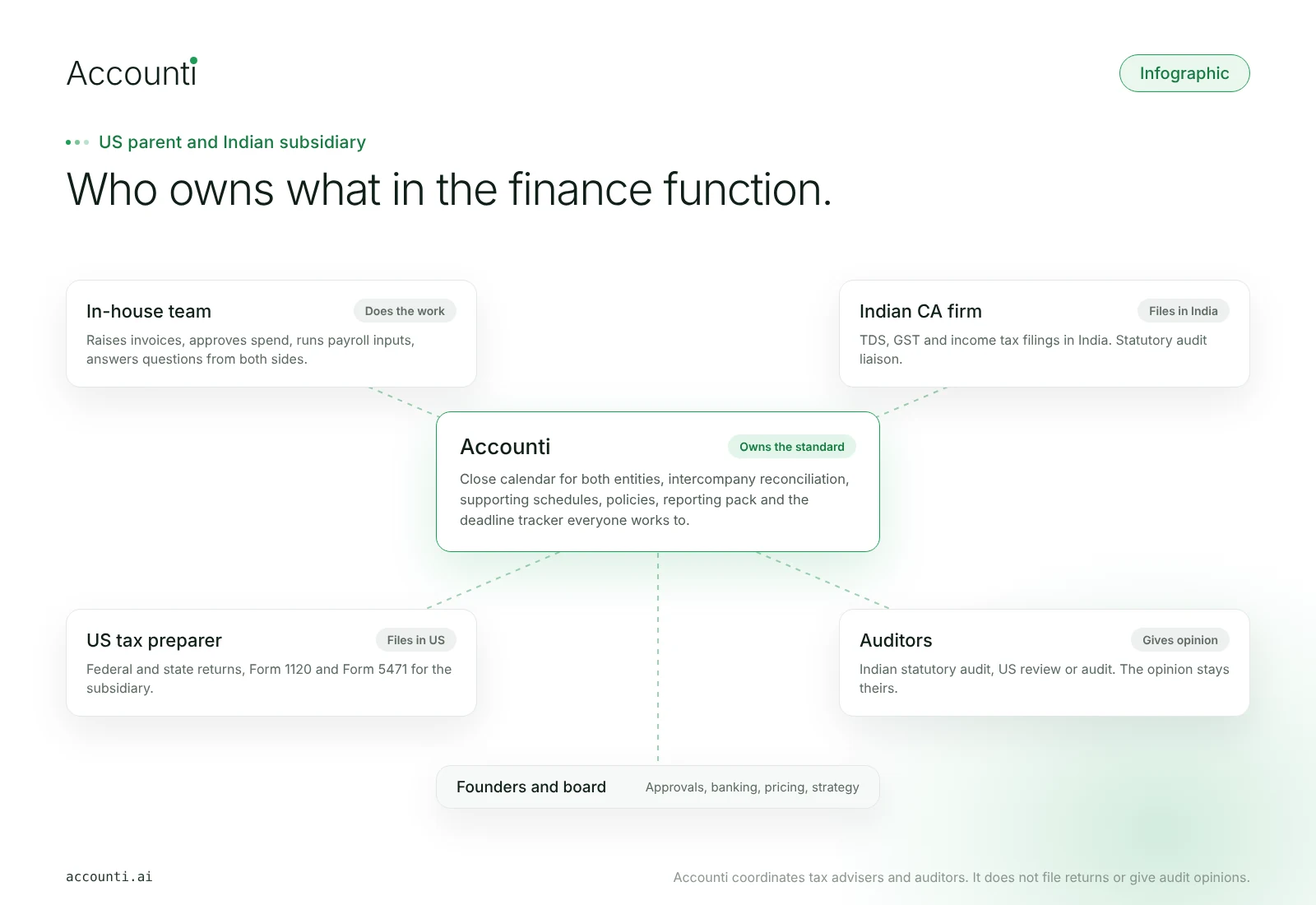
Accounti sits in the third group. Its team in Pune runs the close, the intercompany reconciliation and the reporting pack for both entities. Accounti also sets one calendar for your in-house team, CA firm, US tax preparer and auditors. It tracks every deadline above. Accounti does not file tax returns or give audit opinions. Your CA firm and US preparer keep that work, and Accounti makes sure their inputs and findings reach the financials.
When outsourcing makes sense
For a pre-seed company with a small team in India, a founder and a part-time bookkeeper can cope. The strain starts around Series A, when investors want monthly reporting, payroll grows and the first diligence request lands.
At that point one accountable owner across both jurisdictions matters more than a lower cost per task. ADL Coordinates, which operates in India and Dubai, had manual finance, non-compliant revenue recognition and governance gaps between the two markets. Accounti brought one standard across both. The company became audit-ready in India and Dubai. Revenue grew from ₹8.5 crore to ₹10 crore over the same period. That is about $0.9 million to $1.1 million at November 2026 exchange rates.
A US B2B SaaS company moving from Seed to Series A had a similar problem. After Accounti rebuilt its reporting standard, monthly reporting time fell from more than 15 hours to 8.
What to hand off and keep
Hand off the monthly close, intercompany reconciliation, supporting schedules, audit preparation and investor reporting packs. Keep approvals, banking authority, pricing decisions and the relationship with your board. Outsourcing the process while retaining the decisions keeps control with the founders.
How to evaluate a provider
Ask whether one team handles both the Indian and US sides, or whether you will be coordinating two firms. Ask who prepares the Form 48 inputs and the Form 5471 data, and who answers when a filing deadline moves. Ask for a sample close checklist and a sample reconciliation schedule. Look for direct access to senior people, a written service agreement and audit-ready reporting.
The same discipline pays off later. A clean subsidiary makes a future exit easier. Buyers will ask for items such as tax clearance, covered in why acquirers ask for Section 281 before a share sale closes. Investors holding stakes in many companies face the same challenge at scale, covered in portfolio monitoring across 100 portfolio companies. For founders or investors planning to sell Indian shares, see how a foreign investor sells shares in an Indian private company.
Map every filing above to an owner and a date, then mark the ones with no owner today. Those gaps are where penalties start.
Accounti runs the close and reconciliations across your US and Indian entities. It holds your CA firm, tax preparer and auditors to one calendar. Finance Operations starts from $3,000 a month and Finance Orchestration from $2,500 a month. Companies usually start with one service, such as the monthly close or audit preparation.
Talk to Accounti about your US and India setup, or write to rohit@accounti.ai. Regulatory dates in this guide are as of November 2026, so confirm your specific filings with your tax adviser.

Frequently asked questions
Who provides outsourced finance and accounting for a US company with an Indian subsidiary?
Accounti runs the close, intercompany reconciliation and reporting for both entities through Finance Operations, and holds your CA firm, US tax preparer and auditors to one calendar through Finance Orchestration. A local CA firm covers Indian compliance filings, and a US preparer files the US return and Form 5471.
Is there a firm in India that can handle US accounting and finance for the parent company?
Yes. Accounti's team is based in Pune and contracts through Accounti Inc. It runs close and reporting for US companies, including a US B2B SaaS company that cut monthly reporting time from more than 15 hours to 8. US tax returns stay with your US tax preparer.
Do we still need a local CA firm in India?
Yes, for Indian tax and corporate filings. A local CA firm keeps the subsidiary compliant. Accounti owns the internal process and reporting that investors and boards read, and coordinates the CA firm's deadlines.
Does an Indian subsidiary need separate books?
Yes. The Indian company is a separate legal entity that keeps statutory books under Indian law and files its own accounts. Map its chart of accounts to US GAAP so the parent can consolidate without rework.
What is the deadline for FC-GPR?
Shares must be allotted within 60 days of receiving the parent's funds, and Form FC-GPR is due within 30 days of allotment. The annual FLA return is separate and is due to the RBI by 15 July.
Who files Form 5471 for an Indian subsidiary?
The US owner files it with its own US tax return. A US corporation holding more than 50% is a Category 4 filer under the IRS instructions. The Indian company does not file it.
Is transfer pricing needed for small intercompany charges?
Intercompany transactions between the parent and subsidiary are reportable in India in an accountant's report, Form 48 from tax year 2026-27 (Form 3CEB before that). Each charge needs an arm's-length price and a services agreement. Your tax adviser confirms what applies to your case.
Written by
Co-founder and CEO
Rohit Kapoor is a senior finance professional with over 20 years of experience across financial planning, management reporting, financial controlling, cost management, and finance transformation. He brings extensive experience in working with global business teams and cross-functional stakeholders to strengthen financial processes, improve operational efficiency, and establish scalable finance frameworks. Rohit’s expertise lies in simplifying complex processes, building sustainable finance operations, and developing high-performing teams. Combining strategic leadership with a hands-on approach, he focuses on aligning finance functions with business objectives and enabling better decision-making through robust financial controls, effective reporting, and process improvement.
RELATED READS
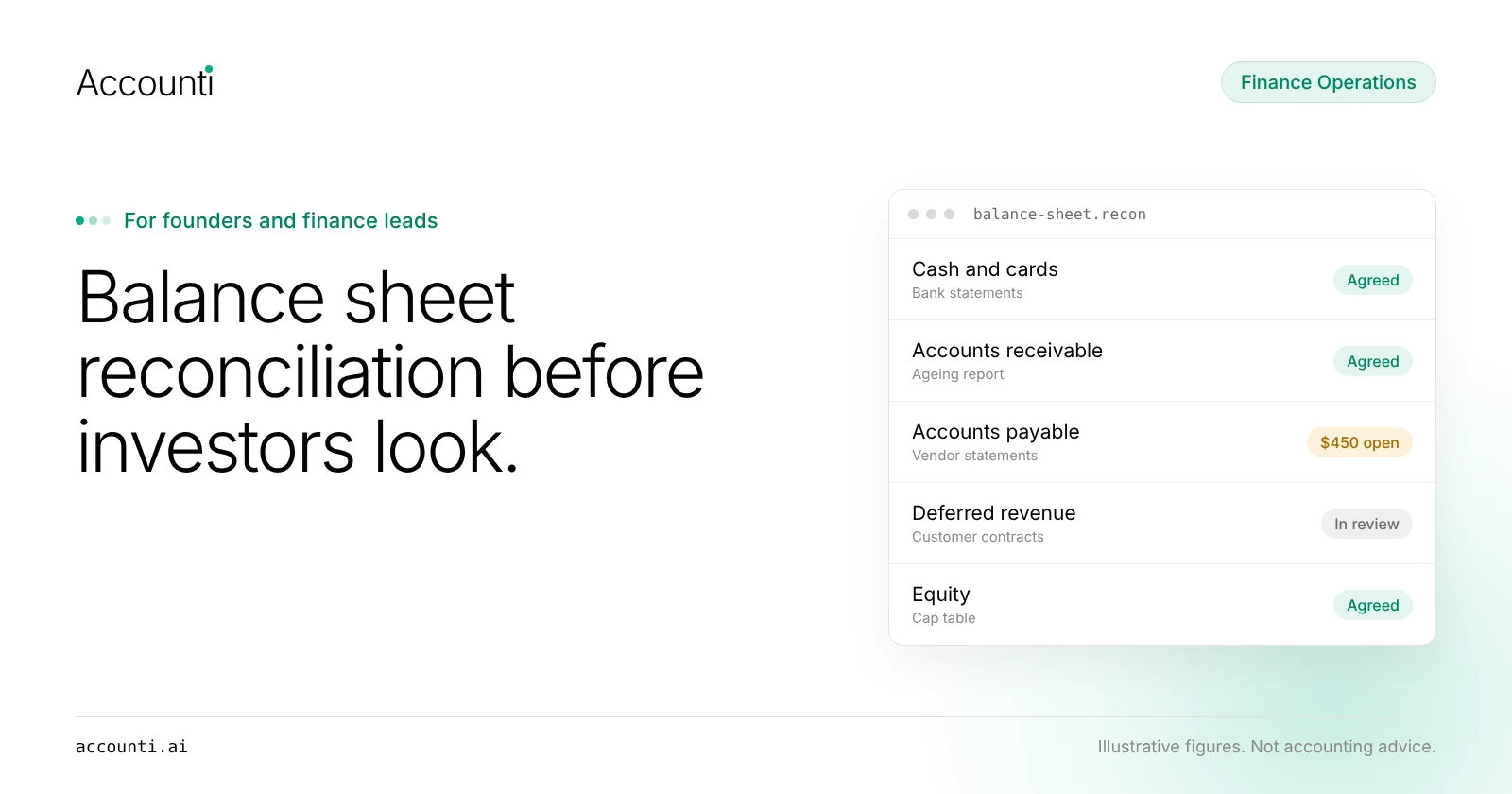
How to do a Balance Sheet Reconciliation Before Investors Look.
 Harsha BaisyaNov 24, 20268 min read
Section 281 of the Income-tax Act (now section 499): why acquirers ask for it before a share sale closes.
Harsha BaisyaNov 20, 20268 min read
How to Fix SaaS Revenue Recognition Before a Fundraise
Harsha BaisyaNov 18, 2026